




Have you ever noticed that when you’re under stress for a few days, your brain doesn’t seem to work quite the same way?
Table Of Content
- What Is Chronic Stress?
- Your Brain Has a Built-In Stress Response
- The Amygdala: Your Brain's Alarm System
- The Hippocampus, Stress, and Memory
- Why Stress Can Make It Harder to Concentrate
- The Prefrontal Cortex: The Part of Your Brain That Helps You Think Clearly
- Chronic Stress Can Change the Way Your Brain Responds to Stress
- Does Chronic Stress Permanently Damage Your Brain?
- Chronic Stress and Emotional Regulation
- Why Chronic Stress Can Increase Anxiety and Worry
- Chronic Stress and Sleep: A Frustrating Cycle
- Why You're More Likely to Make Impulsive Decisions When You're Stressed
- Chronic Stress and Mental Fatigue
- Why Everything Can Start Feeling Like "Too Much"
- Chronic Stress Can Influence Your Behavior, Too
- Can You Help Your Brain Recover From Chronic Stress?
- 1. Prioritise Consistent Sleep
- 2. Move Your Body Regularly
- 3. Create Real Recovery Time
- 4. Practice Mindfulness
- 5. Stay Connected to Other People
- 6. Address the Source of Stress
- 7. Ask for Professional Support When You Need It
- The Most Important Thing to Remember
- How Do You Know If Chronic Stress Is Affecting You?
- Chronic Stress vs. Everyday Stress: What's the Difference?
- A Simple Daily Routine to Support Your Brain During Stress
- Morning: Start Without Immediate Overload
- During the Day: Take Real Breaks
- Afternoon: Move Your Body
- Evening: Create a Transition
- Night: Protect Your Sleep
- Think Beyond Stress Management
- Can Your Brain Recover From Chronic Stress?
- What If I Can't Remove the Source of Stress?
- When Should You Seek Professional Help?
- Final Thoughts
- Frequently Asked Questions
You walk into a room and forget why you went there.
You read the same sentence three times.
You struggle to concentrate on something that would normally be easy.
You feel more irritable than usual.
Or perhaps you find yourself worrying about the same thing over and over again, even when you desperately want your mind to move on.
Most of us have experienced something like this.
And when it happens, it’s easy to think:
“What’s wrong with me?”
Usually, the answer isn’t that something is wrong with you.
Your brain may simply be responding to stress.
Short-term stress is a normal part of being human. Your brain and body are designed to respond to challenges, threats, and demanding situations.
The problem is when stress doesn’t really switch off.
When deadlines keep piling up.
When you’re constantly worried about money.
When you’re dealing with ongoing relationship problems.
When your sleep is consistently poor.
When you’re caring for someone else while barely having time to care for yourself.
Or when your mind simply never seems to get a chance to rest.
That’s when stress can become chronic.
And over time, prolonged stress can influence the way different parts of your brain function.
The good news?
Your brain is not a fixed structure.
It can adapt.
It can change.
And many of the effects associated with prolonged stress are not necessarily permanent.
Understanding what’s happening can be the first step toward taking better care of yourself.
So let’s look at what chronic stress can actually do to your brain and why you may sometimes feel like your mind isn’t working the way it normally does.
What Is Chronic Stress?
Before we talk about the brain, let’s clarify what we mean by chronic stress.
Stress itself isn’t always bad.
Imagine you’re about to give an important presentation.
Your heart beats a little faster.
Your attention becomes sharper.
Your body releases stress hormones that help prepare you to respond to the situation.
Once the presentation is over, ideally, your body gradually returns to its normal state.
That’s a short-term stress response.
Chronic stress is different.
Instead of your stress response switching off after the challenge passes, your body may remain in a heightened state of alertness for much longer.
It’s less about one stressful event and more about repeated or ongoing stress.
And sometimes, you may not even realise how stressed you are.
You might have become so accustomed to feeling tense that it feels normal.
You wake up tired.
You rush through your morning.
You work all day.
You check your phone constantly.
You worry about tomorrow.
You go to bed thinking about everything you didn’t finish.
Then you wake up and do it all again.
Eventually, your brain may begin to behave as though the next problem is always just around the corner.
That’s when understanding the brain’s stress response becomes important.
Your Brain Has a Built-In Stress Response
Your brain is constantly monitoring your environment.
Is this safe?
Is something wrong?
Do I need to act?
When your brain perceives a threat, it activates a complex stress response involving several brain regions and systems throughout the body.
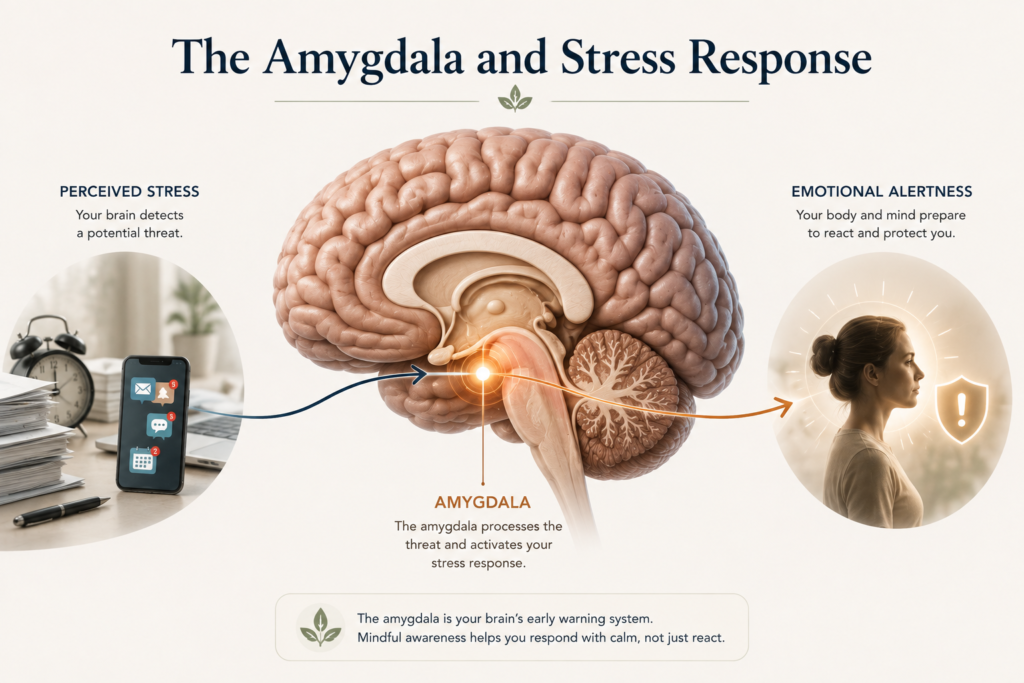
One important area involved in detecting potential threats is the amygdala.
You can think of the amygdala as part of your brain’s alarm system.
It helps you recognise emotionally significant or potentially threatening situations.
When the brain detects danger, the stress response can become activated.
Your body releases hormones such as adrenaline and cortisol.
Your heart rate may increase.
Your muscles become more prepared for action.
Your attention may become focused on the perceived threat.
This response can be extremely useful when you need to react quickly.
Imagine stepping into the road and suddenly noticing a car approaching.
You don’t need to calmly analyse every detail.
Your brain needs to help you respond.
That’s where the stress response can be protective.
The problem begins when the alarm system is activated too frequently or stays activated for too long.
And that’s where chronic stress enters the picture.
The Amygdala: Your Brain's Alarm System
The amygdala plays an important role in processing emotions, particularly those related to threat and fear.
When you’re experiencing chronic stress, your brain may become more sensitive to potential threats.
This doesn’t necessarily mean you’re consciously afraid all the time.
Instead, you may notice that you’re:
- More easily irritated
- More reactive to small problems
- More likely to expect something to go wrong
- More sensitive to criticism
- More easily startled
- More prone to worry
Think about the difference between hearing a notification when you’re relaxed and hearing the same notification when you’re already overwhelmed.
When you’re relaxed, you might simply think:
“I’ll check that later.”
When you’re already stressed, your brain may immediately think:
“What now?”
The notification hasn’t changed.
Your situation hasn’t necessarily changed.
But your brain’s response may be different.
This is one reason chronic stress can make everyday life feel more emotionally intense.
Your brain may be operating with the volume turned up.
And when your internal alarm system is frequently activated, it can become harder to simply switch off and relax.
The Hippocampus, Stress, and Memory
Here’s where things get particularly interesting.
The hippocampus is a brain region strongly involved in learning and memory.
It’s also connected to the regulation of the body’s stress response.
When you’re under prolonged stress, high levels of stress hormones may affect how the hippocampus functions.
This is one reason you might notice changes in your memory or ability to learn when you’re going through a particularly stressful period.
Maybe you forget small things.
You lose track of conversations.
You struggle to absorb new information.
Or you sit down to work and find yourself staring at the screen without really processing anything.
This doesn’t necessarily mean your memory is permanently damaged.
Sometimes, the issue is simply that your brain is allocating more of its resources toward dealing with stress.
Think about trying to remember someone’s name while you’re worrying about an important deadline.
Your brain technically has the ability to remember the name.
But your attention is somewhere else.
This is one reason stress and memory can feel so closely connected.
If you’ve also been experiencing persistent mental exhaustion, Mental Fatigue: Symptoms, Causes, and 10 Science-Backed Recovery Tips explores the connection between prolonged mental demands, concentration, and everyday cognitive functioning.
Why Stress Can Make It Harder to Concentrate
Have you ever tried to focus on something important while your mind keeps jumping from one concern to another?
You sit down to work.
Then you remember an email.
Then you think about an upcoming appointment.
Then you worry about something that happened yesterday.
Then you check your phone.
Then you try to return to your original task.
Twenty minutes later, you’re exhausted and you’ve barely accomplished anything.
Chronic stress can make concentration feel much harder.
When your brain is constantly scanning for problems, your attention can become biased toward potential threats and worries.
This can make it difficult to maintain deep, sustained focus.
It’s one reason people experiencing prolonged stress sometimes describe feeling:
“I can’t think clearly.”
“My brain feels foggy.”
“I can’t focus on anything.”
“I keep forgetting things.”
The experience is real.
And while stress isn’t the only possible explanation for these symptoms, it can certainly be one contributing factor.

The Prefrontal Cortex: The Part of Your Brain That Helps You Think Clearly
Another important area is the prefrontal cortex.
This region is involved in many higher-level functions, including:
- Planning
- Decision-making
- Attention
- Impulse control
- Problem-solving
- Regulating emotions
In simple terms, you can think of it as one of the brain regions that helps you pause and think before you react.
When you’re calm, you’re generally better able to step back from a situation.
You can consider different options.
You can think about consequences.
You can make a deliberate decision.
But when you’re under intense stress, your brain may shift toward a more reactive state.
You might snap at someone.
Make a decision without thinking it through.
Feel overwhelmed by small problems.
Or find it difficult to see the bigger picture.
Again, this doesn’t mean you’ve suddenly become an impulsive person.
It may simply mean that your brain is responding to a high level of stress.
That’s why you might sometimes think:
“I don’t know why I reacted like that.”
Or:
“That’s not how I normally behave.”
Stress can influence how easily you access the calmer, more reflective parts of your thinking.
Chronic Stress Can Change the Way Your Brain Responds to Stress
This is perhaps one of the most important points.
Your brain learns from experience.
If you repeatedly experience stress, your brain may begin to become more accustomed to responding to stress.
The systems involved in the stress response can become dysregulated over time.
In everyday language, this can mean that your body doesn’t always respond to stress in the same balanced way it might when you’re well-rested and recovered.
You might feel constantly “on edge.”
Or perhaps you swing between feeling highly anxious and completely exhausted.
You may find it difficult to relax even when nothing is immediately wrong.
And when you finally have a quiet moment, your mind may not know what to do with it.
This can create a frustrating cycle:
Stress → heightened alertness → poor sleep → exhaustion → reduced coping ability → more stress
Breaking this cycle often requires more than one solution.
You may need better sleep.
More recovery time.
Movement.
Support from other people.
Healthy boundaries.
And sometimes professional help.
Mindfulness can also be useful for developing greater awareness of your thoughts and stress responses. Our guide to Mindfulness Techniques for Mental Overload explores simple ways to reconnect with the present moment when your mind feels crowded.
Does Chronic Stress Permanently Damage Your Brain?
This is a question many people ask after learning about the effects of chronic stress.
The answer isn’t as simple as yes or no.
Research has found associations between prolonged stress and changes in brain structure and function, particularly in areas involved in memory, emotion, and stress regulation.
However, the brain is also remarkably adaptable.
This ability is known as neuroplasticity.
Your brain can change in response to experiences and environmental factors throughout life.
That means the story isn’t simply:
“Stress changes your brain, and you’re stuck that way forever.”
The reality is more complicated.
Reducing chronic stress, improving sleep, engaging in regular physical activity, maintaining social connections, and addressing underlying mental health concerns may all support healthier brain function.
If you’re concerned about how stress is affecting you, the most useful question may not be:
“Have I permanently damaged my brain?”
Instead, consider asking:
“What can I do now to give my brain the conditions it needs to recover and function well?”
That’s a much more empowering question.
Chronic Stress and Emotional Regulation
Have you ever noticed that you’re more emotionally sensitive when you’re exhausted or stressed?
Someone makes a small comment.
Normally, you would let it go.
But today, it bothers you for hours.
A minor inconvenience suddenly feels like a major problem.
You become frustrated more quickly.
Or perhaps you find yourself feeling overwhelmed by emotions that you would normally manage quite easily.
This can happen because chronic stress can affect the brain systems involved in emotional regulation.
When you’re under prolonged stress, your brain may become more focused on detecting potential problems.
At the same time, the systems involved in thoughtful emotional regulation may not function as effectively under high stress.
This doesn’t mean you’re becoming a different person.
It means your brain may be operating under different conditions.
Think about it this way.
When your phone battery is at 2%, you probably don’t expect it to perform at its best.
Your brain can be similar.
When you’ve been under stress for a long time, you may have less mental and emotional capacity available for patience, flexibility, and thoughtful responses.
That’s why you might find yourself thinking:
“Why am I so irritated today?”
Or:
“Why did that bother me so much?”
Sometimes, the answer isn’t the situation itself.
Sometimes, you’re simply running on empty.

Why Chronic Stress Can Increase Anxiety and Worry
Stress and anxiety aren’t exactly the same thing.
But they can interact with each other.
When your brain spends a long time in a heightened state of alertness, you may begin to expect problems even when nothing immediately threatening is happening.
You might constantly think:
“What if something goes wrong?”
“What if I forget something?”
“What if I can’t handle this?”
“What if there’s another problem I haven’t thought about yet?”
This constant scanning for potential threats can be exhausting.
And it can create a cycle where worry itself becomes another source of stress.
You worry about a problem.
The worry activates your stress response.
The stress makes you feel more alert to potential problems.
So you worry even more.
Over time, this can make it increasingly difficult to relax.
You may be sitting on your sofa with nothing urgent happening, yet your brain still feels like it needs to be “on.”
This is one reason that simply telling yourself to “relax” often doesn’t work.
Your brain may need time and consistent experiences of safety before it learns that it doesn’t have to remain constantly alert.
If you regularly experience anxiety alongside chronic stress, it’s worth taking those symptoms seriously rather than simply assuming you need to “try harder” to relax.
Chronic Stress and Sleep: A Frustrating Cycle
Let’s talk about sleep.
Because stress and sleep can become locked in a cycle that is difficult to break.
You’re stressed during the day.
Then, at night, your mind starts replaying everything.
You think about tomorrow’s responsibilities.
You remember something you forgot.
You start worrying about a conversation.
You check the time.
Now you’re worried that you’re not sleeping.
And suddenly, you’re wide awake.
Sound familiar?
The relationship between stress and sleep goes both ways.
Stress can make it harder to sleep.
And poor sleep can make it harder to manage stress.
When you’re sleep-deprived, you may have less emotional resilience.
You may become more irritable.
Your concentration may suffer.
And everyday problems can feel more difficult to manage.
This can create a cycle:
Chronic stress → disrupted sleep → fatigue → reduced coping ability → increased stress
Breaking that cycle isn’t always easy.
But improving sleep can be an important part of supporting your brain and nervous system.
That may mean creating a consistent sleep schedule, reducing stimulating activities before bed, and addressing the underlying sources of stress.
If your mind tends to become particularly active when you’re trying to sleep, you may also find Overthinking at Night: Why Your Mind Won’t Switch Off useful.

Why You're More Likely to Make Impulsive Decisions When You're Stressed
Have you ever made a decision under pressure and later thought:
“Why did I do that?”
Maybe you sent an angry message.
Bought something you didn’t really need.
Skipped something important because you felt overwhelmed.
Or chose the easiest option simply because you didn’t have the mental energy to think through the alternatives.
Stress can affect decision-making.
When you’re overwhelmed, your brain may prioritise immediate relief over long-term consequences.
For example, imagine you’ve had an exhausting day.
You planned to cook a healthy meal.
But you’re tired.
You don’t want to think.
So you order takeaway.
That’s not necessarily a problem.
But imagine this pattern happening repeatedly.
You feel stressed.
You seek immediate relief.
You feel temporary comfort.
Then you feel guilty or frustrated afterward.
And that creates another source of stress.
The problem isn’t that your brain is “weak.”
It’s that when you’re under prolonged stress, your ability to pause, evaluate, and make deliberate decisions can become more difficult.
This is one reason reducing chronic stress isn’t just about feeling calmer.
It’s also about creating the mental space needed to make decisions that align with what you actually want.
Chronic Stress and Mental Fatigue
There’s a point where stress stops feeling like nervous energy.
Instead, you simply feel tired.
Very tired.
You don’t want to think.
You don’t want to make decisions.
You don’t want to answer another question.
You might even find yourself thinking:
“I just can’t deal with one more thing.”
This is where chronic stress and mental fatigue can overlap.
Your brain has been working hard for a long time.
Constantly monitoring.
Planning.
Worrying.
Solving problems.
Switching between tasks.
Trying to anticipate what might happen next.
Eventually, you may feel mentally drained.
This can show up as:
- Difficulty concentrating
- Forgetfulness
- Low motivation
- Slower thinking
- Irritability
- Feeling overwhelmed by simple tasks
- Difficulty making decisions
It’s important to remember that mental fatigue can have many possible causes.
Stress is one of them.
Poor sleep is another.
Certain medical conditions and mental health concerns can also contribute.
So if these symptoms are persistent or significantly affecting your everyday life, it’s worth discussing them with a qualified healthcare professional.

Why Everything Can Start Feeling Like "Too Much"
One of the most frustrating effects of chronic stress is that your tolerance for additional stress may become lower.
Imagine you’re already carrying a heavy backpack.
Then someone adds another book.
Then another.
Eventually, even a small additional weight feels impossible to carry.
Your life may not suddenly have become more difficult.
You may simply have less capacity available.
That’s why a small inconvenience can feel overwhelming when you’ve already been under pressure for weeks or months.
You might find yourself thinking:
“I can’t handle anything else.”
This is not necessarily a sign that you’re weak.
It may be a sign that your system has been carrying too much for too long.
And instead of asking:
“Why can’t I handle this?”
It may be more helpful to ask:
“What can I take off my plate?”
That shift can be powerful.
Sometimes the solution isn’t becoming better at carrying more.
Sometimes it’s carrying less.
Chronic Stress Can Influence Your Behavior, Too
When you’re stressed for a long time, you may notice changes in your everyday habits.
You might:
- Avoid social situations
- Stop exercising
- Eat differently
- Spend more time scrolling
- Drink more caffeine
- Procrastinate
- Become less patient
- Withdraw from people
- Find it harder to enjoy things
These behaviours aren’t necessarily random.
Sometimes, they’re attempts to cope.
For example, scrolling through your phone may provide a brief distraction from uncomfortable thoughts.
Avoiding a difficult task may give you temporary relief.
Staying busy may help you avoid thinking about how exhausted you feel.
The problem is that some coping strategies provide short-term relief but don’t address the underlying stress.
And over time, they can sometimes make the situation harder.
That’s why it can be helpful to approach chronic stress with curiosity rather than judgment.
Instead of:
“Why am I doing this?”
Try:
“What am I trying to get away from or feel better about?”
That question may reveal something important.
Can You Help Your Brain Recover From Chronic Stress?
This is where the conversation becomes more hopeful.
If chronic stress can influence the brain, does that mean you’re stuck with those effects?
No.
The brain is adaptable.
Your brain continues to respond to your experiences and environment throughout your life.
That doesn’t mean every effect of chronic stress can simply be reversed by taking a few days off.
Recovery can take time.
And the right approach depends on what’s causing the stress in the first place.
But there are several areas that can support overall brain and mental wellbeing.
1. Prioritise Consistent Sleep
Sleep isn’t just about feeling less tired.
It’s an important part of physical and mental recovery.
Try to create a consistent sleep schedule when possible.
Keep your bedroom comfortable.
Reduce stimulating activities close to bedtime.
And if you’re struggling with persistent sleep problems, consider talking with a healthcare professional rather than simply accepting poor sleep as your new normal.
2. Move Your Body Regularly
Physical activity can be a valuable part of managing stress and supporting overall health.
You don’t need to become an athlete.
A walk.
A short workout.
Stretching.
Cycling.
Dancing.
Anything that gets you moving can be a starting point.
The goal isn’t perfection.
It’s regular movement that you can realistically maintain.
3. Create Real Recovery Time
There’s a difference between being physically inactive and actually recovering.
Scrolling through social media for an hour may feel like a break.
But your brain may still be processing information.
Real recovery might involve:
Sitting quietly.
Taking a walk.
Spending time in nature.
Talking to someone you trust.
Listening to music.
Practicing mindfulness.
Or simply doing nothing for a while.
If your mind has been overloaded for a long time, recovery may need to become something you intentionally protect.

4. Practice Mindfulness
Mindfulness can help you become more aware of what’s happening in your mind without automatically reacting to every thought.
You don’t have to meditate for an hour.
Even a few minutes can be a starting point.
Try noticing your breathing.
Pay attention to your surroundings.
Take a mindful walk.
Or simply pause before reacting to a stressful situation.
If your mind feels constantly crowded, our guide to Mindfulness Techniques for Mental Overload offers several practical ways to bring your attention back to the present moment.
5. Stay Connected to Other People
Stress can make you want to withdraw.
You may think:
“I don’t have the energy to talk to anyone.”
Sometimes, a little solitude is exactly what you need.
But prolonged isolation can make stress feel heavier.
You don’t have to have a deep conversation every day.
A phone call.
A coffee with a friend.
A walk with someone.
A simple message saying, “I’m having a difficult week,” can be enough to start reconnecting.
Human connection can be an important source of emotional support during stressful periods.
6. Address the Source of Stress
This may be the most important point.
If your stress comes from a situation that can be changed, calming your nervous system is only part of the solution.
Maybe your workload is unrealistic.
Maybe you need to set a boundary.
Maybe a relationship is consistently causing distress.
Maybe you’re taking on more responsibilities than you can reasonably manage.
Mindfulness and breathing exercises can help you cope.
But sometimes, the bigger question is:
“What needs to change?”
You can’t always remove the source of stress.
But when you can change something, even a small change may matter.
7. Ask for Professional Support When You Need It
You don’t have to wait until you’re completely exhausted.
If chronic stress is affecting your sleep, work, relationships, mood, or ability to function, consider speaking with a qualified mental health or healthcare professional.
Getting support isn’t a sign that you can’t cope.
It can be a practical step toward understanding what’s happening and deciding what to do next.
Sometimes, the most effective way to protect your mental wellbeing is to stop trying to handle everything alone.
The Most Important Thing to Remember
If you’ve been under chronic stress for months or even years, you may look back and worry:
“Have I permanently damaged my brain?”
It’s understandable to have that fear.
But your brain is not a static machine.
It’s dynamic.
It adapts.
And supporting your brain doesn’t require changing your entire life overnight.
Start with one thing.
Maybe tonight, you get to bed a little earlier.
Tomorrow, you take a 15-minute walk.
You put your phone away during lunch.
You say no to one unnecessary commitment.
You talk to someone you trust.
You take five minutes to breathe.
Small changes may not feel dramatic.
But your brain and body don’t need perfection.
They need consistent opportunities to recover.
We’ve talked about what chronic stress can do to the brain, from influencing the systems involved in threat detection and emotional regulation to affecting memory, concentration, sleep, and decision-making.
But there’s an important point I want to leave you with.
Feeling the effects of chronic stress doesn’t automatically mean you’ve permanently damaged your brain.
The brain is adaptable.
And while prolonged stress deserves to be taken seriously, there are meaningful steps you can take to support your mental and physical wellbeing.
Let’s bring everything together.
How Do You Know If Chronic Stress Is Affecting You?
There’s no single symptom that proves chronic stress is changing the way your brain works.
Many of the symptoms associated with stress can also have other causes.
But if you’ve been under prolonged pressure, you may notice a pattern.
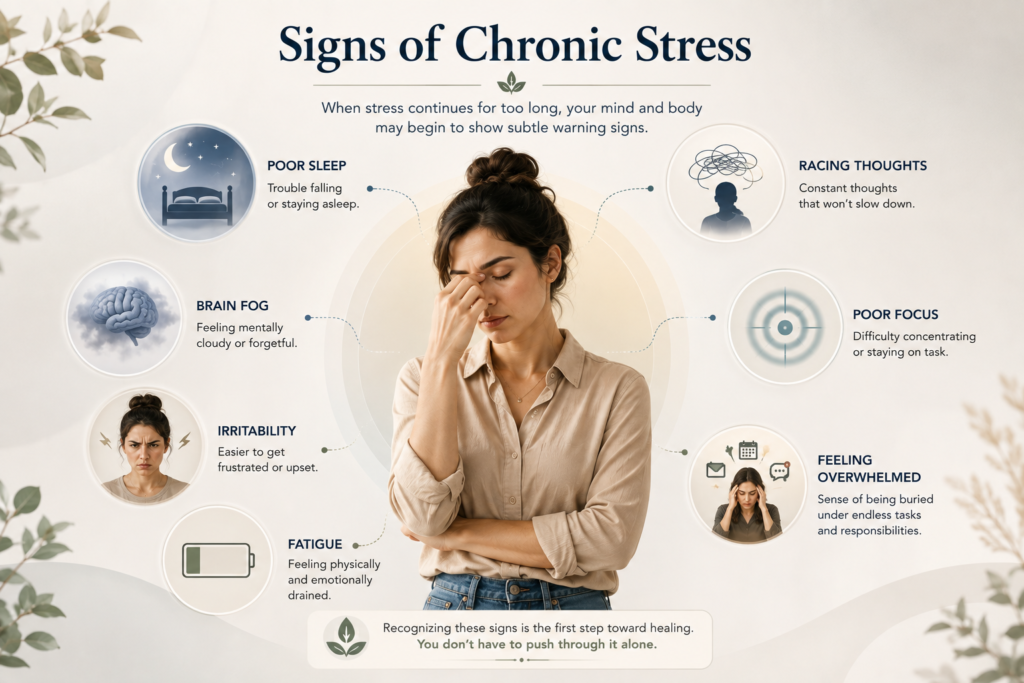
Perhaps you’ve started experiencing:
- Difficulty concentrating
- Increased forgetfulness
- Racing or repetitive thoughts
- Irritability
- Feeling emotionally overwhelmed
- Trouble relaxing
- Changes in sleep
- Constant fatigue
- Difficulty making decisions
- Feeling easily overwhelmed by everyday tasks
You may also notice that your usual coping strategies aren’t working as well as they once did.
Things that normally wouldn’t bother you suddenly feel exhausting.
Your patience seems shorter.
Your attention feels scattered.
You may feel like you’re constantly reacting instead of intentionally choosing how to respond.
These experiences don’t necessarily mean chronic stress is the only cause.
But they can be signals that your mind and body need attention.
Chronic Stress vs. Everyday Stress: What's the Difference?
Everyone experiences stress.
That’s normal.
You may feel stressed before an important presentation.
You may feel overwhelmed during a busy week.
You may worry about an upcoming appointment.
These short-term experiences don’t necessarily mean you’re experiencing chronic stress.
The bigger concern is when stress becomes persistent and starts affecting your everyday life.
Ask yourself:
Has this been going on for weeks or months?
Am I finding it difficult to relax even when nothing urgent is happening?
Is my sleep consistently affected?
Am I struggling to concentrate?
Have I become more irritable or emotionally reactive?
Does everything feel harder than it used to?
If the answer is yes to several of these questions, it may be worth taking a closer look at what’s happening.
You don’t need to diagnose yourself.
Instead, think of these questions as an invitation to pause and pay attention.
Sometimes, the first step toward reducing chronic stress is simply recognising that you’re carrying too much.
A Simple Daily Routine to Support Your Brain During Stress
You don’t need to completely redesign your life.
In fact, trying to change everything at once can create even more pressure.
Instead, focus on a few basic habits that support recovery.
Here’s an example of what that could look like.
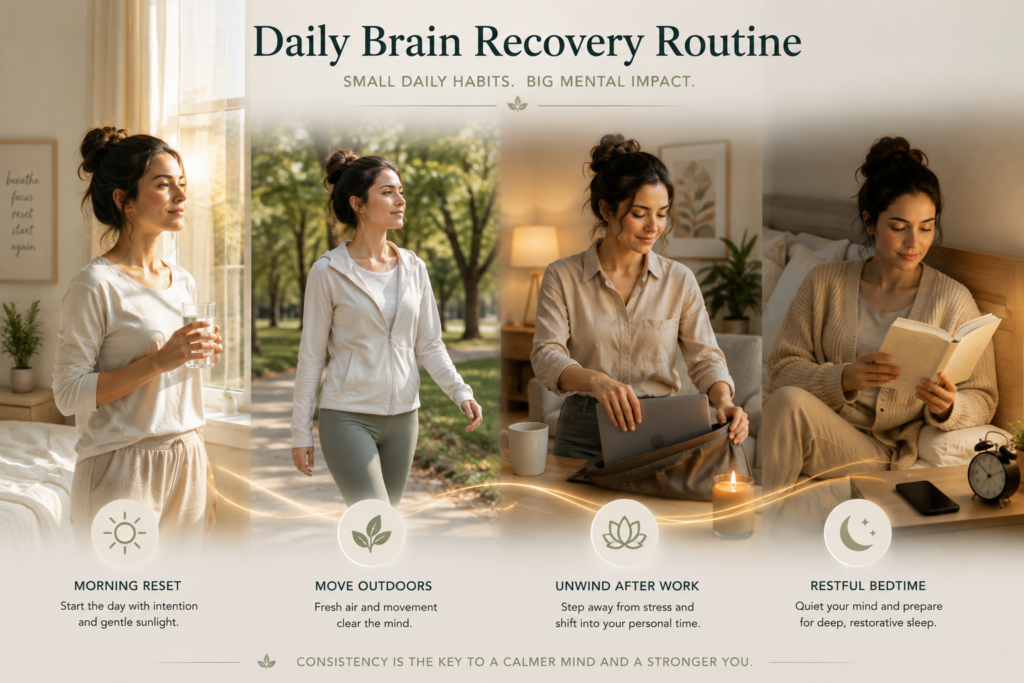
Morning: Start Without Immediate Overload
If possible, avoid reaching for your phone the moment you wake up.
Give yourself a few minutes before diving into notifications and messages.
Take a few comfortable breaths.
Drink some water.
Open a window.
Step outside for a moment.
You don’t need a perfect morning routine.
Just give your brain a little time to transition into the day.
During the Day: Take Real Breaks
If you’re working for several hours without stopping, your brain may eventually struggle to maintain focus.
Try taking short breaks.
Stand up.
Walk around.
Look outside.
Stretch.
Take a few slow breaths.
The goal isn’t to be unproductive.
It’s to give your attention a chance to reset.
Afternoon: Move Your Body
If you can, add some form of movement to your day.
It could be:
- A short walk
- Stretching
- Cycling
- A workout
- Dancing
- Household activities
You don’t need to exercise perfectly.
Regular movement is more important than doing something extreme once in a while.
Evening: Create a Transition
Try not to move directly from work stress into bedtime.
Create a small transition.
Take a shower.
Go for a walk.
Change your clothes.
Listen to music.
Talk to someone.
Practice a few minutes of mindfulness.
Give your brain a signal that the workday is over.
Night: Protect Your Sleep
Create a sleep environment that supports rest.
If possible, reduce stimulating activities before bed.
Keep your sleep schedule reasonably consistent.
And if you find yourself lying awake with racing thoughts, don’t immediately assume you need to “try harder” to sleep.
Sometimes, persistent sleep difficulties are a sign that the underlying stress needs attention.
Think Beyond Stress Management
When people talk about managing stress, the advice often sounds like:
“Just relax.”
But chronic stress isn’t always solved by relaxation techniques.
Sometimes, the source of stress needs to change.
If your workload is consistently unreasonable, you may need to discuss your responsibilities.
If you’re constantly available to everyone, you may need stronger boundaries.
If a relationship is causing ongoing distress, you may need support in deciding how to handle it.
If you’re struggling with anxiety, depression, or another mental health concern, professional treatment may be appropriate.
And if you’re dealing with persistent physical symptoms, it’s important to speak with a healthcare professional.
Breathing exercises, mindfulness, exercise, and sleep can all be valuable.
But they shouldn’t become a way of coping indefinitely with a situation that genuinely needs to change.
Sometimes, the healthiest thing you can do for your brain is to address the problem itself.
Can Your Brain Recover From Chronic Stress?
This is one of the most important questions.
And the honest answer is that recovery isn’t identical for everyone.
The effects of stress depend on many factors, including the intensity and duration of stress, individual differences, overall health, sleep, environment, and access to support.
Research suggests that the brain has a capacity for adaptation and change.
This is one reason why reducing prolonged stress and improving overall wellbeing can be meaningful.
But it’s important not to think of recovery as a simple switch.
You may not feel better overnight.
If you’ve been under stress for months or years, your mind and body may need time to adjust.
Think of it less like flipping a switch and more like gradually changing the conditions your brain is operating in.
You begin sleeping better.
You create more space in your schedule.
You move your body.
You reconnect with people.
You learn to recognise stress earlier.
You address the problems you can change.
You ask for help when you need it.
Over time, those changes can create a healthier environment for recovery.
What If I Can't Remove the Source of Stress?
This is a very real question.
Not every stressful situation can be changed immediately.
You may have caregiving responsibilities.
Financial pressures.
A demanding job.
Health concerns.
Family challenges.
Sometimes, the stressor isn’t something you can simply walk away from.
In these situations, the goal may not be to eliminate stress completely.
Instead, focus on increasing your capacity to recover.
Ask:
Where can I create small pockets of rest?
Who can I ask for support?
What responsibilities can I reduce?
What boundaries can I set?
What is within my control today?
Even when you can’t change the entire situation, you may be able to change one part of it.
And sometimes, that is where progress begins.
When Should You Seek Professional Help?
If stress is persistent and interfering with your life, consider talking to a qualified healthcare or mental health professional.
This may be especially important if you’re experiencing:
- Persistent anxiety or low mood
- Significant sleep problems
- Difficulty functioning at work or home
- Ongoing feelings of hopelessness
- Severe emotional distress
- Significant changes in appetite or behaviour
- Persistent problems with concentration or memory
- Physical symptoms that concern you
Don’t assume every symptom is caused by stress.
Concentration problems, fatigue, sleep difficulties, and memory changes can have many possible causes.
A healthcare professional can help you explore what’s actually happening.
And if you’re struggling emotionally, seeking support isn’t a sign of weakness.
It’s a form of taking care of yourself.
Final Thoughts
Your brain is doing something remarkable every day.
It’s trying to protect you.
It’s constantly scanning your environment.
Processing information.
Managing emotions.
Making decisions.
Remembering the past.
Preparing for the future.
And when you’re under stress, it works even harder.
That’s why chronic stress can leave you feeling like you’re not quite yourself.
You may struggle to concentrate.
You may forget things.
You may become more irritable.
You may find it harder to sleep.
You may feel overwhelmed by situations that you would normally handle with ease.
These experiences can be frustrating.
But they’re also reminders that your brain and body may need support.
So instead of asking yourself:
“Why can’t I handle this?”
Try asking:
“What has my brain been dealing with lately?”
And then:
“What can I do to give it a little more support?”
Maybe it’s getting more consistent sleep.
Maybe it’s taking a walk.
Maybe it’s putting your phone away for an hour.
Maybe it’s saying no to something you don’t have the capacity for.
Maybe it’s talking to someone you trust.
Maybe it’s asking a professional for help.
You don’t have to change everything at once.
Start with one small thing.
Then another.
Because caring for your brain isn’t about achieving a perfectly stress-free life.
That’s probably not realistic.
It’s about creating enough moments of safety, rest, connection, and recovery that your brain doesn’t have to stay in survival mode all the time.
Your mind deserves recovery, too.
And sometimes, the first step is simply recognising that you’ve been carrying too much for too long.
Frequently Asked Questions
Can chronic stress permanently damage the brain?
Chronic stress has been associated with changes in brain structure and function, particularly in systems involved in memory, emotion, and stress regulation. However, the brain is adaptable, and the effects of stress are not necessarily permanent. Individual outcomes vary, and recovery depends on many factors.
What part of the brain is affected by chronic stress?
Chronic stress can influence several brain regions and systems. Research commonly discusses the amygdala, hippocampus, and prefrontal cortex because of their roles in emotional processing, memory, stress regulation, attention, and decision-making. The brain’s stress response involves interconnected networks rather than one isolated area.
Can chronic stress cause memory problems?
Chronic stress may contribute to difficulties with memory and concentration. However, memory problems can have many possible causes, including poor sleep, medications, medical conditions, and mental health concerns. Persistent or significant changes should be discussed with a healthcare professional.
Can the brain recover after chronic stress?
The brain has the ability to adapt and change throughout life. Reducing ongoing stress and supporting overall health may help create better conditions for recovery. However, recovery varies from person to person and may take time.
How does chronic stress affect sleep?
Chronic stress can contribute to difficulty falling asleep, staying asleep, or getting restorative sleep. Poor sleep can then make it harder to manage stress, creating a cycle that can be difficult to break.
Can chronic stress cause brain fog?
Stress can contribute to experiences commonly described as brain fog, such as difficulty concentrating, forgetfulness, and mental fatigue. However, brain fog isn’t a medical diagnosis and can have many possible causes, so persistent symptoms deserve appropriate evaluation.
Does exercise help the brain recover from stress?
Regular physical activity is associated with many aspects of physical and mental wellbeing and can be part of a healthy approach to stress management. You don’t necessarily need intense exercise; choosing activities you can maintain consistently may be more realistic.
Can mindfulness help with chronic stress?
Mindfulness may help some people become more aware of their thoughts, emotions, and physical responses to stress. It can be one useful tool within a broader approach to managing stress, but it shouldn’t replace professional care when it’s needed.
How long does it take to recover from chronic stress?
There’s no universal recovery timeline. It depends on factors such as how long the stress has been present, the intensity of the stress, sleep, overall health, environment, and available support. If you’ve been experiencing significant stress for a long time, recovery may be gradual rather than immediate.

Art of Wellness Team is a collective of mental wellness writers and researchers focused on stress, anxiety, and mental clarity. We create practical, evidence-informed content to help readers better understand their mental well-being and build healthier habits for everyday life.






[…] you’ve been under pressure for weeks or months, you may also find our article How Chronic Stress Changes the Brain helpful, where we explore how prolonged stress can affect concentration, memory, and emotional […]
[…] you’ve been under pressure for an extended period, you may also find our article How Chronic Stress Changes the Brain helpful. It explains how prolonged stress can influence memory, concentration, emotional […]
[…] you’ve been living under pressure for a long time, our article How Chronic Stress Changes the Brain explains how prolonged stress can influence your thinking patterns, emotional responses, and […]
[…] you’ve been living under constant pressure for weeks or months, our guide How Chronic Stress Changes the Brain explains why long-term stress can alter the way you think, feel, and respond to everyday […]