




Some Problems Can’t Be Solved Today
Table Of Content
- The Kind of Stress Nobody Talks About
- Your Brain Wants Answers
- Why "Just Stop Worrying" Doesn't Work
- The Hidden Cost of Fighting Reality
- The Difference Between Solvable Stress and Unavoidable Stress
- A Different Question Changes Everything
- What You'll Learn in This Guide
- The Two Circles That Can Change the Way You Handle Stress
- Imagine Two Circles
- Circle One: Where Your Energy Actually Makes a Difference
- Circle Two: The Place Where Worry Loves to Live
- Which Circle Are You Living In?
- Why Your Brain Keeps Leaving Circle One
- What Happens When You Shift Your Energy?
- Person A
- Person B
- The Gentle Question That Changes Everything
- A Simple Exercise for Today
- Acceptance Isn't Giving Up, It's Choosing Where Your Energy Goes
- The Tug-of-War You Can't Win
- What Acceptance Really Sounds Like
- The Difference Between Acceptance and Giving Up
- Why Fighting Reality Creates More Stress
- Acceptance Frees Up Mental Energy
- A Story You'll Probably Recognize
- Try This Five-Minute Acceptance Practice
- Step 1
- Step 2
- Step 3
- Step 4
- Peace Doesn't Always Arrive When Problems End
- Your 10-Minute Daily "Control Reset"
- Morning: Start With What You Can Control (2 Minutes)
- Midday: Check Where Your Mind Has Drifted (3 Minutes)
- Evening: Finish With Self-Compassion (5 Minutes)
- What went well today?
- What was outside my control today?
- What is one thing I'm grateful for today?
- Progress Doesn't Mean Feeling Calm Every Day
- Final Thoughts
- Frequently Asked Questions
There are certain kinds of stress that a good to-do list can’t fix.
You can’t schedule your way out of waiting for medical test results.
You can’t cross “find a new job” off your list overnight after being laid off.
You can’t instantly repair a relationship that’s been hurting for years.
You can’t make someone else change their mind.
You can’t fast-forward through uncertainty.
And that’s what makes these situations so exhausting.
Most of us are taught that if we work hard enough, think carefully enough, or plan well enough, we’ll eventually solve our problems.
Often, that’s true.
But life also presents challenges that don’t respond to effort alone.
Sometimes all you can do is wait.
And waiting can be one of the hardest emotional experiences you’ll ever face.
The Kind of Stress Nobody Talks About
Imagine this.
You wake up in the morning and check your phone before your feet even touch the floor.
No new email.
No missed calls.
No update.
You tell yourself you’ll stop checking every few minutes.
But by lunchtime, you’ve refreshed your inbox ten times.
You replay conversations in your head.
You imagine every possible outcome.
Some hopeful.
Some frightening.
You tell yourself to focus on work, but your mind keeps drifting back to the same unanswered question.
“What if things don’t work out?”
The strange thing is that nothing has actually happened today.
No bad news.
No crisis.
No emergency.
Yet you’re completely exhausted.
Why?
Because uncertainty demands energy.
Even when nothing changes on the outside, your mind may be working overtime on the inside.
Your Brain Wants Answers
Human beings are naturally wired to seek certainty.
From an evolutionary perspective, knowing what to expect helped our ancestors stay safe.
If they could predict danger, they had a better chance of avoiding it.
Although modern life is very different, our brains still crave predictability.
We like knowing:
- What’s going to happen.
- When it will happen.
- How it will end.
- What we should do next.
When those answers disappear, your brain doesn’t simply shrug and move on.
It starts searching.
It analyzes.
It predicts.
It prepares.
Unfortunately, when there aren’t enough facts, the brain often fills the gaps with worry.
It begins asking questions like:
“What if the results are bad?”
“What if I lose my job?”
“What if things never improve?”
“What if I’m making the wrong decision?”
Notice something important.
These questions don’t solve the situation.
They simply keep your brain busy trying to solve something that currently has no solution.

Why "Just Stop Worrying" Doesn't Work
If you’ve ever shared your worries with someone, you’ve probably heard advice like:
“Don’t think about it.”
“Everything happens for a reason.”
“Just stay positive.”
Although these comments are usually well-intentioned, they often miss the point.
You can’t simply switch worry off like a light.
If it were that easy, nobody would stay awake replaying conversations.
Nobody would spend hours imagining different outcomes.
Nobody would feel anxious while waiting for important news.
Your brain worries because it believes worry is helping.
It mistakenly assumes that if it thinks about the problem long enough, it might discover the perfect solution.
That strategy works for problems you can actually solve.
It doesn’t work for situations outside your control.
The result?
Your mind keeps working…
without making meaningful progress.
It’s like trying to open a locked door by turning the handle a thousand times.
The effort continues.
The outcome doesn’t change.
The Hidden Cost of Fighting Reality
Many people don’t realize that they’re fighting reality.
Not intentionally.
Quietly.
Internally.
They keep thinking:
“This shouldn’t be happening.”
“This isn’t fair.”
“I can’t believe this is my life.”
“Things were supposed to be different.”
Those thoughts are completely understandable.
But they also require enormous emotional energy.
Imagine trying to swim against a strong river current.
Every movement becomes exhausting.
Now imagine turning around and swimming with the current toward the nearest shore.
The river hasn’t changed.
But your relationship with it has.
The same principle applies to stress.
Sometimes we become exhausted not only because life is difficult…
but because we’re constantly fighting the fact that life is difficult.
There’s an important distinction here.
Accepting reality doesn’t mean approving of it.
It doesn’t mean giving up.
It simply means acknowledging what’s true right now so your energy can be spent on what actually helps.
We’ll explore this idea in much greater depth later in this guide.
The Difference Between Solvable Stress and Unavoidable Stress
Some forms of stress respond to action.
If your house is messy, you can clean it.
If you have an exam, you can study.
If you’ve missed a deadline, you can create a plan.
Action reduces uncertainty.
But some situations don’t improve because you work harder.
Examples include:
- Waiting for medical results.
- Supporting a loved one through illness.
- Grieving a loss.
- Living through financial uncertainty.
- Going through a divorce.
- Waiting to hear back after a job interview.
- Caring for aging parents.
- Recovering from a natural disaster.
These situations require something different.
Not more control.
More resilience.
That’s an important shift.
Because when you stop measuring success by how quickly you can fix the situation, you begin measuring it by how well you care for yourself while living through it.
If prolonged uncertainty has left you emotionally exhausted, our article How to Recover From Emotional Exhaustion explains why recovery isn’t about pretending everything is okay, it’s about restoring the emotional energy you’ve been using to cope.

A Different Question Changes Everything
When people feel overwhelmed by uncertainty, they often ask:
“How do I make this stop?”
But sometimes that question has no immediate answer.
A more helpful question is:
“How do I take care of myself while this is happening?”
That single shift changes your focus.
Instead of spending all your energy trying to control the uncontrollable, you begin investing your energy where it can actually make a difference.
Your health.
Your habits.
Your relationships.
Your mindset.
Your recovery.
The situation may not change overnight.
But your experience of living through it can.
And that’s where real resilience begins.
What You'll Learn in This Guide
If you’re facing a situation you can’t immediately fix, this guide isn’t going to promise quick solutions or unrealistic positivity.
Instead, you’ll discover:
- Why uncertainty is one of the most mentally exhausting experiences we face.
- How constantly seeking control can increase stress instead of reducing it.
- A simple exercise that helps you separate what you can control from what you can’t.
- Practical ways to reduce emotional exhaustion while life remains uncertain.
- Daily habits that help you build resilience, even when circumstances don’t improve right away.
Most importantly, you’ll learn that while you may not be able to control every chapter of your life, you can influence how you move through it.
And sometimes, that’s the most powerful form of control we have.
The Two Circles That Can Change the Way You Handle Stress
“You can’t always control what happens to you, but you can choose where your energy goes.”
Take a moment before reading further.
Think about the biggest source of stress in your life right now.
Maybe it’s:
- Waiting to hear back after a job interview.
- A loved one going through a difficult illness.
- Financial uncertainty.
- A relationship that’s become complicated.
- A legal issue that’s taking months to resolve.
- A child who is struggling.
- A future that suddenly feels unclear.
Now ask yourself one simple question:
How much of your mental energy today has been spent trying to change something you cannot change today?
For many people, the honest answer is:
Almost all of it.
That’s where one simple exercise can completely change your perspective.
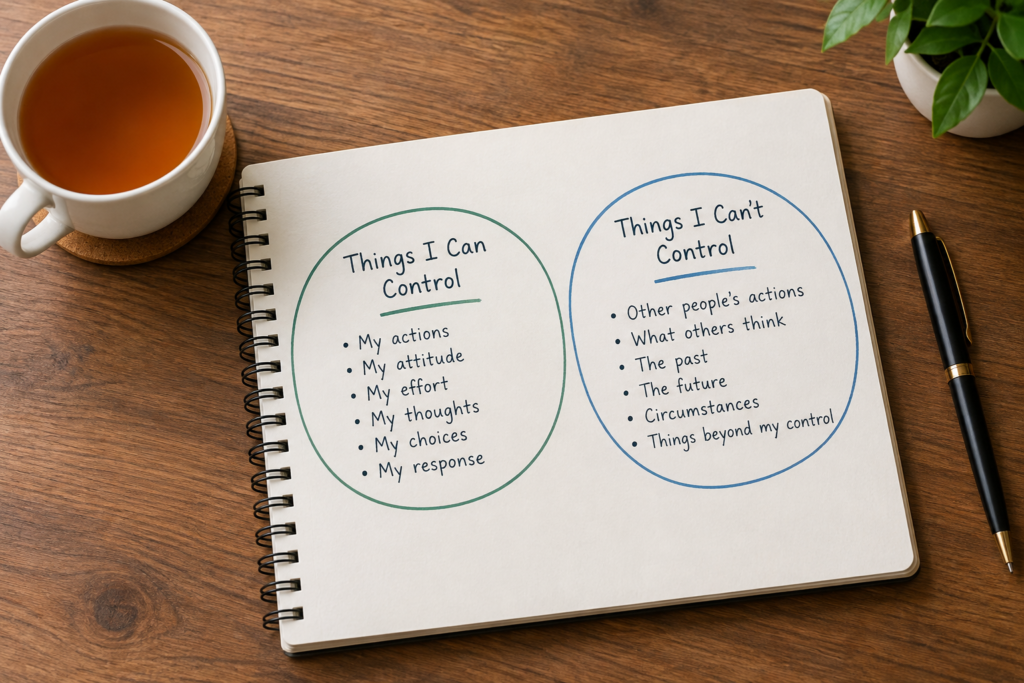
Imagine Two Circles
Close your eyes for a moment and picture two circles drawn on a piece of paper.
The first circle is smaller.
The second circle surrounds it.
We’ll call them:
Circle One
Things You Can Control
Circle Two
Things You Cannot Control
It sounds almost too simple.
But don’t underestimate it.
Many therapists, coaches, and psychologists encourage similar exercises because they help people distinguish between productive action and unproductive worry.
The goal isn’t to ignore reality.
The goal is to stop spending precious emotional energy where it can’t create change.
Circle One: Where Your Energy Actually Makes a Difference
Let’s start with the inner circle.
This is where your influence lives.
These are the things you may not control perfectly, but you can influence through your choices.
For example:
- How much sleep you aim for.
- Whether you take a short walk today.
- How you speak to yourself.
- Whether you ask for support.
- The food you choose to eat.
- Whether you keep refreshing your email every five minutes.
- How often you check the news.
- The boundaries you set.
- Your breathing.
- Your daily routines.
- Your response to setbacks.
Notice something important.
Most of these things seem small.
None of them magically remove life’s uncertainty.
But together, they strengthen your ability to live through uncertainty.
Imagine someone waiting for important medical results.
They cannot control what the results will say.
But they can choose to:
- Eat nourishing meals.
- Spend time with family.
- Limit endless internet searches.
- Go for a walk.
- Practice slow breathing.
- Get enough sleep.
These actions don’t change the diagnosis.
They change the person living through the waiting.
And that’s incredibly important.
Circle Two: The Place Where Worry Loves to Live
Now look at the larger outer circle.
This is where many of us accidentally spend most of our emotional energy.
It contains things like:
- Other people’s decisions.
- Other people’s opinions.
- The economy.
- Political events.
- Traffic.
- Delayed flights.
- Past mistakes.
- Unexpected illnesses.
- Company restructuring.
- Whether someone replies to your message.
- The future.
- The weather.
- Things that already happened.
Think about how often your thoughts return to these topics.
Hours.
Sometimes days.
Sometimes months.
Your brain believes that if it worries long enough, something might change.
But does it?
No amount of worrying can make tomorrow arrive faster.
No amount of replaying yesterday changes what already happened.
No amount of imagining worst-case scenarios guarantees you’ll avoid them.
The effort is real.
The control is not.
Which Circle Are You Living In?
Let’s do a quick check-in.
Read each statement slowly.
Today, I’ve spent time thinking about…
☐ Someone else’s behavior.
☐ Something that happened last week.
☐ A conversation I can’t replay differently.
☐ Whether people approve of me.
☐ A future event I can’t predict.
☐ News I have no influence over.
☐ An outcome I’m waiting for.
Now read this list.
Today, I’ve spent time doing…
☐ Drinking enough water.
☐ Taking a break.
☐ Moving my body.
☐ Asking for help.
☐ Eating a proper meal.
☐ Resting.
☐ Practicing gratitude.
☐ Taking one useful action.
Which list feels more familiar?
For many of us, the first list receives far more attention.
That’s understandable.
The human brain naturally wants certainty.
But certainty isn’t always available.
Control often is.
Why Your Brain Keeps Leaving Circle One
If focusing on what you can control is so helpful…
Why don’t we naturally do it?
Because uncertainty feels uncomfortable.
When we don’t know what’s going to happen, our brain starts searching for answers.
Unfortunately, when answers don’t exist, the brain often substitutes them with mental activity.
We replay conversations.
We imagine future scenarios.
We check our phones repeatedly.
We refresh our inbox.
We overanalyze every detail.
It feels productive.
But it’s actually a form of emotional exhaustion.
Your brain mistakes constant thinking for problem-solving.
The result?
Hours of mental effort…
Without genuine progress.
If you’ve noticed your mind constantly replaying situations you can’t change, our guide Why You Can’t Relax Even When Everything Is Fine explores why your brain sometimes struggles to leave “problem-solving mode,” even when there’s nothing left to solve.
What Happens When You Shift Your Energy?
Imagine two different people facing the exact same situation.
Both are waiting to hear whether they’ve been accepted for a new job.
Person A
Refreshes their email every ten minutes.
Sleeps poorly.
Imagines rejection.
Reads online forums.
Constantly checks their phone.
Feels guilty for relaxing.
Their stress grows every day.
Person B
Checks email twice a day.
Updates their résumé.
Exercises regularly.
Spends time with family.
Reads before bed.
Applies for other opportunities.
Gets enough sleep.
The outcome hasn’t changed.
Neither person knows what tomorrow will bring.
But their experience of waiting is completely different.
One person spends every day inside Circle Two.
The other keeps returning to Circle One.
The situation remains uncertain.
Their relationship with uncertainty changes dramatically.

The Gentle Question That Changes Everything
The next time you notice yourself spiraling, pause for a moment and ask:
“Is this thought helping me take action… or is it simply helping me worry?”
If the answer is worry…
Ask a second question.
“What’s one thing that’s still inside my circle of control today?”
Maybe it’s drinking water.
Maybe it’s taking a walk.
Maybe it’s calling a friend.
Maybe it’s simply turning your phone off for thirty minutes.
Small actions won’t eliminate uncertainty.
But they remind your brain that you are not powerless.
Even when life feels unpredictable, there is almost always something you can influence.
And those small choices become the foundation of emotional resilience.
A Simple Exercise for Today
Before you move on to the next section, grab a notebook or open a notes app.
Draw two circles.
Inside the first circle, write down everything you can control.
Inside the second, write down everything you can’t.
Now look at your lists honestly.
Which circle has been receiving most of your attention?
More importantly…
Which circle deserves more of it?
Sometimes, that one simple exercise reveals why you’ve been feeling so emotionally drained.
It’s not because life is impossible.
It’s because you’ve been trying to carry things that were never yours to carry in the first place.
In the next part of this guide, we’ll explore one of the most misunderstood ideas in mental wellness: acceptance. You’ll discover why acceptance isn’t the same as giving up, and how learning to stop fighting reality can free up the emotional energy you’ve been spending on battles you can’t win.
Acceptance Isn't Giving Up, It's Choosing Where Your Energy Goes
There is one word that makes many people uncomfortable.
Acceptance.
For some, it sounds like surrender.
For others, it feels like admitting defeat.
You might even think,
“If I accept this situation, doesn’t that mean I’m saying it’s okay?”
Not at all.
In reality, acceptance is one of the most misunderstood skills in emotional well-being.
It isn’t about liking what’s happening.
It isn’t about pretending everything is fine.
And it certainly isn’t about giving up on your future.
Acceptance simply means acknowledging reality as it is today, so you can stop exhausting yourself fighting something that already exists.
Ironically, acceptance often gives you more control, not less.
The Tug-of-War You Can't Win
Imagine you’re standing in the middle of a field, holding one end of a rope.
On the other end is a giant monster named Reality.
You pull with all your strength.
Reality pulls back.
You pull harder.
Reality doesn’t move.
Minutes pass.
Then hours.
Eventually, you’re exhausted.
Your hands hurt.
Your shoulders ache.
You haven’t moved forward at all.
Now imagine something different.
Instead of pulling harder…
You simply let go of the rope.
Did the monster disappear?
No.
Did your situation suddenly improve?
No.
But something important changed.
You’re no longer wasting all your energy on a battle you were never going to win.
That energy is now available for something far more useful.
Healing.
Resting.
Planning.
Connecting.
Living.
Sometimes, acceptance looks less like surrender and more like finally putting down a weight you’ve been carrying for far too long.
What Acceptance Really Sounds Like
Many people imagine acceptance sounds like this:
“I guess this is just my life now.”
“Nothing matters anymore.”
“There’s nothing I can do.”
But healthy acceptance sounds very different.
It sounds like:
“I don’t like this situation, but I recognize that it’s real.”
“I can’t change what happened yesterday, but I can decide how I respond today.”
“This isn’t the future I wanted, but it’s the reality I’m living right now.”
Notice the difference.
Acceptance doesn’t remove hope.
It removes resistance.
And resistance is often what drains us the most.

The Difference Between Acceptance and Giving Up
Let’s make this simple.
Giving Up Says:
“I can’t do anything.”
Acceptance Says:
“I can’t change this part, but I can still influence what happens next.”
Giving Up Says:
“My life is over.”
Acceptance Says:
“My life is different than I expected, and I’ll learn how to move forward.”
Giving Up Says:
“There’s no point trying.”
Acceptance Says:
“I’ll stop trying to control the uncontrollable and focus on what still matters.”
Acceptance isn’t passive.
It’s incredibly active.
It asks you to stop spending energy on impossible tasks and redirect it toward meaningful ones.
That’s not weakness.
It’s wisdom.
Why Fighting Reality Creates More Stress
Think about how much energy we spend arguing with reality.
“This shouldn’t have happened.”
“Why me?”
“If only I had done something differently.”
“I refuse to accept this.”
These thoughts are completely human.
But they often keep us emotionally stuck.
Imagine standing outside during a rainstorm and shouting at the clouds to stop raining.
The rain continues.
You’re soaked.
And now you’re exhausted from yelling.
Life works the same way.
Some realities cannot be changed immediately.
The illness.
The loss.
The waiting.
The uncertainty.
The breakup.
The delayed answer.
The difficult season you’re living through.
You don’t have to like these things.
But constantly arguing with them often creates a second layer of suffering on top of the original problem.
That second layer is optional.
Acceptance Frees Up Mental Energy
Remember the two circles from Part 2?
Every time you stop trying to control something outside your influence, something interesting happens.
Your mental energy returns.
Instead of spending hours replaying yesterday’s conversation…
You can finally enjoy dinner with your family.
Instead of imagining twenty different futures…
You can focus on today’s responsibilities.
Instead of refreshing your email every five minutes…
You can finish the project that’s in front of you.
The situation may not have changed.
But you have.
And sometimes that’s enough to make today feel lighter.
If you’ve noticed that your mind constantly jumps ahead to future problems, our article Why You Can’t Relax Even When Everything Is Fine explains why the brain often mistakes constant vigilance for safety, and how to gently interrupt that cycle.
A Story You'll Probably Recognize
Imagine two friends, Emma and Sarah.
Both lose their jobs unexpectedly.
Emma spends every day thinking,
“This shouldn’t have happened.”
“Why did they choose me?”
“My career is ruined.”
She spends hours replaying the meeting in her mind.
Weeks pass.
She’s emotionally exhausted before she even begins applying for new opportunities.
Sarah also feels shocked.
She cries.
She worries.
She feels disappointed.
But after allowing herself to process those emotions, she says:
“I don’t like this. But it’s where I am today.”
The next morning she updates her résumé.
Calls a friend.
Applies for two jobs.
Takes a walk.
Reads before bed.
Neither woman chose what happened.
But one continued fighting the past.
The other slowly started building her future.
Acceptance didn’t remove Sarah’s pain.
It gave her somewhere healthier to place her energy.

Try This Five-Minute Acceptance Practice
The next time you feel trapped by a situation you can’t control, pause for five minutes.
Step 1
Name the situation honestly.
“I’m waiting for test results.”
“I’m worried about money.”
“I don’t know what will happen next.”
Don’t minimize it.
Don’t exaggerate it.
Simply tell yourself the truth.
Step 2
Say this quietly to yourself:
“I may not like this situation, but this is where I am today.”
Notice how different that feels from saying,
“This shouldn’t be happening.”
Step 3
Ask yourself:
“What is one thing I still have control over today?”
Maybe it’s:
- Drinking enough water.
- Calling someone you trust.
- Going for a walk.
- Cooking dinner.
- Turning your phone off for an hour.
- Going to bed earlier.
Small actions remind your brain that uncertainty doesn’t mean helplessness.
Step 4
Release what belongs to tomorrow.
You don’t have to solve next month today.
You don’t have to answer questions that life hasn’t asked yet.
Sometimes your only responsibility is to live today well.
Peace Doesn't Always Arrive When Problems End
Many of us quietly believe this:
“I’ll finally feel calm once everything is fixed.”
But life rarely works that way.
One challenge ends.
Another begins.
Another uncertainty appears.
Another unexpected change arrives.
If peace always depends on perfect circumstances, it remains permanently out of reach.
Real peace often begins somewhere else.
It begins when you stop demanding certainty before allowing yourself to breathe.
When you stop postponing your happiness until every problem disappears.
When you stop believing you must control everything before you can feel okay.
Because the truth is:
You can experience moments of joy while waiting.
You can laugh during difficult seasons.
You can feel grateful while life remains uncertain.
And you can build emotional resilience long before your circumstances become ideal.
In the final part of this guide, we’ll bring everything together with a simple daily “Control Reset” routine, practical takeaways you can use whenever uncertainty feels overwhelming, and answers to the most common questions about managing stress when life is beyond your control.
Your 10-Minute Daily "Control Reset"
One of the biggest myths about stress is that it disappears after one deep breath, one relaxing weekend, or one good night’s sleep.
In reality, resilience is something you build through small daily habits.
Just like brushing your teeth protects your dental health before problems develop, taking a few minutes each day to reset your mind helps prevent stress from quietly building until it feels overwhelming.
The following routine isn’t about avoiding life’s challenges.
It’s about helping your mind return to what it can influence, again and again.
You don’t have to complete it perfectly.
You simply have to practice it consistently.
Morning: Start With What You Can Control (2 Minutes)
Before checking your phone, reading the news, or opening your email, ask yourself one question:
“What is one thing I can influence today?”
Notice that the question isn’t:
“How can I solve everything?”
It’s much smaller.
Maybe today’s answer is:
- I’ll drink enough water.
- I’ll take my lunch break.
- I’ll go for a 20-minute walk.
- I’ll speak kindly to myself.
- I’ll finish one important task.
- I’ll spend quality time with my family.
Beginning your day this way reminds your brain that your attention belongs in Circle One, the place where your actions matter.
Instead of starting your morning with uncertainty, you begin with intention.
Midday: Check Where Your Mind Has Drifted (3 Minutes)
Stress has a quiet way of pulling us back into Circle Two.
Without noticing, you might spend hours thinking about:
- Someone who hasn’t replied.
- Tomorrow’s meeting.
- A conversation from last week.
- An outcome you can’t predict.
- A mistake you wish you could undo.
When that happens, pause for a moment.
Ask yourself:
“Am I solving something… or simply worrying about it?”
If the answer is worrying, gently redirect yourself.
Choose one action that’s within your control.
Stand up.
Stretch.
Drink water.
Finish one small task.
Step outside for fresh air.
Tiny actions interrupt mental spirals more effectively than endless thinking ever will.
Evening: Finish With Self-Compassion (5 Minutes)
Many people end their day by reviewing everything they didn’t accomplish.
Your brain naturally remembers unfinished tasks more easily than completed ones.
That’s why it’s helpful to intentionally end the day differently.
Before going to bed, ask yourself these three questions:
What went well today?
It doesn’t have to be something extraordinary.
Maybe you stayed patient during a difficult conversation.
Maybe you cooked dinner.
Maybe you simply got through a challenging day.
Progress deserves to be noticed.
What was outside my control today?
Write it down.
Then consciously remind yourself:
“I don’t have to carry this into tomorrow.”
This doesn’t erase the problem.
It simply prevents your mind from rehearsing it all night long.
What is one thing I'm grateful for today?
Gratitude doesn’t deny difficulty.
It broadens your perspective.
Even during stressful seasons, there are often small moments worth noticing:
A supportive friend.
A good meal.
A laugh.
A quiet sunset.
A peaceful cup of coffee.
These moments remind your brain that life is never made up entirely of stress.

Progress Doesn't Mean Feeling Calm Every Day
One mistake many people make is expecting stress management to feel like flipping a switch.
“If I’m doing this right, I shouldn’t feel anxious anymore.”
But healing rarely works that way.
Some days you’ll feel calm.
Other days uncertainty will return.
There will be mornings when your mind races before you’ve even gotten out of bed.
That doesn’t mean you’ve failed.
It means you’re human.
Emotional resilience isn’t measured by how rarely you feel stressed.
It’s measured by how quickly you’re able to return to balance after stress appears.
That’s real progress.
Imagine learning to ride a bicycle.
Falling off doesn’t mean you’ll never learn.
Each time you get back on, your balance improves.
Managing stress works in much the same way.
Every time you pause instead of panic…
Every time you breathe instead of catastrophizing…
Every time you focus on what you can control instead of what you can’t…
You’re strengthening emotional muscles that will serve you for years to come.
Final Thoughts
Life will always include situations you can’t immediately fix.
There will be seasons of waiting.
Moments of uncertainty.
Unexpected losses.
Conversations that don’t go as planned.
Questions that remain unanswered.
The goal isn’t to eliminate every difficult experience.
The goal is to stop allowing those experiences to consume every moment of your life.
Throughout this guide, we’ve explored an important truth:
You don’t need complete control over your circumstances to regain a sense of stability.
You only need to recognize where your energy can make a difference.
You learned about the Two Circles.
You discovered that acceptance isn’t surrender.
You practiced shifting your attention from endless worry toward meaningful action.
Those ideas won’t remove uncertainty overnight.
But they can completely change how you live through it.
The next time you catch yourself worrying about something beyond your control, pause for a moment and ask:
“What is one thing I can influence right now?”
It might seem like a simple question.
But simple questions often lead to life-changing habits.
Because peace isn’t found by controlling every outcome.
Peace grows when you stop giving your energy to battles you were never meant to fight.
And every time you return your attention to what you can control, you’re taking another step toward a calmer, healthier, and more resilient life.
Frequently Asked Questions
How do I stop stressing about things I can't control?
Start by identifying whether your thoughts are leading to action or simply repeating worries. Redirect your attention to one small action that is within your control, such as taking a walk, calling someone you trust, or focusing on your next priority.
Why does uncertainty cause so much stress?
Your brain naturally seeks predictability because it helps you feel safe. When the future is uncertain, your mind often fills in the gaps with worry, even when there’s nothing you can do to change the outcome.
Is accepting a difficult situation the same as giving up?
No. Acceptance means acknowledging reality without wasting energy fighting it. It allows you to focus on the choices and actions that are still available instead of resisting what cannot currently be changed.
What should I do when my mind keeps imagining worst-case scenarios?
Pause and ask yourself whether those thoughts are helping you prepare or simply increasing your anxiety. Ground yourself by returning to the present moment and taking one practical step that’s within your control today.
Can focusing on what I can control really reduce stress?
Yes. While it won’t eliminate difficult circumstances, it reduces feelings of helplessness and gives your brain a greater sense of purpose, direction, and emotional stability.
How can I stay calm while waiting for important news?
Maintain your normal routines as much as possible, limit repetitive checking for updates, spend time with supportive people, and focus on activities that help you feel grounded instead of feeding uncertainty.
Why do I keep replaying situations that already happened?
Your brain is often trying to learn from past experiences or prevent future pain. Unfortunately, repeatedly replaying events rarely changes the outcome and often increases emotional exhaustion instead.
What are some healthy ways to cope with situations I can't change?
Regular exercise, quality sleep, mindfulness, journaling, deep breathing, meaningful conversations, and limiting exposure to constant negative news can all help strengthen your ability to cope with uncertainty.
When should I seek professional help for ongoing stress?
If stress continues for several weeks, affects your sleep, work, relationships, or daily functioning, or leaves you feeling persistently overwhelmed, reaching out to a qualified healthcare provider or licensed mental health professional is an important step.
What's the most important lesson from this article?
You may not be able to control every situation life brings, but you can always choose where your attention, energy, and actions go. Over time, that choice becomes the foundation of emotional resilience.

Art of Wellness Team is a collective of mental wellness writers and researchers focused on stress, anxiety, and mental clarity. We create practical, evidence-informed content to help readers better understand their mental well-being and build healthier habits for everyday life.






No Comment! Be the first one.