




Have you ever had one of those days where nothing particularly terrible happened…
Table Of Content
- What Does Emotional Exhaustion Actually Feel Like?
- Emotional Exhaustion Isn't a Sign of Weakness
- Why Emotional Exhaustion Builds So Slowly
- The Hidden Signs of Emotional Exhaustion Most People Miss
- 1. You Stop Looking Forward to Things
- 2. Small Problems Suddenly Feel Much Bigger
- 3. You Find Yourself Saying "I'm Fine" More Than You Actually Mean It
- 4. Decision-Making Starts Feeling Surprisingly Difficult
- 5. You Feel Emotionally Present... But Mentally Distant
- Emotional Exhaustion vs. Everyday Stress
- Emotional Exhaustion vs. Burnout
- Emotional Exhaustion
- Burnout
- Emotional Exhaustion vs. Depression
- Why Sleeping More Doesn't Always Fix Emotional Exhaustion
- How Emotional Exhaustion Can Affect Your Relationships
- Before You Focus on Recovery, Start With Awareness
- 10 Practical Ways to Recover From Emotional Exhaustion (With a 7-Day Recovery Plan)
- 1. Stop Waiting Until You're Completely Drained to Rest
- 2. Learn the Difference Between Rest and Distraction
- 3. Start Protecting Your Emotional Boundaries
- 4. Reconnect With Activities That Make You Feel Like Yourself
- 5. Stop Carrying Tomorrow Into Tonight
- 6. Spend Time With People Who Leave You Feeling Lighter
- 7. Give Your Brain Quiet Time Every Day
- 8. Practice Self-Compassion Instead of Self-Criticism
- 9. Build Recovery Into Your Week, Not Just Your Vacation
- 10. Accept That Recovery Isn't Linear
- A Simple 7-Day Emotional Recovery Plan
- Day 1 , Notice What Drains You
- Day 2 , Create One Healthy Boundary
- Day 3 , Spend 20 Minutes Outdoors
- Day 4 , Reach Out to Someone You Trust
- Day 5 , Have a Digital Sunset
- Day 6 , Do Something That Brings You Joy
- Day 7 , Reflect Without Judging
- Try This Today: The 20-Minute Emotional Reset
- Frequently Asked Questions
Yet by the evening, you felt completely empty?
You finished your work.
Answered messages.
Paid the bills.
Made dinner.
Helped your family.
Smiled during conversations.
From the outside, it looked like a perfectly ordinary day.
But inside, something felt different.
You weren’t just tired.
You felt emotionally worn out.
Someone asked,
“How was your day?”
And you struggled to answer.
Not because you didn’t know what happened.
But because you didn’t have the energy to explain it.
Even choosing what to watch on television felt like another decision you didn’t want to make.
Your favorite hobby no longer sounded exciting.
You ignored messages you normally would have answered.
You wanted quiet, not because you were upset with anyone, but because even small interactions felt like they required more emotional energy than you had left.
If this sounds familiar, you’re far from alone.
Many people experience periods where life doesn’t necessarily become more difficult overnight, but their ability to cope gradually begins to shrink. Emotional exhaustion often builds slowly, after weeks or months of carrying responsibilities, managing stress, supporting others, or simply trying to keep everything together.
Unlike physical tiredness, emotional exhaustion isn’t always something a long night’s sleep can fix.
You might wake up after eight hours of rest and still feel emotionally flat.
You may take a weekend off and wonder why Monday doesn’t feel any easier.
That’s because emotional exhaustion isn’t simply about needing more sleep.
It’s often a sign that your emotional reserves have been running low for longer than you’ve realized.
The encouraging news is that emotional exhaustion doesn’t mean you’re broken.
It doesn’t mean you’ve failed.
And it certainly doesn’t mean you’ll always feel this way.
Like physical recovery after overusing a muscle, emotional recovery takes time, awareness, and consistent care.
This guide will help you understand:
- What emotional exhaustion really is
- Why it develops so gradually
- How it’s different from everyday stress and burnout
- The hidden signs many people overlook
- Practical, realistic ways to rebuild your emotional energy
- How to prevent yourself from ending up emotionally drained again
Most importantly, you’ll discover that recovery isn’t about becoming “more productive.”
It’s about learning how to protect the emotional energy you already have.
What Does Emotional Exhaustion Actually Feel Like?
People often describe emotional exhaustion as being “tired.”
But that word doesn’t quite capture the experience.
Imagine carrying a backpack every single day.
At first, it only contains a few books.
Barely noticeable.
Then someone adds a laptop.
A water bottle.
A few folders.
A jacket.
Groceries.
Another bag.
You adjust.
You keep walking.
After a while, you stop noticing each individual item.
You simply accept that carrying the weight has become part of daily life.
Then one day…
The backpack doesn’t get any heavier.
But suddenly it feels impossible to keep carrying it.
Emotional exhaustion works in much the same way.
Rarely is it caused by one difficult meeting.
One bad week.
Or one stressful conversation.
Instead, it develops through the accumulation of emotional demands.
Every deadline.
Every disappointment.
Every difficult conversation.
Every responsibility.
Every time you put someone else’s needs ahead of your own.
Every time you tell yourself,
“I’ll deal with my feelings later.”
Eventually, “later” never comes.
Instead, your emotional battery continues draining without enough opportunities to recharge.
Over time, you may begin to notice subtle changes.
You become less patient.
Small inconveniences feel much bigger than they used to.
You struggle to enjoy activities you once loved.
You start saying “I’m fine” even when you’re anything but.
And perhaps the most confusing part is that many people continue functioning remarkably well.
They go to work.
Take care of their families.
Meet deadlines.
Show up for everyone else.
While quietly wondering why they no longer feel like themselves.
That quiet disconnect is one reason emotional exhaustion is often overlooked until it begins affecting relationships, work, motivation, and overall well-being.

Emotional Exhaustion Isn't a Sign of Weakness
One of the biggest myths surrounding emotional exhaustion is that it only happens to people who “can’t handle stress.”
Nothing could be further from the truth.
In fact, emotional exhaustion is often experienced by people who are incredibly capable.
The people who always volunteer to help.
The parent who makes sure everyone else is okay before thinking about themselves.
The healthcare worker who comforts patients all day.
The teacher who stays late to help struggling students.
The manager who carries their team’s problems home.
The entrepreneur who feels personally responsible for every outcome.
The friend everyone turns to for advice.
These aren’t weak people.
They’re often the strongest people in the room.
But strength doesn’t mean your emotional resources are unlimited.
Imagine charging your phone every night.
Now imagine never plugging it in.
Eventually, no matter how advanced the phone is, the battery runs out.
Your emotional energy works much the same way.
No amount of resilience can replace regular recovery.
The human mind wasn’t designed to absorb constant pressure without moments of restoration.
Research consistently shows that prolonged emotional demands, whether from work, caregiving, chronic stress, grief, or ongoing life challenges, can gradually deplete emotional resources if recovery doesn’t keep pace.
Recognizing emotional exhaustion isn’t admitting defeat.
It’s recognizing that you’re human.
And humans need recovery just as much as they need productivity.
Why Emotional Exhaustion Builds So Slowly
One reason emotional exhaustion catches people by surprise is because it rarely arrives overnight.
It’s usually the result of dozens, or even hundreds, of small emotional withdrawals over time.
Think about the last few months.
Maybe you’ve been balancing work deadlines while worrying about finances.
Helping your children with school.
Supporting an aging parent.
Trying to stay healthy.
Keeping friendships alive.
Responding to endless notifications.
Managing household responsibilities.
Planning for the future.
Making hundreds of decisions every single day.
None of these things, by themselves, may seem overwhelming.
But together, they create a constant stream of emotional effort.
Your brain and nervous system are remarkably adaptable.
They allow you to keep functioning even when you’re under prolonged pressure.
The downside is that adaptation can hide the warning signs.
Instead of noticing you’re becoming emotionally exhausted, you simply become accustomed to feeling:
- A little more tired.
- A little less motivated.
- A little more impatient.
- A little less excited.
- A little less connected.
Until one day you realize…
This has become your new normal.
If you’ve also noticed that your thoughts feel scattered or even simple decisions have become unusually difficult, you may find our guide on Why Your Brain Feels Overwhelmed by Simple Tasks helpful. Emotional exhaustion and cognitive overload often occur together, although they’re not exactly the same experience.
The Hidden Signs of Emotional Exhaustion Most People Miss
One of the reasons emotional exhaustion is so difficult to recognize is that it rarely announces itself with one dramatic symptom.
Instead, it quietly changes the way you think, feel, and respond to everyday life.
Many people assume they’re simply “going through a busy season.”
Others blame themselves for becoming less motivated or less patient.
In reality, emotional exhaustion often appears in small ways long before it reaches a breaking point.
Let’s explore some of the signs that are easy to overlook.
1. You Stop Looking Forward to Things
Remember when weekends felt exciting?
When meeting friends sounded enjoyable?
When planning a vacation gave you something to anticipate?
One of the earliest signs of emotional exhaustion is that excitement slowly disappears.
It isn’t that you’ve stopped caring.
It’s that your emotional energy has become so limited that even positive experiences begin to feel like they require effort.
Someone invites you out for dinner.
Instead of feeling excited, your first thought is:
“I don’t know if I have the energy.”
You finally get a free evening.
Instead of enjoying it, you spend it recovering from the week.
This doesn’t mean you’ve become ungrateful.
It often means your emotional battery has been running on low power for longer than you realized.
If you’ve also noticed that your daily routines feel harder to maintain, our guide on Creating a Sustainable Mental Wellness Routine That Lasts explores why consistent recovery habits are just as important as productivity.
2. Small Problems Suddenly Feel Much Bigger
Everyone experiences frustration from time to time.
But emotional exhaustion changes your ability to cope with ordinary stress.
A delayed email.
A traffic jam.
A spilled cup of coffee.
Someone asking one more question.
Normally, these situations might cause minor irritation.
When you’re emotionally exhausted, they can feel surprisingly overwhelming.
This happens because your emotional capacity has already been stretched.
Think of it like carrying a full glass of water.
One extra drop isn’t very much.
But when the glass is already full, that final drop causes it to overflow.
The problem isn’t necessarily the coffee or the traffic.
It’s that your emotional resources have already been depleted before those situations even happen.

3. You Find Yourself Saying "I'm Fine" More Than You Actually Mean It
Someone asks,
“How are you?”
You automatically answer,
“I’m good.”
“I’m fine.”
“Just busy.”
Even when you know that’s not the whole truth.
Many emotionally exhausted people become experts at functioning.
They continue meeting deadlines.
Showing up for family.
Helping friends.
Keeping promises.
From the outside, nothing appears wrong.
Inside, however, they’re constantly running on emotional reserve.
Sometimes this happens because they don’t want to burden others.
Sometimes it’s because they’ve become so used to ignoring their own feelings that they genuinely struggle to describe them.
Over time, constantly dismissing your emotional needs can make you feel increasingly disconnected from yourself.
Recovery begins with one simple question:
“How am I actually feeling today?”
Not the answer you think you should give.
The honest one.
4. Decision-Making Starts Feeling Surprisingly Difficult
Have you ever stared at a restaurant menu and thought,
“I honestly don’t care. You choose.”
Or spent fifteen minutes deciding what to watch on Netflix?
Or opened your wardrobe and suddenly felt overwhelmed by choosing what to wear?
These aren’t necessarily signs of laziness or indecisiveness.
They can be signs that your brain is already carrying too many emotional demands.
Every decision requires mental energy.
When that energy becomes limited, even ordinary choices begin to feel exhausting.
This is closely connected to decision fatigue, where repeated choices throughout the day gradually reduce your ability to make thoughtful decisions.
If this experience sounds familiar, our article Why Your Brain Feels Overwhelmed by Simple Tasks explains why ordinary decisions can suddenly feel mentally exhausting.
5. You Feel Emotionally Present... But Mentally Distant
You’re sitting with your family.
A friend is telling you a story.
A colleague is speaking during a meeting.
You’re listening.
At least, you think you are.
But halfway through the conversation you realize…
You haven’t absorbed a word.
Your mind has wandered elsewhere.
Not because you don’t care.
Because your emotional system is overloaded.
Emotional exhaustion doesn’t only affect your feelings.
It also reduces your ability to stay mentally present.
This can lead to:
- Forgetting conversations
- Losing focus during meetings
- Difficulty finishing books
- Reading the same paragraph multiple times
- Feeling mentally “foggy”
These experiences can be frustrating, especially if you’re someone who normally enjoys learning or staying organized.
Emotional Exhaustion vs. Everyday Stress
People often use the words stress and emotional exhaustion as though they mean the same thing.
They’re related, but they’re not identical.
Stress is generally your body’s response to demands or challenges.
It can sometimes even motivate you to solve problems, meet deadlines, or perform well under pressure.
Emotional exhaustion is what can happen when that pressure continues without enough recovery.
Think of it this way:
Stress says,
“I have too much to do.”
Emotional exhaustion says,
“I don’t know how much more of this I can carry.”
Stress often feels temporary.
Emotional exhaustion tends to feel persistent.
Stress usually improves once the stressful situation ends.
Emotional exhaustion may remain long after the original challenge has passed because your emotional reserves haven’t had time to rebuild.
If you’re unsure whether you’re primarily dealing with stress or anxiety, our guide Anxiety vs. Stress: Key Differences You Should Know can help you understand the important differences.
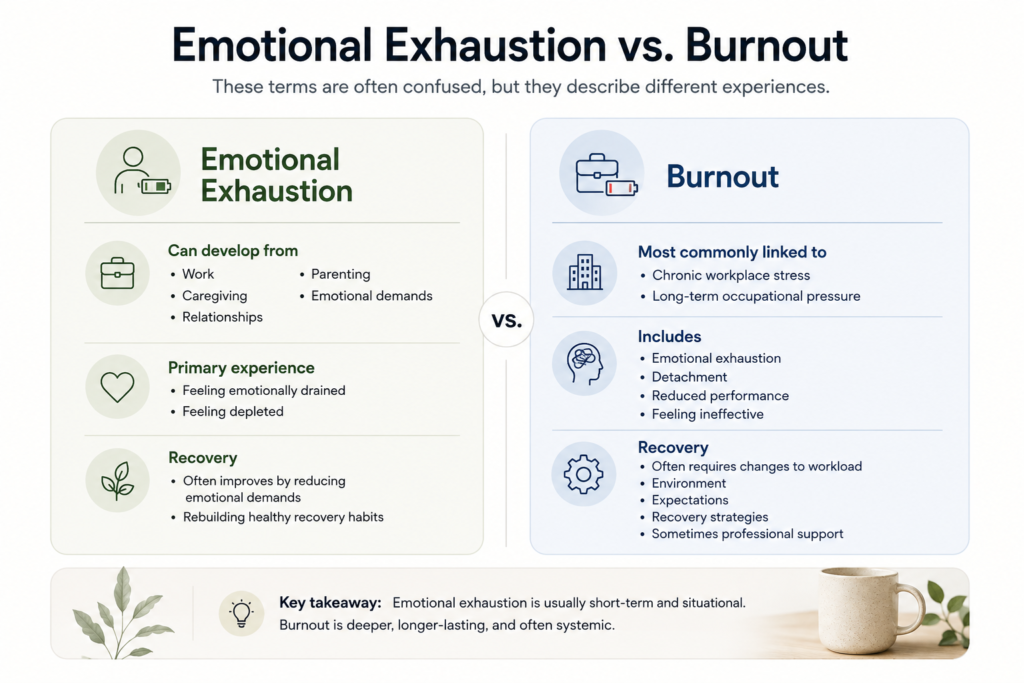
Emotional Exhaustion vs. Burnout
These terms are often confused, but they’re not exactly the same.
Emotional Exhaustion
- Can develop from work, caregiving, relationships, parenting, or prolonged emotional demands.
- Focuses on feeling emotionally drained and depleted.
- May improve by reducing emotional demands and rebuilding recovery habits.
Burnout
- Most commonly associated with chronic workplace or occupational stress.
- Includes emotional exhaustion along with detachment, reduced performance, and feeling ineffective.
- Often requires changes to workload, environment, expectations, and recovery strategies.
You can experience emotional exhaustion without being completely burned out.
However, emotional exhaustion is often one of the earliest warning signs that burnout may be developing.
If you want to prevent that progression, our article How to Prevent Burnout Before It Starts offers practical strategies for recognizing the warning signs early.
Emotional Exhaustion vs. Depression
This is an important distinction.
Emotional exhaustion and depression can share symptoms such as:
- Low motivation
- Fatigue
- Difficulty concentrating
- Reduced enjoyment
- Feeling emotionally drained
However, they are not the same condition.
Emotional exhaustion is often linked to prolonged emotional demands and may improve as stress is reduced and recovery increases.
Depression is a medical condition with many possible contributing factors and should be assessed by a qualified healthcare professional.
If you’re experiencing persistent sadness, hopelessness, loss of interest in nearly all activities, or symptoms that significantly interfere with daily life, it’s important not to self-diagnose.
Seeking professional support is a sign of strength, not weakness.
Why Sleeping More Doesn't Always Fix Emotional Exhaustion
One of the most frustrating parts of emotional exhaustion is this:
You finally get the chance to rest.
You sleep in on Saturday.
You spend Sunday relaxing.
Yet Monday morning arrives…
And you still don’t feel emotionally refreshed.
Why?
Because physical rest and emotional recovery aren’t always the same thing.
Sleep helps restore your body.
But emotional exhaustion often develops because you’ve been carrying emotional responsibilities without enough opportunities to process, release, and recover.
Imagine spending months carrying heavy grocery bags every day.
Taking one afternoon off doesn’t immediately remove the strain those muscles have experienced.
Your emotional system works in a similar way.
Recovery often requires:
- Processing difficult emotions instead of suppressing them.
- Creating healthier boundaries.
- Reducing unnecessary emotional demands.
- Reconnecting with activities that genuinely restore you.
- Building recovery into everyday life instead of waiting for vacations.
Many people first recognize this pattern because they continue feeling mentally exhausted despite getting enough sleep. If that’s something you’ve experienced, you’ll find our guide Why You Feel Mentally Drained Even After Rest especially helpful, as it explores why physical rest alone isn’t always enough to restore mental and emotional energy.
How Emotional Exhaustion Can Affect Your Relationships
When you’re emotionally exhausted, you may still love the people around you.
You simply have less emotional capacity to engage.
You may notice that you:
- Withdraw from conversations.
- Feel impatient with loved ones.
- Cancel social plans more often.
- Struggle to be fully present.
- Feel guilty for wanting time alone.
This can be confusing for family and friends.
They may think you’re upset with them.
In reality, you’re often trying to conserve what little emotional energy you have left.
That’s why honest communication matters.
Instead of saying,
“I’m just busy,”
you might say,
“I’ve been feeling emotionally drained lately, and I need a little time to recharge.”
That small shift helps the people who care about you understand what you’re experiencing.
Before You Focus on Recovery, Start With Awareness
Many people jump straight to asking,
“What should I do?”
A better first question is:
“What has been draining me?”
Recovery begins with awareness.
Not judgment.
Not guilt.
Simply noticing.
What situations leave you emotionally empty?
Who consistently restores your energy?
Which habits help you feel calmer?
Which habits quietly leave you feeling worse?
The answers to those questions become the foundation of meaningful recovery.
10 Practical Ways to Recover From Emotional Exhaustion (With a 7-Day Recovery Plan)
At this point, you might be thinking:
“I understand why I feel this way… but how do I actually recover?”
That’s one of the biggest questions people ask when they realize they’re emotionally exhausted.
The answer isn’t to completely change your life overnight.
It isn’t to book an expensive vacation.
It isn’t to become a different person.
Real recovery happens much more quietly.
It’s built through dozens of small decisions that gradually restore the emotional energy you’ve been giving away.
Think of it like filling a bucket that’s been slowly leaking for months.
You don’t refill it with one huge splash.
You refill it one cup at a time.
That’s exactly how emotional recovery works.
Let’s look at ten practical strategies that can help you begin rebuilding your emotional reserves.
1. Stop Waiting Until You're Completely Drained to Rest
One of the biggest mistakes emotionally exhausted people make is believing they have to earn rest.
They tell themselves:
“I’ll relax after this deadline.”
“I’ll take care of myself once things calm down.”
“I just need to get through this week.”
The problem is that another deadline always appears.
Another responsibility arrives.
Another problem needs solving.
Eventually, rest becomes something that exists only in the future.
Imagine driving your car until the fuel tank is completely empty every single week.
Eventually, the engine would begin struggling.
Yet many of us treat ourselves exactly that way.
We keep pushing until our emotional reserves are almost gone before giving ourselves permission to recover.
Healthy recovery looks different.
Instead of waiting for complete exhaustion, begin adding small recovery moments throughout your day.
That might mean:
- Taking a five-minute walk after a long meeting.
- Eating lunch away from your desk.
- Spending ten quiet minutes outside.
- Stretching between tasks.
- Taking three slow breaths before opening another email.
These moments may seem insignificant.
But together, they interrupt the cycle of constant emotional output.
If you’ve struggled with maintaining these habits, our guide on Creating a Sustainable Mental Wellness Routine That Lasts explains how to build routines that are realistic enough to continue long after motivation fades.

2. Learn the Difference Between Rest and Distraction
After a difficult day, many of us automatically reach for our phones.
We scroll.
Watch videos.
Check social media.
Read the news.
Answer messages.
Hours pass.
Then we wonder why we still don’t feel rested.
The truth is that distraction isn’t always the same as recovery.
Scrolling may temporarily take your mind off stress.
But your brain is still processing information.
Still making decisions.
Still reacting to new content.
Real emotional recovery often comes from activities that reduce mental stimulation rather than increase it.
For example:
- Sitting outside with a cup of tea.
- Listening to calming music.
- Reading a novel.
- Gardening.
- Gentle stretching.
- Walking without your phone.
- Watching the sunset.
- Journaling.
Ask yourself one simple question:
“When I finish this activity, do I usually feel calmer or more stimulated?”
If the answer is calmer, you’ve probably found something that genuinely restores you.
3. Start Protecting Your Emotional Boundaries
Emotional exhaustion often develops because we spend so much time meeting everyone else’s needs that our own quietly disappear.
You answer work emails late at night.
Say yes when you want to say no.
Take on extra responsibilities because you don’t want to disappoint anyone.
Listen to everyone else’s problems while keeping your own to yourself.
Over time, these habits create emotional overload.
Healthy boundaries aren’t about becoming selfish.
They’re about recognizing that your emotional energy is limited.
Just like your time.
Some examples of healthy boundaries include:
- Not checking work emails after a certain time.
- Saying, “I can’t commit to that right now.”
- Taking time before responding to requests.
- Protecting your lunch break.
- Allowing yourself quiet evenings without guilt.
Every boundary you set is a way of protecting the emotional energy you’ll need tomorrow.
4. Reconnect With Activities That Make You Feel Like Yourself
When people become emotionally exhausted, they often stop doing the things they genuinely enjoy.
Not because they no longer like them.
Because they feel they don’t have time.
Eventually life becomes nothing but responsibilities.
Work.
Household tasks.
Appointments.
Emails.
Bills.
Laundry.
Repeat.
Recovery isn’t only about removing stress.
It’s also about bringing meaningful experiences back into your life.
Ask yourself:
What made me feel alive before life became so busy?
Maybe it was:
- Reading.
- Painting.
- Photography.
- Hiking.
- Cooking.
- Playing music.
- Gardening.
- Playing with your dog.
- Cycling.
Notice that none of these activities are productive in the traditional sense.
And that’s exactly why they’re valuable.
Joy restores emotional energy in ways productivity cannot.

5. Stop Carrying Tomorrow Into Tonight
Have you ever climbed into bed only to begin mentally planning tomorrow?
Meetings.
Groceries.
Deadlines.
School schedules.
Appointments.
Emails.
Your body is in bed.
Your brain is already living tomorrow.
One simple habit can help:
Create a Tomorrow List.
Before your evening begins, write down:
- Your three most important tasks.
- Anything you don’t want to forget.
- One thing that can wait.
Then close the notebook.
You’re giving your brain permission to stop rehearsing tomorrow.
If nighttime overthinking is something you experience regularly, our article Night Routines to Reduce Overthinking offers additional strategies for calming a busy mind before bed.
6. Spend Time With People Who Leave You Feeling Lighter
Not every relationship affects your emotional energy in the same way.
Think about the people in your life.
After spending time with some people, you feel:
Inspired.
Supported.
Seen.
Calmer.
Others may leave you feeling:
Drained.
Criticized.
Anxious.
Responsible for solving their problems.
Emotionally exhausted people often continue giving to everyone else while forgetting to seek support themselves.
You don’t need a large social circle.
Sometimes one genuine conversation with someone you trust can restore more emotional energy than hours spent alone trying to figure everything out.
Connection is a basic human need, not a luxury.
7. Give Your Brain Quiet Time Every Day
Many people wake up to notifications.
Spend the day in meetings.
Listen to podcasts while driving.
Scroll during lunch.
Watch television while checking social media.
Then wonder why their minds never seem to slow down.
Your brain rarely experiences silence anymore.
Quiet isn’t wasted time.
It’s recovery time.
You don’t have to meditate if that’s not your style.
Simply try spending ten minutes each day:
- Sitting outside.
- Walking without headphones.
- Watching the rain.
- Drinking coffee without your phone.
- Looking out of the window.
Those moments give your nervous system a chance to settle.

8. Practice Self-Compassion Instead of Self-Criticism
Many emotionally exhausted people become their own harshest critics.
They think:
“I should be handling this better.”
“Other people seem fine.”
“Why can’t I keep up?”
But imagine speaking to a close friend that way.
You probably wouldn’t.
Instead, you’d remind them they’ve been carrying a lot.
Try offering yourself that same kindness.
Recovery begins when you replace:
“What’s wrong with me?”
with
“I’ve been carrying a lot lately.”
That shift doesn’t remove your responsibilities.
But it changes the way you experience them.
9. Build Recovery Into Your Week, Not Just Your Vacation
Vacations are wonderful.
But if you’re emotionally exhausted for 50 weeks of the year and relaxed for two, your recovery isn’t sustainable.
Instead of relying on occasional escapes, create regular recovery habits.
Perhaps:
Monday evening , phone-free dinner.
Wednesday morning , walk before work.
Friday afternoon , leave work on time.
Saturday morning , time outdoors.
Sunday evening , prepare calmly for the week.
Consistency is far more powerful than occasional perfection.
10. Accept That Recovery Isn't Linear
Some days you’ll feel much better.
Other days you’ll wonder whether you’ve made any progress at all.
That’s normal.
Recovery rarely follows a straight line.
There will be stressful weeks.
Unexpected setbacks.
Busy seasons.
The goal isn’t to eliminate every difficult day.
The goal is to return to balance more quickly when life becomes demanding again.
Progress isn’t measured by never feeling overwhelmed.
It’s measured by recognizing the signs earlier and responding with care instead of simply pushing harder.
A Simple 7-Day Emotional Recovery Plan
You don’t need to change everything at once.
Try focusing on one small action each day.
Day 1 , Notice What Drains You
Carry a notebook or use your phone to write down moments when you feel emotionally depleted.
Don’t judge them.
Just notice patterns.
Day 2 , Create One Healthy Boundary
Say no to one unnecessary commitment.
Turn off work notifications after hours.
Protect one hour of personal time.
Day 3 , Spend 20 Minutes Outdoors
Leave your phone in your pocket.
Notice your surroundings.
Breathe slowly.
Allow your attention to shift away from responsibilities.
Day 4 , Reach Out to Someone You Trust
Send a message.
Call a friend.
Meet someone for coffee.
You don’t have to solve everything.
Simply reconnect.
Day 5 , Have a Digital Sunset
Choose a time, perhaps one hour before bed, when you put your phone away.
Replace scrolling with reading, stretching, journaling, or simply sitting quietly.
Day 6 , Do Something That Brings You Joy
Choose an activity with no productive outcome.
Bake.
Paint.
Walk.
Listen to music.
Play with your children.
Watch the sunset.
Let yourself enjoy it without feeling guilty.
Day 7 , Reflect Without Judging
Ask yourself:
- What helped me feel calmer this week?
- What drained my energy the most?
- What small habit do I want to continue next week?
Remember, emotional recovery isn’t about perfection.
It’s about paying attention.
Try This Today: The 20-Minute Emotional Reset
If you’re feeling emotionally overwhelmed right now, try this simple exercise.
Minutes 1–5: Put your phone away and take five slow breaths.
Minutes 6–10: Write down everything that’s been weighing on your mind.
Minutes 11–15: Go for a slow walk or stretch gently.
Minutes 16–20: Sit quietly with a cup of tea, read a few pages of a book, or simply look outside.
You haven’t solved every problem.
But you’ve given your mind something it may not have had in a long time:
Permission to pause.
Frequently Asked Questions
What is emotional exhaustion?
Emotional exhaustion is a state of feeling emotionally drained after prolonged stress or ongoing emotional demands. It can leave you feeling overwhelmed, disconnected, and unable to enjoy things you normally would, even if you’re getting enough physical rest.
What causes emotional exhaustion?
It often develops from long-term stress, caregiving, work pressure, relationship challenges, financial worries, or constantly putting others’ needs before your own. Small emotional demands can build up over time if you don’t have enough opportunities to recover.
What are the signs of emotional exhaustion?
Common signs include feeling emotionally empty, losing motivation, becoming easily irritated, struggling to concentrate, avoiding social interactions, and finding everyday tasks more difficult than usual. These symptoms often appear gradually rather than all at once.
Can emotional exhaustion go away on its own?
Mild emotional exhaustion may improve with rest and reduced stress, but lasting recovery usually requires healthier boundaries, regular self-care, and addressing the sources of emotional strain. Ignoring it may allow symptoms to persist or worsen.
Why doesn't sleep fix emotional exhaustion?
Sleep restores physical energy, but emotional exhaustion often requires emotional recovery as well. Processing emotions, reducing ongoing stress, reconnecting with enjoyable activities, and creating healthy routines are just as important as getting enough sleep.
Is emotional exhaustion the same as burnout?
No. Emotional exhaustion is a feeling of being emotionally depleted, while burnout is a broader condition often linked to chronic workplace stress. Emotional exhaustion is frequently one of the earliest signs that burnout may be developing.
How long does it take to recover from emotional exhaustion?
Recovery varies depending on the cause and your circumstances. Some people notice improvement within a few weeks, while others may need several months. Consistent self-care, healthy boundaries, and support from others can make recovery more sustainable.
Can emotional exhaustion affect relationships?
Yes. You may become less patient, withdraw from loved ones, or struggle to be emotionally present. Open communication and taking time to recharge can help maintain healthy relationships while you recover.
What are the best ways to recover from emotional exhaustion?
Start with small, realistic changes such as setting boundaries, taking regular breaks, reconnecting with hobbies, spending time outdoors, getting quality sleep, and talking to supportive people. Consistency is usually more effective than trying to change everything at once.
When should I seek professional help?
If emotional exhaustion lasts for several weeks, affects your work, relationships, or daily life, or is accompanied by persistent anxiety, hopelessness, or depression, consider speaking with a qualified healthcare or mental health professional for personalized support.

Art of Wellness Team is a collective of mental wellness writers and researchers focused on stress, anxiety, and mental clarity. We create practical, evidence-informed content to help readers better understand their mental well-being and build healthier habits for everyday life.






[…] prolonged uncertainty has left you emotionally exhausted, our article How to Recover From Emotional Exhaustion explains why recovery isn’t about pretending everything is okay, it’s about restoring […]