




Before You Read Another Notification…
Table Of Content
- We Live in a World That Never Stops Calling for Our Attention
- Your Brain Was Never Designed for This
- The Cost of "Just Checking"
- Your Attention Is More Fragile Than You Think
- The Stress You Don't Notice Is Still Stress
- A Day Filled With Invisible Interruptions
- Sarah
- James
- Your Phone Isn't Just Competing for Your Time
- What Happens Inside Your Brain Every Time Your Phone Buzzes
- Step 1: Your Brain Detects Something New
- Step 2: Your Attention Leaves the Present Moment
- Step 3: Curiosity Activates Your Brain's Reward System
- Step 4: The Reward Doesn't Have to Be Big
- Why "Maybe" Is More Powerful Than "Always"
- Step 5: Your Brain Has to Switch Back
- Your Brain Starts Expecting Interruptions
- The Hidden Stress of Constant Alertness
- One Notification Isn't the Problem
- The Hidden Ways Notifications Quietly Change Your Daily Life
- During Conversations: Your Body Is Present, but Your Mind Keeps Leaving
- During Work: Why Your Brain Feels Busy but Less Productive
- During Meals: Your Brain Never Fully Slows Down
- During Quiet Moments: We Stop Being Alone With Our Thoughts
- Before Bed: Why Falling Asleep Feels Harder
- Notifications Quietly Increase Decision Fatigue
- Even Silent Notifications Can Interrupt Your Mind
- What Happens Over Time?
- Reclaim Your Attention Without Giving Up Your Phone
- Step 1: Do a Notification Audit
- Step 2: Stop Letting Every App Decide Your Priorities
- Step 3: Create Phone-Free Zones
- During Meals
- During Deep Work
- During Conversations
- Before Bed
- Step 4: Check Your Phone Intentionally
- Step 5: Rediscover Moments of Boredom
- Try a "Silent Morning"
- A Weekend Notification Reset
- Final Thoughts
- Frequently Asked Questions
Let’s try a small experiment.
Imagine you’re reading this article with complete focus.
You’re following every sentence.
You’re beginning to think,
“This is interesting…”
Then,
Buzz.
Your phone vibrates.
Maybe it’s a text.
Maybe an email.
Maybe a social media notification.
Maybe nothing important at all.
You don’t even unlock your phone.
You simply glance at the screen.
Three seconds later, you return to reading.
It feels like nothing happened.
But inside your brain…
A lot just happened.
Your attention shifted.
Your concentration paused.
Your thoughts briefly changed direction.
Your brain began processing new information before it had even finished processing the last one.
You may think you’ve returned exactly where you left off.
But your mind is still catching up.
Now imagine that happening not once…
But fifty times today.
Or a hundred.
Or every single day for years.
Suddenly, the problem isn’t the notification itself.
It’s the thousands of invisible interruptions quietly shaping the way your brain works.
We Live in a World That Never Stops Calling for Our Attention
Take a moment and think about how many things compete for your attention in a typical day.
Your phone buzzes.
Your smartwatch vibrates.
A calendar reminder appears.
An email notification pops up.
A news alert flashes across your screen.
Someone tags you in a photo.
A shopping app announces a sale.
A messaging app tells you someone is typing.
Even your television, laptop, tablet, and smart speaker compete for your attention.
Many of these notifications aren’t emergencies.
Most aren’t even important.
Yet your brain doesn’t know that immediately.
Every sound.
Every vibration.
Every flashing icon.
Every banner across your screen sends your brain the same initial message:
“Pay attention. This might matter.”
Whether the notification is from your boss…
Your best friend…
Or an online store advertising shoes…
Your brain reacts before it knows the difference.
That’s why notifications don’t just interrupt your schedule.
They interrupt your nervous system.
Your Brain Was Never Designed for This
For most of human history, unexpected sounds carried meaning.
A branch snapping in the forest.
Someone calling your name.
A baby crying.
An approaching animal.
Your brain evolved to notice sudden changes in your environment because those changes sometimes meant danger.
That survival system still exists today.
The only difference is that instead of hearing rustling bushes…
You’re hearing:
Ping.
Buzz.
Ding.
Your brain hasn’t evolved quickly enough to distinguish between a life-threatening sound and a phone notification.
For a brief moment…
It simply notices something unexpected.
And unexpected things demand attention.
That’s why even a harmless vibration can interrupt your concentration before you’ve consciously decided whether it deserves your attention.
The Cost of "Just Checking"
Many of us have a phrase we repeat without thinking.
“I’ll just check my phone.”
Just check the message.
Just read the notification.
Just reply quickly.
Just one minute.
But have you ever noticed that “just checking” rarely lasts only a few seconds?
You unlock your phone to answer one message.
Then you notice another notification.
Then you remember an email.
Then you quickly check Instagram.
Someone shared a video.
Now you’re watching it.
Twenty minutes later, you finally remember what you were doing before you picked up your phone.
Sound familiar?
This isn’t simply a lack of discipline.
Modern apps are intentionally designed to encourage repeated engagement.
Every notification creates an opportunity for your attention to move somewhere new.
Over time, your brain begins expecting those interruptions.
Eventually, silence itself starts feeling unusual.
Your Attention Is More Fragile Than You Think
Imagine trying to read a novel.
Every two minutes, someone taps you on the shoulder.
They don’t always say anything important.
Sometimes they simply whisper,
“Just wanted to let you know…”
Would you finish the chapter?
Probably.
Would you enjoy it as much?
Probably not.
Would you remember it as well?
Almost certainly not.
Notifications work in much the same way.
Each interruption may seem tiny.
But tiny interruptions accumulate.
One interruption becomes ten.
Ten become fifty.
Fifty become hundreds each week.
Eventually, uninterrupted focus starts feeling unfamiliar.
Many people assume they’re losing their ability to concentrate.
Often, they’re simply losing opportunities to practice concentration.
If you’ve noticed that even simple tasks feel harder to focus on lately, our article Why Your Brain Feels Overwhelmed by Simple Tasks explores how constant mental interruptions gradually reduce your cognitive capacity throughout the day.
The Stress You Don't Notice Is Still Stress
When people think about stress, they usually imagine obvious situations.
An important exam.
A difficult meeting.
Financial pressure.
Family conflict.
But stress doesn’t always arrive dramatically.
Sometimes it arrives quietly.
One vibration.
One notification.
One email.
One interruption.
None of these moments seem stressful on their own.
Yet each one asks your brain to stop what it’s doing, assess new information, and decide whether action is required.
That tiny decision takes mental effort.
One decision isn’t exhausting.
Hundreds are.
This is why many people feel mentally tired by the end of the day without understanding why.
They haven’t spent the day solving major crises.
They’ve spent it constantly switching attention.
And every switch has a cost.
A Day Filled With Invisible Interruptions
Imagine two people working from home.
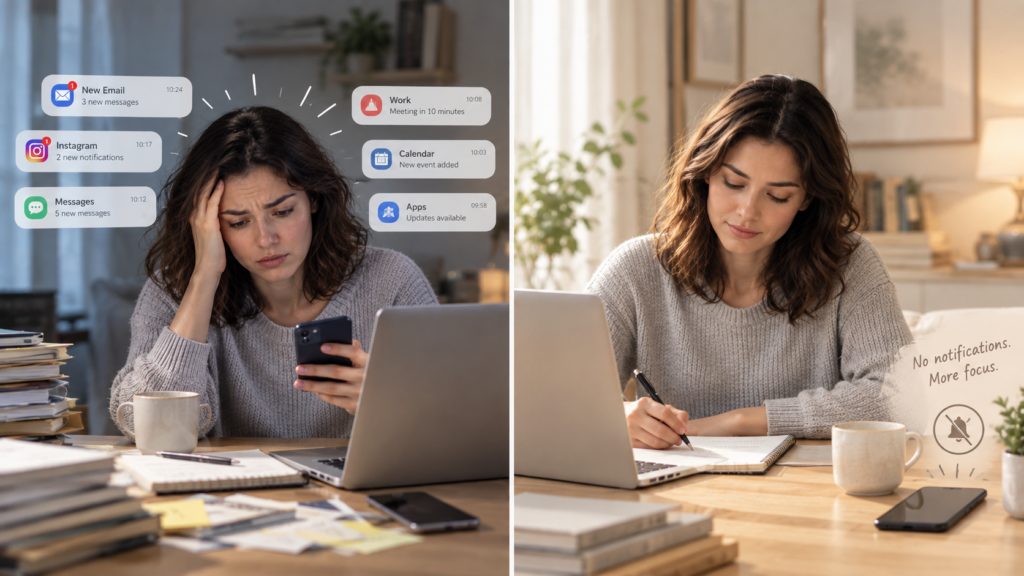
Sarah
Turns on every notification.
Every email appears instantly.
Every message vibrates.
Every social media alert pops up.
Every news headline flashes across her screen.
She rarely ignores them.
By 5 p.m., she feels exhausted despite not completing as much work as she’d hoped.
James
Disables most notifications.
Checks email at scheduled times.
Keeps his phone face down while working.
Uses Focus Mode during important tasks.
He experiences the same workload.
The same deadlines.
The same responsibilities.
But he finishes the day feeling noticeably calmer.
The difference isn’t intelligence.
It isn’t motivation.
It’s the number of times their brains were forced to start over.
Your Phone Isn't Just Competing for Your Time
Many people believe smartphones mainly steal time.
But time isn’t the biggest cost.
Attention is.
You can always make more plans.
You can reorganize tomorrow.
You can change your schedule.
But every moment your attention is pulled away is a moment you can never fully get back.
Attention shapes:
- Your relationships.
- Your creativity.
- Your productivity.
- Your memory.
- Your emotional well-being.
- Your sense of presence.
Every notification asks the same question:
“Will you give me your attention?”
The more often the answer is yes, the harder it becomes to protect your focus when it truly matters.
And over time, that constant tug-of-war doesn’t just affect your productivity.
It begins influencing your stress levels, your emotional resilience, and even how your brain responds to everyday life.
In the next section, we’ll follow a single phone notification through your brain, from the moment it buzzes to the chemical reactions it triggers. You’ll discover why checking your phone can feel almost automatic, how dopamine keeps you coming back, and why your brain starts craving interruptions even when there’s nothing important waiting.
What Happens Inside Your Brain Every Time Your Phone Buzzes
Let’s slow everything down for a moment.
Imagine your phone is lying on the table beside you.
You’re working.
Reading.
Studying.
Talking to someone.
Or simply enjoying a quiet moment.
Then,
Buzz.
It lasts less than a second.
But inside your brain, an incredibly fast chain reaction has already begun.
It happens so quickly that most people never notice it.
Understanding that reaction is the key to understanding why constant notifications can leave you feeling mentally exhausted, anxious, and unable to focus.
Let’s follow that single notification from beginning to end.
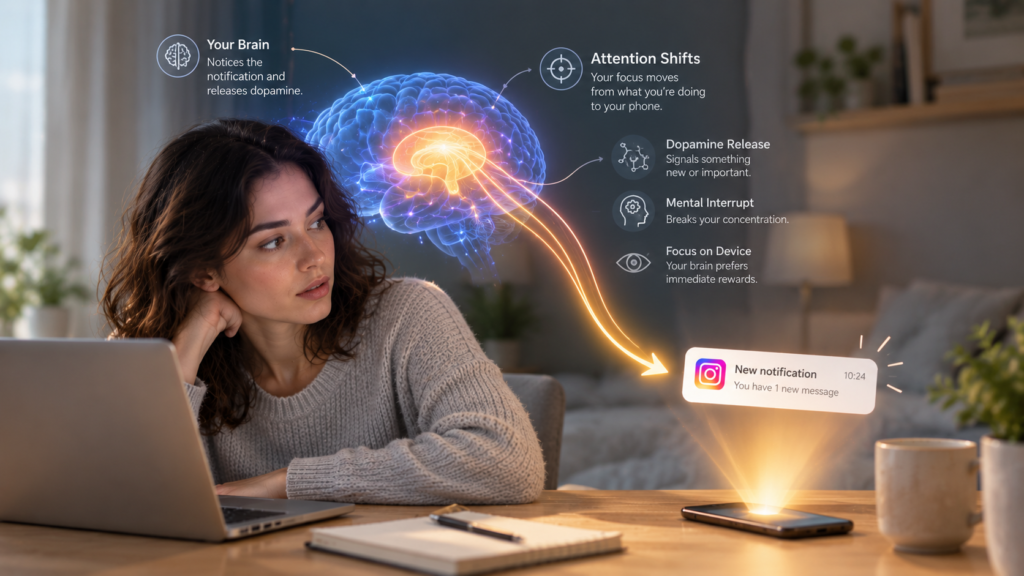
Step 1: Your Brain Detects Something New
The vibration reaches your ears or your hand.
Before you’ve consciously decided whether to look at your phone, your brain has already detected something unexpected.
This happens because your brain is constantly scanning your surroundings for change.
Psychologists sometimes refer to this as the orienting response, an automatic reaction that shifts your attention toward something new or potentially important.
Thousands of years ago, this response helped humans survive.
Today, it responds just as quickly to a smartphone vibration.
Your brain doesn’t initially know whether the notification is:
- A family emergency.
- An important work message.
- A reminder.
- A friend saying hello.
- Or simply an online shopping promotion.
It simply thinks:
“Something changed. Pay attention.”
That automatic reaction happens before you’ve had time to decide whether the notification deserves your attention.
Step 2: Your Attention Leaves the Present Moment
Have you ever been halfway through reading a paragraph…
…only to realize you don’t remember what you just read?
Notifications are one reason this happens.
The moment your brain notices the alert, your attention begins shifting away from your current task.
Even if you don’t unlock your phone, part of your mind has already started asking questions.
“Who messaged me?”
“Could it be work?”
“Is something important happening?”
“Should I check now?”
Those thoughts may last only a few seconds.
But they’re enough to interrupt your concentration.
Imagine watching a movie while someone pauses it every few minutes.
Eventually, following the story becomes difficult.
Your brain experiences something similar every time its focus is interrupted.
The interruption itself is often brief.
Recovering your previous level of concentration takes much longer.
Step 3: Curiosity Activates Your Brain's Reward System
Here’s where things become fascinating.
You haven’t even opened your phone yet.
But your brain is already anticipating what might be waiting.
Maybe it’s good news.
Maybe someone liked your post.
Maybe you’ve received an exciting message.
Maybe it’s nothing important.
Your brain doesn’t know.
And that’s exactly what keeps you interested.
It’s the possibility of something rewarding that captures your attention.
Researchers have found that unpredictable rewards tend to hold our attention more strongly than predictable ones.
Think about opening a wrapped gift.
Part of the excitement comes from not knowing what’s inside.
Notifications work in a similar way.
Every alert carries a tiny question mark.
Your brain becomes curious.
That curiosity encourages you to check.
Step 4: The Reward Doesn't Have to Be Big
You unlock your phone.
Maybe it’s a message from a close friend.
Maybe someone commented on your photo.
Maybe it’s an email confirming a delivery.
Or maybe it’s simply another advertisement.
Interestingly…
Your brain learns from all of these experiences.
Even notifications that aren’t especially meaningful reinforce the habit of checking.
Why?
Because occasionally, there is something exciting waiting.
A message you’ve been hoping for.
A job interview invitation.
A compliment.
A funny photo.
Good news.
Those occasional rewarding experiences teach your brain an important lesson:
“The next notification might be worth checking immediately.”
That expectation is powerful.
It’s one reason many people reach for their phones almost automatically, even without hearing a notification.
Why "Maybe" Is More Powerful Than "Always"
Imagine two vending machines.
The first machine gives you chocolate every single time.
The second machine gives you chocolate only occasionally.
Surprisingly, many people continue checking the second machine more often.
Why?
Because uncertainty creates anticipation.
Social media platforms, messaging apps, games, and even email often work this way.
Sometimes there’s something exciting waiting.
Sometimes there isn’t.
Your brain never knows which notification will be rewarding.
That uncertainty keeps curiosity alive.
It’s one reason checking your phone can become such an automatic habit.
Step 5: Your Brain Has to Switch Back
After checking your phone, you return to work.
At least…
That’s what it feels like.
But your brain isn’t quite where it was before.
Part of your attention remains attached to what you just saw.
Maybe you’re thinking about replying later.
Maybe you’re wondering whether someone else will respond.
Maybe you’re still replaying the message in your mind.
Psychologists often describe this as attention residue, the lingering mental effect of switching from one task to another.
Instead of giving your full attention to your current activity, a small part of your mind remains connected to the previous one.
One notification creates only a little attention residue.
Dozens throughout the day begin to accumulate.
That’s why many people feel busy all day while struggling to remember what they actually accomplished.
If you’ve been wondering why concentrating feels harder than it used to, our article Why Your Brain Feels Overwhelmed by Simple Tasks explains how repeated mental switching gradually drains cognitive energy.

Your Brain Starts Expecting Interruptions
Here’s where notifications begin changing more than your daily routine.
They begin changing your expectations.
After enough repetitions, your brain starts anticipating interruptions, even when none occur.
Have you ever:
- Reached for your phone without hearing it vibrate?
- Thought you felt a notification that wasn’t actually there?
- Unlocked your phone without knowing why?
- Opened one app and forgotten what you intended to do?
These experiences are surprisingly common.
They’re signs that checking your phone has become less of a conscious decision and more of an automatic habit.
Over time, your brain learns:
“When I’m bored… check my phone.”
“When I’m waiting… check my phone.”
“When work becomes difficult… check my phone.”
Eventually, the phone becomes a default response to almost any moment of discomfort.
Not because you’re lacking willpower.
Because your brain has been trained through repetition.
The Hidden Stress of Constant Alertness
Imagine living in a house where someone rings the doorbell randomly throughout the day.
Sometimes it’s important.
Most of the time it isn’t.
Even if you don’t answer every time, you’ll still notice the sound.
You’ll still wonder who’s outside.
You’ll still experience a brief interruption.
That’s what constant notifications do to your nervous system.
They keep your brain in a state of low-level alertness.
Not enough to trigger panic.
But enough to make genuine relaxation more difficult.
Instead of fully settling into a task, a conversation, or a quiet evening, part of your mind remains ready for the next interruption.
That constant readiness quietly consumes mental energy.
If you’ve ever finished the day feeling mentally drained without knowing why, these small moments of vigilance may be part of the reason.
One Notification Isn't the Problem
It’s important to be clear:
Notifications themselves aren’t the enemy.
A reminder to take medication can be helpful.
A message from a loved one can brighten your day.
An emergency alert can keep you safe.
The issue isn’t one notification.
It’s the hundreds of unnecessary interruptions that slowly teach your brain to live in a constant state of anticipation.
Every buzz asks your attention to change direction.
Every interruption leaves a small mental footprint.
One footprint isn’t noticeable.
Thousands create a path.
And before long, that path becomes your brain’s default way of operating.
In the next section, we’ll move beyond the brain and explore how constant notifications quietly influence your relationships, conversations, work performance, sleep quality, and emotional well-being, even when you believe you’re “used to them.”
The Hidden Ways Notifications Quietly Change Your Daily Life
By now, you know that a single notification does much more than light up your screen.
It interrupts your attention.
Triggers your brain’s alert system.
Creates curiosity.
And leaves behind a small amount of mental residue every time you switch tasks.
But perhaps the biggest impact of constant notifications isn’t what they do in a single moment.
It’s what they do after months and years of repetition.
Most people don’t wake up one morning and suddenly struggle to focus.
They don’t suddenly become more anxious.
They don’t suddenly find it difficult to relax.
These changes happen gradually, so gradually that they begin to feel normal.
Let’s look at where those tiny interruptions quietly reshape everyday life.
During Conversations: Your Body Is Present, but Your Mind Keeps Leaving
Think about the last time you had dinner with family or met a friend for coffee.
The conversation was flowing.
Someone was sharing an important story.
Then…
Buzz.
You glance down.
Only for a second.
You quickly put your phone away and say,
“Sorry, keep going.”
But something changed.
Your attention briefly left the conversation.
The person speaking noticed.
You may have missed a sentence.
Or perhaps you heard the words but didn’t fully absorb them.
Now imagine this happening five or six times during the same conversation.
Each interruption may seem harmless.
Together, they quietly reduce something incredibly valuable:
Presence.
Being present isn’t simply about sitting beside someone.
It’s about giving them your full attention.
When notifications constantly pull that attention away, conversations become more fragmented.
Over time, people may begin to feel unheard, even if you’re physically there.
Strong relationships are built through moments of focused attention.
Every unnecessary interruption quietly takes a small piece of that away.
During Work: Why Your Brain Feels Busy but Less Productive
Have you ever reached the end of a workday and wondered,
“I’ve been busy all day… so why does it feel like I accomplished so little?”
Constant notifications are often part of the answer.
Imagine trying to write an important report.
You work for ten minutes.
A message arrives.
Back to work.
An email appears.
Back to work.
A calendar reminder pops up.
Back to work.
Someone comments on a shared document.
Back to work.
Although each interruption lasts only seconds, your brain repeatedly has to rebuild its concentration.
It’s similar to repeatedly stopping a car at every traffic light.
Even if each stop is brief, the journey becomes much slower.
Deep thinking requires uninterrupted time.
Creative problem-solving requires uninterrupted time.
Learning requires uninterrupted time.
When your attention is constantly divided, your brain spends more energy restarting than progressing.
That’s why many people finish the day mentally exhausted while feeling surprisingly unproductive.
If you’ve noticed that concentrating feels more difficult than it used to, our article Why Your Brain Feels Overwhelmed by Simple Tasks explains how repeated interruptions gradually reduce your ability to think clearly and make decisions.

During Meals: Your Brain Never Fully Slows Down
Meals used to provide natural breaks in the day.
A chance to pause.
Talk.
Taste your food.
Let your mind slow down.
Now think about how many meals include this routine:
Take a bite.
Check the phone.
Reply to a message.
Scroll briefly.
Continue eating.
Repeat.
Instead of allowing your nervous system to settle, your brain remains partially engaged with digital activity.
Even if you’re eating healthy food, your mind may never experience a true mental break.
Over weeks and months, those missed moments of recovery begin to matter.
Recovery isn’t only something that happens during vacations.
It happens in small everyday pauses.
And notifications quietly interrupt many of them.
During Quiet Moments: We Stop Being Alone With Our Thoughts
Imagine waiting in line at a grocery store twenty years ago.
People simply waited.
They looked around.
They noticed their surroundings.
Sometimes they daydreamed.
Sometimes they thought about nothing at all.
Today, waiting often lasts only a few seconds before someone reaches for their phone.
Waiting for coffee.
Waiting for an elevator.
Waiting at a red light.
Waiting for a friend.
Those tiny pauses have almost disappeared.
At first, this doesn’t seem important.
But quiet moments give your brain something valuable.
Time to process.
Time to reflect.
Time to connect ideas.
Time to recover from constant stimulation.
When every spare moment is filled with new information, your mind rarely gets the opportunity to simply exist without consuming something else.
Before Bed: Why Falling Asleep Feels Harder
You tell yourself you’ll check your phone for five minutes before sleeping.
Five minutes becomes twenty.
Then thirty.
One notification leads to another.
An email reminds you about tomorrow.
A news headline raises a new concern.
A social media post sparks comparison.
A work message appears unexpectedly.
By the time you finally put your phone down, your body is lying in bed.
Your brain, however, is still awake.
Instead of gradually preparing for sleep, your mind continues processing new information.
It’s much like trying to fall asleep immediately after walking into a loud, brightly lit shopping mall.
The transition simply isn’t smooth.
Creating even thirty minutes without notifications before bedtime gives your brain a chance to shift into a calmer state.
If falling asleep has become more difficult lately, our article How to Calm Your Mind After a Difficult Day shares practical strategies for helping your mind slow down before bed.
Notifications Quietly Increase Decision Fatigue
Here’s something many people never notice.
Every notification asks your brain to make another decision.
Should I open it?
Ignore it?
Reply now?
Wait until later?
Is it important?
Can this wait?
One decision doesn’t seem like much.
But multiply that by dozens, or even hundreds, of notifications throughout the day.
Suddenly your brain has made countless extra decisions before dinner.
Decision fatigue doesn’t only come from major life choices.
It also comes from hundreds of tiny choices that quietly consume mental energy.
That’s one reason many people feel mentally drained by evening.
Not because every decision was difficult.
Because there were simply so many of them.
If decision-making feels exhausting lately, you may also relate to our article Decision Fatigue: Why Simple Choices Feel Exhausting, which explores how constant mental demands gradually reduce your ability to think clearly.
Even Silent Notifications Can Interrupt Your Mind
Some people solve the problem by turning off notification sounds.
That’s certainly helpful.
But here’s something surprising.
Even silent notifications can interrupt attention.
A screen lighting up.
A badge showing “12 unread.”
A smartwatch vibrating gently.
A banner appearing at the top of your screen.
Your brain still notices these visual cues.
The interruption becomes quieter.
Not necessarily smaller.
This explains why many people instinctively reach for their phones even in completely silent environments.
The trigger isn’t always sound.
Sometimes it’s simply the expectation that something new might be waiting.
What Happens Over Time?
None of these moments seem serious on their own.
One interrupted conversation.
One distracted meal.
One late-night scroll.
One quick glance during work.
But imagine repeating them…
Every day.
Every week.
Every year.
Small interruptions gradually become habits.
Habits become routines.
And routines begin shaping the way your brain expects the world to work.
You may start believing that constant distraction is normal.
That checking your phone every few minutes is unavoidable.
That feeling mentally scattered is simply part of modern life.
It doesn’t have to be.
Your brain is remarkably adaptable.
Just as it learned to expect constant interruptions, it can also relearn how to enjoy periods of uninterrupted focus, deeper conversations, and genuine moments of rest.
The final part of this guide will show you exactly how to reclaim your attention without giving up your smartphone. You’ll learn practical strategies, such as notification audits, Focus Mode, phone-free mornings, and digital boundaries, that help technology support your well-being instead of constantly competing for it.
Reclaim Your Attention Without Giving Up Your Phone
After reading this far, you might be thinking:
“So… should I just turn my phone off?”
For most people, that’s not realistic.
Your phone helps you work.
Stay connected with family.
Navigate unfamiliar places.
Pay bills.
Manage your schedule.
Capture memories.
Technology isn’t the problem.
The problem begins when technology quietly starts controlling your attention instead of supporting your life.
The goal isn’t to use your phone less.
The goal is to let your phone interrupt you less.
Small changes to the way you use technology can dramatically reduce unnecessary stress while allowing you to enjoy everything your devices still have to offer.
Let’s start with one of the simplest changes you can make.
Step 1: Do a Notification Audit
Most people have never looked at how many apps are allowed to interrupt them.
Take your phone.
Open your notification settings.
Now ask yourself a simple question for every app:
“Does this notification genuinely improve my life?”
If the answer is no…
Turn it off.
You don’t need notifications for:
- Shopping discounts.
- Game reminders.
- Social media likes.
- News alerts every hour.
- Promotional emails.
- Random app updates.
- Apps reminding you to come back.
Instead, reserve notifications for things that genuinely matter, such as:
- Phone calls from important contacts.
- Messages from close family.
- Calendar reminders.
- Medical appointments.
- Banking security alerts.
- Emergency weather notifications.
Many people are surprised to discover they can eliminate 70–90% of their notifications without missing anything important.
Step 2: Stop Letting Every App Decide Your Priorities
Imagine someone walked into your office every few minutes and said,
“Excuse me…”
Sometimes it was important.
Most of the time it wasn’t.
Eventually, you would probably ask them to stop interrupting you.
Yet we often allow our phones to do exactly that.
Every notification is an app deciding:
“What you’re doing right now is less important than what I’m about to show you.”
The question is:
Who should decide where your attention goes?
An app…
Or you?
Reclaiming your attention starts with making that decision yourself.

Step 3: Create Phone-Free Zones
Not every part of your day needs to include your phone.
In fact, some moments become more meaningful when your phone isn’t present at all.
Consider creating small “phone-free zones.”
For example:
During Meals
Place your phone in another room.
Instead of checking notifications between bites, focus on the conversation, the food, and the people around you.
During Deep Work
Keep your phone face down or out of sight.
Research has shown that even the visible presence of a smartphone can make it more difficult to stay fully focused.
When your phone isn’t constantly within reach, your brain spends less energy resisting the urge to check it.
During Conversations
When someone is speaking to you, give them the same attention you’d hope to receive.
Looking someone in the eyes instead of glancing at your screen communicates something powerful:
“Right now, you matter more than my notifications.”
Before Bed
Create a simple habit:
Charge your phone outside the bedroom if possible.
If that’s not practical, place it across the room and enable Do Not Disturb mode.
Giving your brain even thirty uninterrupted minutes before sleep can help it transition more naturally into rest.
If you’ve found it difficult to unwind at night, our article How to Calm Your Mind After a Difficult Day explores additional ways to help your brain shift from constant stimulation into genuine relaxation.
Step 4: Check Your Phone Intentionally
Many people check their phones whenever they receive a notification.
Try reversing that habit.
Instead of allowing notifications to decide when you check your phone…
Decide for yourself.
For example:
- Check email at 9:00 a.m., 1:00 p.m., and 4:30 p.m.
- Reply to messages every couple of hours.
- Browse social media after work instead of throughout the day.
This simple change transforms your phone from something that constantly interrupts you into a tool that works on your schedule.
Step 5: Rediscover Moments of Boredom
This may sound strange.
But boredom isn’t your enemy.
It’s one of the few times your brain gets the opportunity to wander naturally.
Think about the last time you waited in line without looking at your phone.
Or sat quietly during a train ride.
Or watched the rain without immediately reaching for a screen.
These moments may seem unproductive.
They’re not.
They’re opportunities for your brain to:
- Process emotions.
- Organize memories.
- Generate creative ideas.
- Recover from constant stimulation.
Many great ideas appear when the mind is allowed to wander.
Unfortunately, notifications rarely give it that chance.

Try a "Silent Morning"
Think about how most mornings begin.
Your alarm goes off.
Before your feet touch the floor, you check your phone.
Emails.
News.
Social media.
Messages.
Your brain begins reacting to other people’s priorities before you’ve even considered your own.
Try something different tomorrow.
For the first 30–60 minutes after waking up:
- Don’t check email.
- Don’t scroll social media.
- Don’t read the news.
- Don’t respond to notifications.
Instead:
Stretch.
Drink water.
Eat breakfast.
Go for a walk.
Journal.
Read a few pages of a book.
Simply allow your own thoughts to arrive before inviting everyone else’s into your day.
Many people find that this single habit creates a noticeable difference in their stress levels.
A Weekend Notification Reset
You don’t have to disconnect forever.
But you might benefit from experimenting.
Choose one afternoon this weekend.
Turn off all non-essential notifications for just a few hours.
Notice:
- Do you feel calmer?
- Are conversations easier?
- Is it easier to finish what you started?
- Do you feel less rushed?
The goal isn’t perfection.
The goal is awareness.
Once you notice how constant interruptions affect you, you’ll begin making healthier choices naturally.
Final Thoughts
Notifications aren’t inherently harmful.
They’re simply tools.
The challenge begins when every buzz, vibration, and banner slowly teaches your brain that constant interruption is normal.
Over time, that expectation quietly changes how you think.
How you work.
How you rest.
How you listen.
How you connect with the people around you.
The good news is that your attention isn’t permanently damaged.
Just as your brain learned to expect interruptions, it can learn to enjoy uninterrupted moments again.
Every unnecessary notification you disable…
Every phone-free conversation…
Every focused hour of work…
Every quiet walk without checking your screen…
Is a reminder to your brain that it doesn’t need to be constantly alert.
You don’t have to abandon technology to protect your mental health.
You simply need to create boundaries that allow technology to serve you instead of constantly competing for your attention.
Because in the end, your attention is one of the most valuable resources you have.
Where you place it shapes your relationships, your creativity, your peace of mind, and ultimately, your life.
Choose carefully.
Frequently Asked Questions
Can constant notifications really affect mental health?
Yes. Frequent notifications can increase stress, interrupt concentration, contribute to mental fatigue, and make it more difficult to relax. While a single notification isn’t harmful, repeated interruptions throughout the day can gradually affect emotional well-being.
Why do I automatically check my phone even without a notification?
Over time, your brain forms habits through repetition. If checking your phone has frequently led to rewarding experiences, you may begin reaching for it automatically, even when no notification has appeared.
Do silent notifications still interrupt focus?
Yes. Even without sound, vibrations, screen lights, or notification badges can capture your attention and interrupt your train of thought before you consciously decide whether to check your phone.
How many notifications are too many?
There’s no universal number because everyone’s needs differ. However, if notifications frequently interrupt work, conversations, meals, or sleep, it’s worth reviewing which alerts are truly necessary and disabling the rest.
Can notifications increase anxiety?
They can. Constant alerts keep your brain in a state of anticipation, making it harder to fully relax. For some people, this ongoing sense of alertness contributes to feelings of stress or anxiety.
Should I turn off all notifications?
Probably not. Essential notifications, such as calls from important contacts, calendar reminders, medical alerts, or banking security messages, can be helpful. The goal is to remove unnecessary interruptions while keeping the ones that genuinely support your daily life.
What's the easiest way to reduce notification overload?
Start with a notification audit. Review each app individually and ask whether its alerts improve your life. Disabling promotional, shopping, and unnecessary social media notifications is often an effective first step.
Can reducing notifications improve productivity?
Yes. Fewer interruptions allow your brain to stay focused for longer periods, making it easier to complete complex tasks, think creatively, and reduce the mental effort of constantly switching between activities.
Why do I feel mentally exhausted after using my phone all day?
Constant context switching, repeated decision-making, and continuous exposure to new information can leave your brain feeling mentally overloaded, even if you haven’t been doing physically demanding work.
What's one habit that can make the biggest difference?
Protect the first hour of your morning from unnecessary notifications. Beginning the day without immediately reacting to emails, social media, or news gives your brain time to wake up calmly and set its own priorities before responding to everyone else’s.

Art of Wellness Team is a collective of mental wellness writers and researchers focused on stress, anxiety, and mental clarity. We create practical, evidence-informed content to help readers better understand their mental well-being and build healthier habits for everyday life.






[…] How Constant Notifications Affect Your Mental Health (And Why Your Brain Never Gets a Break) […]