




It Starts the Night Before
Table Of Content
- Sleep Isn't Time You're Losing
- Your Brain Never Truly "Switches Off"
- Why One Bad Night Feels Bigger Than It Should
- The Invisible Connection Between Sleep, Stress, and Anxiety
- Why Mental Clarity Begins the Night Before
- Your Tomorrow Is Being Built Tonight
- What Your Brain Is Doing While You Sleep (Hour by Hour)
- Stage One: Your Brain Begins Letting Go
- Stage Two: Your Brain Starts Organizing the Day
- Deep Sleep: Your Brain's Recovery Shift Begins
- Your Emotional "Inbox" Gets Processed
- Why Everything Feels More Personal When You're Tired
- Your Brain Gets Ready for Tomorrow
- Every Night Is an Investment in Tomorrow
- What Happens When Your Brain Doesn't Get Enough Sleep
- Morning: Your Brain Starts the Day Running on Empty
- Why Everything Feels More Stressful
- Your Mind Starts Looking for Problems
- Mental Fog Isn't Just Feeling Tired
- Why Anxiety Often Feels Stronger After Poor Sleep
- The Stress–Sleep Cycle
- Sleep Also Affects Your Choices
- Breaking the Cycle Starts Smaller Than You Think
- Helping Your Brain Recover Every Night
- Build a 60-Minute Wind-Down Routine
- 60 Minutes Before Bed: Dim the World Around You
- 45 Minutes Before Bed: Put Your Phone Away
- 30 Minutes Before Bed: Help Your Mind Let Go
- 15 Minutes Before Bed: Slow Your Body to Calm Your Mind
- Morning Habits That Improve Tonight's Sleep
- Get Morning Sunlight
- Move Your Body
- Be Mindful With Caffeine
- Keep a Consistent Wake-Up Time
- Sleep Is Part of Stress Management
- Progress Is Better Than Perfection
- Final Thoughts
- Frequently Asked Questions
It’s 11:14 p.m.
You planned to be asleep by 10:30.
Instead, you’re sitting in bed with your phone.
You answer one last message.
Check tomorrow’s weather.
Scroll through social media.
Watch one short video.
Then another.
You glance at the clock.
12:07 a.m.
“I’ll catch up on sleep tomorrow.”
It sounds harmless.
After all, everyone does it occasionally.
But tomorrow arrives looking very different than you expected.
Your alarm rings.
You hit snooze.
Twice.
You finally get out of bed feeling as though you never really slept.
On your way to work, traffic feels more frustrating than usual.
Someone sends a short email.
It somehow feels rude.
A small mistake makes you unusually irritated.
By lunchtime, you’re already reaching for another coffee.
By evening, your head feels heavy.
You can’t concentrate.
Simple decisions suddenly seem difficult.
The strange thing is…
Nothing particularly bad happened today.
You simply started the day with a brain that hadn’t fully recovered from yesterday.
Most people think stress begins when something stressful happens.
In reality, stress often begins long before the stressful moment itself.
It begins with the quality of the sleep you got the night before.
Sleep Isn't Time You're Losing
Many people quietly think of sleep as time they’re giving up.
More sleep means less time for work.
Less time for entertainment.
Less time to answer emails.
Less time to finish everything on the to-do list.
So sleep becomes negotiable.
“I’ll sleep after this project.”
“I’ll sleep on the weekend.”
“I’ll sleep when life becomes less busy.”
But here’s something worth considering.
What if sleep isn’t taking time away from your life…
What if it’s preparing you to experience your life better?
Think about your phone for a moment.
If you forgot to charge it overnight, you wouldn’t expect it to perform at its best the next day.
The battery would drain faster.
Apps might run more slowly.
Eventually, it would shut down.
Yet many of us expect our brains to perform brilliantly after giving them only a few hours to recover.
We ask ourselves to:
- Stay patient.
- Solve problems.
- Learn new information.
- Make good decisions.
- Manage emotions.
- Handle stress.
All while running on an almost empty battery.
The problem isn’t that your brain isn’t capable.
The problem is that it hasn’t had enough time to recharge.
Your Brain Never Truly "Switches Off"
One of the biggest misconceptions about sleep is that your brain simply shuts down for the night.
It doesn’t.
In many ways, your brain becomes incredibly busy while you’re asleep.
While your body appears still, your brain is working through an overnight maintenance schedule that would be impossible to complete while you’re awake.
Imagine leaving your office at the end of the day.
After everyone goes home, the cleaning crew arrives.
They empty the trash.
Vacuum the floors.
Repair what’s broken.
Organize supplies.
Prepare everything for tomorrow morning.
When you arrive the next day, everything is ready.
Your brain works in a surprisingly similar way.
During sleep, it begins countless behind-the-scenes tasks that help you function the next day.
It organizes memories.
Processes emotions.
Strengthens learning.
Restores energy.
Regulates important hormones.
Prepares your nervous system for another day.
When sleep becomes shorter or constantly interrupted, many of these important jobs are left unfinished.
Imagine asking the cleaning crew to leave halfway through their shift every night.
Eventually, the workplace would become disorganized.
Your brain experiences something similar after repeated nights of poor sleep.

Why One Bad Night Feels Bigger Than It Should
Have you ever noticed this?
After sleeping poorly…
Everything feels slightly harder.
You’re less patient.
More sensitive.
More forgetful.
More emotional.
Small inconveniences suddenly feel enormous.
A traffic jam feels unbearable.
A minor disagreement feels personal.
A simple decision becomes exhausting.
It’s tempting to think the world suddenly became more stressful.
Often…
It didn’t.
Your brain simply lost some of its ability to cope with normal challenges.
Imagine carrying two heavy grocery bags.
If you’re well rested, you might carry them comfortably.
If you’re already exhausted, those exact same bags suddenly feel much heavier.
The bags didn’t change.
Your capacity did.
Stress works the same way.
Poor sleep doesn’t necessarily create new problems.
It reduces your ability to handle the problems that already exist.
The Invisible Connection Between Sleep, Stress, and Anxiety
Many people treat stress, anxiety, and sleep as three separate issues.
But they’re closely connected.
Think of them as three gears inside a machine.
When one gear moves, the others move too.
Poor sleep can make stress feel stronger.
Higher stress can make it harder to sleep.
Anxiety can keep your mind racing at night.
Poor sleep the next morning can increase anxious thinking.
The cycle continues.
That’s why improving sleep often has effects far beyond simply feeling less tired.
Many people notice they become:
- More patient.
- Better able to focus.
- Less reactive.
- More emotionally balanced.
- Better at solving problems.
Not because life suddenly became easier…
But because their brain finally had enough time to recover.
If you’ve been feeling emotionally drained even after resting during the day, our article Why You Feel Mentally Exhausted All the Time explores how ongoing mental fatigue can quietly build over weeks or months, even when you think you’re getting enough rest.
Why Mental Clarity Begins the Night Before
People often wake up expecting to feel motivated.
Focused.
Creative.
Productive.
But these qualities don’t magically appear with your morning coffee.
They’re built overnight.
Think about athletes.
They don’t become stronger while lifting weights.
They become stronger while recovering afterward.
The workout creates the challenge.
Recovery creates the improvement.
Your brain works in much the same way.
The learning happens during the day.
The recovery happens at night.
Every conversation.
Every decision.
Every problem you solve.
Every emotion you experience.
Your brain spends the night processing those experiences so you can wake up ready to handle another day.
Without enough quality sleep, it’s like trying to build a house without giving the workers time to organize their tools.
Everything becomes slower.
Harder.
Less efficient.

Your Tomorrow Is Being Built Tonight
Every evening, you make hundreds of small decisions.
When to stop working.
Whether to keep scrolling.
Whether to answer one more email.
Whether to watch one more episode.
Whether to go to bed when your body asks you to.
Each decision feels small.
But together, they shape how your brain will function tomorrow.
That’s why sleep isn’t just another healthy habit.
It’s the foundation that supports nearly every other aspect of mental well-being.
Better focus.
Better emotional regulation.
Better stress management.
Clearer thinking.
Greater resilience.
All begin before your alarm clock rings.
In the next section, we’ll follow your brain through an entire night’s sleep, hour by hour, to discover what it’s actually doing while you rest, why every stage of sleep matters, and how missing even part of that process can quietly affect your stress levels, anxiety, memory, and mental clarity the following day.
What Your Brain Is Doing While You Sleep (Hour by Hour)
When you fall asleep, it might seem like everything inside your body slows down.
The lights are off.
Your eyes are closed.
Your muscles relax.
From the outside, it looks peaceful and quiet.
But inside your brain…
An overnight shift has just begun.
Imagine your brain as the manager of a busy city.
During the day, traffic is everywhere.
People are making decisions.
Learning.
Solving problems.
Handling emotions.
Remembering conversations.
Reacting to unexpected events.
By nighttime, that city has become incredibly busy.
Sleep is when the overnight crew arrives.
Roads are cleaned.
Repairs begin.
Files are organized.
Waste is removed.
Power systems are restored.
Everything is prepared for tomorrow morning.
If that overnight crew doesn’t get enough time to finish its work…
Tomorrow starts with unfinished business.
Let’s walk through what happens while you’re asleep.
Stage One: Your Brain Begins Letting Go
You climb into bed.
The lights are off.
Your breathing slows.
Your heartbeat becomes steadier.
Your muscles begin to relax.
Although it feels like you’ve already fallen asleep, your brain is still gently transitioning from the busy outside world into recovery mode.
Think about leaving a noisy office after work.
You don’t instantly become relaxed the moment you walk out the door.
Your mind needs time to slow down.
Sleep works the same way.
This first stage acts like a bridge between being awake and entering deeper, more restorative sleep.
That’s one reason scrolling through social media or replying to emails right before bed can make falling asleep more difficult.
Your brain hasn’t been given enough time to shift gears.
If you’ve been using your phone late into the evening, you might also enjoy our article How Constant Notifications Affect Your Mental Health, where we explore how constant digital interruptions keep the brain in a state of alertness long after the screen is turned off.
Stage Two: Your Brain Starts Organizing the Day
Now you’re sleeping more deeply.
Outside, everything appears quiet.
Inside your brain, something fascinating begins.
Imagine walking into a library where thousands of books have been thrown onto the floor throughout the day.
Nothing is where it belongs.
Finding anything tomorrow would be almost impossible.
So the librarian begins sorting every book.
Today’s conversations.
Things you learned.
People you met.
Problems you solved.
Ideas you had.
Your brain does something remarkably similar.
It starts deciding:
“What should I keep?”
“What isn’t important?”
“What belongs in long-term memory?”
Without this nightly organization, yesterday’s information begins piling up on today’s information.
Eventually, everything feels cluttered.
That’s one reason learning becomes harder after several nights of poor sleep.
It’s not simply that you’re tired.
Your brain hasn’t finished organizing yesterday before trying to absorb today.

Deep Sleep: Your Brain's Recovery Shift Begins
As the night continues, you enter one of the most restorative parts of sleep.
This is when your brain focuses less on the outside world…
And more on repairing itself.
Think of deep sleep like closing a busy highway overnight.
Traffic stops.
Construction crews move in.
Road repairs begin.
Damaged sections are replaced.
Everything is prepared before morning traffic returns.
Your brain uses deep sleep in much the same way.
It restores energy.
Supports communication between brain cells.
Helps maintain healthy brain function.
Gives your nervous system a chance to recover after a demanding day.
This recovery doesn’t only help you feel less tired.
It helps you think more clearly.
Respond more calmly.
And manage stress more effectively the next day.
When deep sleep is repeatedly shortened, your brain misses valuable recovery time.
Imagine trying to renovate a house while people are constantly walking through it.
Progress becomes much slower.
Your Emotional "Inbox" Gets Processed
Have you ever noticed that a problem sometimes feels less overwhelming after a good night’s sleep?
There’s a reason for that.
During sleep, your brain doesn’t simply organize facts.
It also processes emotions.
Think about everything you experience in one day.
A difficult meeting.
An awkward conversation.
A disagreement.
Good news.
Bad news.
Unexpected stress.
Excitement.
Disappointment.
Your brain doesn’t have time to fully process every emotion while you’re awake.
You’re too busy moving on to the next task.
Sleep gives your mind the opportunity to sort through those emotional experiences.
It’s almost like opening an overflowing email inbox.
Instead of reacting to every message immediately, you finally have time to organize everything calmly.
This is one reason people often say,
“Things looked different in the morning.”
The situation may not have changed.
But your brain has had time to process it.
Without enough sleep, emotional reactions often remain unfinished.
Small frustrations feel bigger.
Patience becomes shorter.
Stress feels heavier.
Why Everything Feels More Personal When You're Tired
Imagine someone makes a brief comment at work.
After a good night’s sleep, you might think,
“They probably didn’t mean anything by it.”
After a poor night’s sleep…
The exact same comment may feel upsetting.
You might replay it all day.
Wonder if someone is annoyed with you.
Or assume you’ve done something wrong.
The event didn’t change.
Your brain’s ability to regulate emotions did.
Sleep helps create emotional balance.
Without enough of it, your mind is more likely to react quickly before it has fully evaluated the situation.
This is one reason lack of sleep can make stressful days feel even more overwhelming.
If you often find yourself reacting more strongly than you’d like, our article Why Small Problems Feel So Overwhelming explains how mental fatigue changes the way the brain interprets everyday challenges.

Your Brain Gets Ready for Tomorrow
As morning approaches, your brain begins preparing you to wake up.
It starts shifting from deep recovery toward greater alertness.
Hormones gradually change.
Your body temperature begins to rise.
Your brain prepares to reconnect with the outside world.
Imagine preparing for an important presentation.
You wouldn’t simply walk into the room without organizing your notes first.
Your brain spends the final part of the night doing something similar.
It prepares your attention.
Supports memory.
Gets your thinking ready.
Helps you transition into the new day.
When you’ve slept well, you often wake feeling mentally lighter.
Not because life suddenly became easier…
But because your brain finished much of the work it needed to do overnight.
Every Night Is an Investment in Tomorrow
Many people think sleep only affects how tired they feel.
In reality, it influences far more than energy.
Each night, your brain is quietly preparing you for tomorrow’s conversations.
Tomorrow’s decisions.
Tomorrow’s challenges.
Tomorrow’s emotions.
Tomorrow’s opportunities.
Every hour of quality sleep strengthens your ability to stay calm under pressure, think clearly, solve problems, and recover from stress.
That’s why sleep isn’t simply about avoiding fatigue.
It’s one of the most powerful ways to support your mental health.
In the next section, we’ll explore what happens when this overnight recovery process is interrupted. You’ll discover how missing sleep creates a cycle of higher stress, increased anxiety, emotional reactivity, and mental fog, and why breaking just one part of that cycle can dramatically improve how you feel every day.
What Happens When Your Brain Doesn't Get Enough Sleep
You wake up after a poor night’s sleep.
At first, nothing seems dramatically different.
You brush your teeth.
Make coffee.
Get dressed.
Drive to work.
Life continues as usual.
But then…
Someone cuts in front of you in traffic.
Your patience disappears.
A coworker asks a simple question.
It somehow feels irritating.
You reread the same email three times because your brain refuses to focus.
By mid-afternoon, you’re craving sugar.
By evening, you’re too mentally exhausted to cook dinner.
And later that night…
You lie awake worrying about tomorrow.
It feels like you’ve had a stressful day.
But what if your stressful day actually started the night before?
Sleep doesn’t just determine how awake you feel.
It changes how your brain experiences the entire day.
Let’s follow what happens when your brain misses the recovery it needs.
Morning: Your Brain Starts the Day Running on Empty
Think of your brain like a smartphone.
If you charge it to 100% overnight, it handles the day with ease.
Apps open quickly.
Everything works smoothly.
But imagine unplugging it after charging for only an hour.
The battery might still turn on…
But every task drains it much faster.
Poor sleep affects your brain in a similar way.
You may still wake up.
Go to work.
Take care of responsibilities.
From the outside, everything appears normal.
Inside, however, your brain is using more effort for almost everything.
Tasks that normally feel easy suddenly require extra concentration.
Simple conversations demand more patience.
Small setbacks feel heavier than they usually would.
Nothing around you has changed.
Your brain simply has fewer resources available.
Why Everything Feels More Stressful
Have you ever noticed that after sleeping well, you’re better at handling unexpected problems?
Maybe your train is delayed.
Someone cancels plans.
A meeting runs longer than expected.
You deal with it and move on.
Now imagine facing those exact same situations after sleeping only four or five hours.
The delay feels unbearable.
The meeting feels overwhelming.
The smallest inconvenience seems to ruin your mood.
Why?
Because sleep doesn’t remove stressful situations.
It strengthens your ability to respond to them.
Without enough recovery, your brain has less emotional flexibility.
Instead of responding calmly, it reacts more quickly.
Instead of pausing to think, it jumps straight to frustration.
That’s why poor sleep often makes ordinary days feel unusually difficult.
Your Mind Starts Looking for Problems
Imagine walking through a forest.
One day, you’re relaxed.
You notice the trees.
The birds.
The fresh air.
The sunshine.
The next day, you’re exhausted.
Suddenly every unfamiliar sound catches your attention.
Every movement in the bushes feels suspicious.
The forest hasn’t changed.
Your level of alertness has.
The same thing happens after poor sleep.
A tired brain becomes more sensitive to potential problems.
A delayed text message feels more worrying.
A short reply sounds colder than it probably was.
A mistake feels much bigger than it actually is.
Your brain isn’t trying to make your life harder.
It’s simply operating in a more defensive mode.
When you’re well-rested, you have more space between a situation and your reaction.
When you’re sleep deprived, that space becomes much smaller.

Mental Fog Isn't Just Feeling Tired
People often describe poor sleep by saying,
“I’m exhausted.”
But exhaustion isn’t always the biggest challenge.
Mental fog can be even more frustrating.
You’ve probably experienced it before.
You walk into a room and forget why.
You lose your train of thought halfway through a sentence.
You read the same paragraph repeatedly.
Simple decisions suddenly feel complicated.
Your brain isn’t broken.
It’s overloaded.
Imagine trying to work on a computer with twenty programs running in the background.
Everything slows down.
The computer still works.
Just not efficiently.
Your brain experiences something similar after poor sleep.
Without enough overnight recovery, it becomes harder to filter distractions, organize thoughts, and focus on what matters most.
If you’ve been wondering why concentrating feels so difficult lately, our article Why You Feel Mentally Exhausted All the Time explains how ongoing mental fatigue quietly builds when your brain doesn’t get enough opportunity to recover.
Why Anxiety Often Feels Stronger After Poor Sleep
Many people notice something interesting.
After a good night’s sleep…
Their worries seem manageable.
After a poor night’s sleep…
The exact same worries feel overwhelming.
Imagine trying to solve a puzzle in a brightly lit room.
Now imagine solving the same puzzle during a power outage with only a flashlight.
The puzzle didn’t become harder.
Your ability to see clearly changed.
Sleep affects anxiety in much the same way.
When you’re well rested, your brain is generally better at putting worries into perspective.
When you’re sleep deprived, uncertainty often feels larger than it really is.
Questions that normally wouldn’t bother you may suddenly replay in your mind:
“Did I say the wrong thing?”
“What if something goes wrong tomorrow?”
“Why hasn’t that person replied yet?”
Poor sleep doesn’t create every anxious thought.
But it often turns the volume up on thoughts that were already there.
The Stress–Sleep Cycle
Here’s where many people become stuck.
Poor sleep makes you feel more stressed.
Higher stress makes it harder to sleep.
Poor sleep the next night leaves you even more emotionally reactive.
Stress increases again.
The cycle repeats.
It often looks like this:
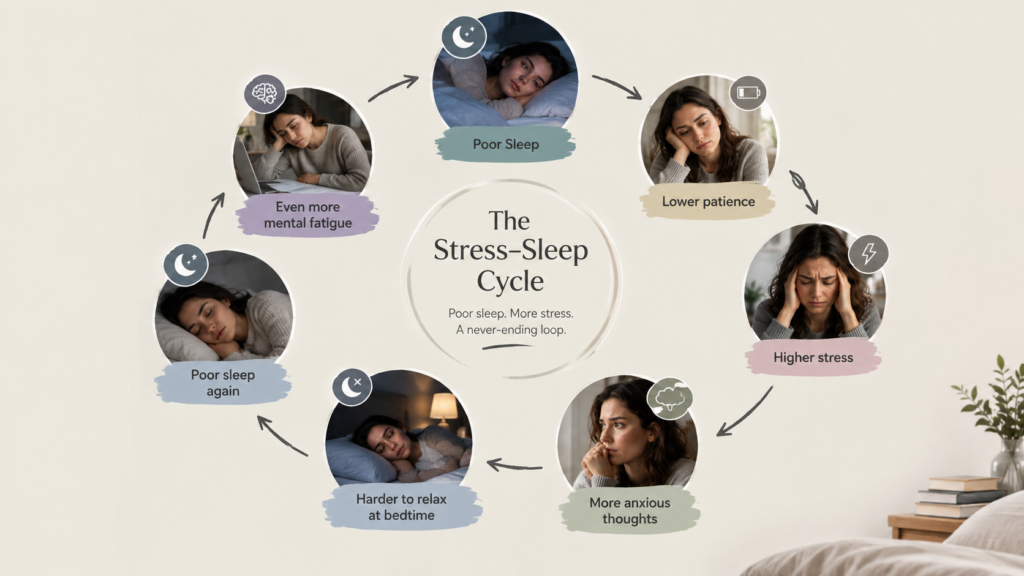
The longer this cycle continues, the more “normal” it begins to feel.
People often assume,
“This is just how I am now.”
But this isn’t your personality.
It’s often a sign that your brain hasn’t had the recovery it needs.
Sleep Also Affects Your Choices
One of the least talked-about effects of poor sleep is how it changes everyday decisions.
After sleeping well, choosing a healthy breakfast may feel easy.
Going for a walk after work feels realistic.
Cooking dinner feels manageable.
After poor sleep…
Fast food sounds more appealing.
Exercise feels impossible.
Scrolling your phone seems easier than reading a book.
Your brain naturally looks for the quickest source of comfort because it’s already running low on energy.
This doesn’t mean you lack motivation.
It means your brain is trying to conserve resources.
That’s why improving sleep often leads to healthier habits without relying solely on willpower.
If late-night scrolling has become part of your bedtime routine, our article How Constant Notifications Affect Your Mental Health explores how digital interruptions keep your brain alert long after you’re ready for bed.
Breaking the Cycle Starts Smaller Than You Think
When people feel stressed, anxious, and mentally exhausted, they often search for one dramatic solution.
A new planner.
A different productivity app.
A motivational book.
A complicated morning routine.
Those tools can be helpful.
But they often overlook something more fundamental.
Your brain doesn’t always need more strategies.
Sometimes it simply needs better recovery.
The encouraging news is that you don’t have to transform your life overnight.
Small improvements in sleep can gradually improve how you think, feel, and respond to everyday challenges.
One better night won’t erase months of stress.
But several weeks of better sleep can begin changing the way your brain experiences the world.
In the final part of this guide, you’ll learn practical, science-supported habits that help your brain recover more effectively each night. We’ll build a simple 60-minute evening routine, explore morning habits that improve sleep quality, and finish with practical answers to the questions people most often ask about sleep, stress, anxiety, and mental clarity.
Helping Your Brain Recover Every Night
By now, one thing should be clear.
Sleep isn’t simply about avoiding tiredness.
It’s one of the most powerful ways to support your mental health.
Every night, your brain has an opportunity to recover from the stress, emotions, decisions, and information it collected throughout the day.
The challenge is that many of us unintentionally make that recovery more difficult.
We work until bedtime.
Scroll through social media.
Reply to emails.
Watch “just one more episode.”
Then expect our brains to fall asleep the moment our heads touch the pillow.
Imagine asking a marathon runner to sprint right up until bedtime and then instantly relax.
It wouldn’t work.
Your brain is no different.
Just as your body benefits from slowing down before sleep, your mind also needs a gradual transition.
The good news?
You don’t need expensive gadgets or a complicated bedtime routine.
A few consistent habits can make a remarkable difference over time.
Build a 60-Minute Wind-Down Routine
Think of the hour before bed as your brain’s landing strip.
An airplane doesn’t suddenly drop out of the sky onto the runway.
It gradually slows down before landing safely.
Your brain needs the same gentle transition.
Instead of staying mentally busy until the last minute, create an evening routine that tells your mind:
“The day is ending. It’s safe to slow down now.”
Here’s a simple routine you can adapt to your lifestyle.
60 Minutes Before Bed: Dim the World Around You
Bright lights tell your brain it’s still daytime.
Whenever possible:
- Dim the lights in your home.
- Reduce screen brightness.
- Switch to warmer lighting.
- Avoid unnecessary work if possible.
This small change creates an environment that feels calmer and less stimulating.
Your surroundings influence your mind more than you might realize.
45 Minutes Before Bed: Put Your Phone Away
This is often the hardest step.
And for many people…
It’s also the most important.
Scrolling social media, checking emails, or reading stressful news keeps your attention active when it should be slowing down.
Instead of reaching for your phone, consider:
- Reading a few pages of a book.
- Listening to calming music.
- Stretching gently.
- Having a quiet conversation.
- Preparing for tomorrow.
You don’t have to avoid technology completely.
Simply give your brain a short period without new information.
If notifications regularly interrupt your evenings, our article How Constant Notifications Affect Your Mental Health explains why reducing digital interruptions before bed can improve both sleep quality and emotional well-being.
30 Minutes Before Bed: Help Your Mind Let Go
One reason people struggle to fall asleep is that tomorrow keeps showing up in today’s thoughts.
Tasks.
Appointments.
Conversations.
Things you forgot.
Things you’re worried about.
Instead of trying to remember everything, write it down.
Keep a notebook beside your bed.
Spend five minutes writing:
- Tasks for tomorrow.
- Things you’re grateful for.
- Thoughts you don’t want to carry into the night.
- Problems you’ll deal with in the morning.
This simple habit tells your brain:
“I don’t need to keep holding onto this tonight.”
Many people find that once their thoughts are on paper, their minds become noticeably quieter.
15 Minutes Before Bed: Slow Your Body to Calm Your Mind
Your body and mind are constantly communicating.
When your breathing becomes slower, your nervous system often follows.
You don’t need a complicated meditation practice.
Even a few minutes of intentional relaxation can help.
Try:
- Gentle stretching.
- Slow breathing.
- Progressive muscle relaxation.
- Quiet reflection.
- Guided mindfulness.
The goal isn’t to force sleep.
The goal is simply to stop asking your brain to solve problems.
If racing thoughts are keeping you awake, our article How to Calm Your Mind After a Difficult Day shares practical techniques for easing mental tension before bedtime.

Morning Habits That Improve Tonight's Sleep
Good sleep doesn’t begin at bedtime.
It begins the moment you wake up.
The choices you make throughout the day influence how easily your brain can recover that night.
Here are a few simple habits that support healthier sleep.
Get Morning Sunlight
Natural light soon after waking helps your body’s internal clock understand when the day has begun.
Even 10–20 minutes outside can help reinforce a more consistent sleep-wake rhythm.
Move Your Body
You don’t need an intense workout every day.
Walking.
Stretching.
Cycling.
Yoga.
Any regular movement helps your body build healthy sleep pressure by the evening.
Be Mindful With Caffeine
Coffee can be enjoyable and part of a healthy routine for many people.
However, consuming large amounts late in the afternoon or evening may make it harder for some people to fall asleep.
Pay attention to how your own body responds.
Keep a Consistent Wake-Up Time
Sleeping in for several hours on weekends may feel helpful in the moment.
But constantly changing your wake-up time can make it harder for your body to maintain a regular sleep pattern.
Consistency is often more valuable than perfection.
Sleep Is Part of Stress Management
When people think about managing stress, they often focus on what happens during the day.
Exercise.
Meditation.
Healthy eating.
Time management.
All of these are valuable.
But stress management also happens while you’re asleep.
A rested brain is generally better prepared to:
- Stay calm under pressure.
- Think clearly.
- Solve problems.
- Regulate emotions.
- Adapt to unexpected situations.
Sleep doesn’t eliminate challenges.
It improves your ability to meet them.
That’s why improving sleep is one of the most effective long-term investments you can make in your mental well-being.
Progress Is Better Than Perfection
You don’t need to sleep perfectly every night.
Everyone has difficult nights.
Travel.
Illness.
Stressful events.
Busy schedules.
Life happens.
What matters most is your overall pattern.
Instead of aiming for perfect sleep, aim for better sleep.
Going to bed 20 minutes earlier.
Reducing late-night scrolling.
Keeping a more consistent bedtime.
Creating a relaxing evening routine.
These small habits may seem insignificant on their own.
But repeated over weeks and months, they can make a meaningful difference to how you feel each day.
Final Thoughts
People often search for ways to become:
More productive.
More focused.
Less anxious.
Less overwhelmed.
More emotionally resilient.
Sometimes they look for a new planner.
A better app.
A different productivity system.
Another motivational video.
Those tools can certainly help.
But they all rely on one thing:
A brain that’s had enough opportunity to recover.
Sleep isn’t a luxury.
It isn’t wasted time.
It’s one of the most important investments you can make in your mental clarity, emotional balance, and ability to handle life’s challenges.
The quality of tomorrow doesn’t begin with your morning alarm.
It begins with the choices you make tonight.
So instead of asking,
“How can I get more done tomorrow?”
Try asking,
“How can I help my brain recover tonight?”
Because a well-rested mind doesn’t just feel better.
It thinks better.
Responds better.
Learns better.
Lives better.
Frequently Asked Questions
How does poor sleep affect stress?
Poor sleep reduces your brain’s ability to cope with everyday challenges. As a result, situations that normally feel manageable may seem more frustrating, emotionally draining, or overwhelming.
Can lack of sleep increase anxiety?
Yes. Many people notice that anxious thoughts become stronger after a poor night’s sleep. Sleep deprivation can make it harder to regulate emotions and keep worries in perspective.
Why do I feel mentally foggy after not sleeping well?
Your brain uses sleep to organize memories, restore energy, and prepare for the next day. Without enough quality sleep, concentrating, remembering information, and making decisions can become more difficult.
How many hours of sleep do adults generally need?
Most adults benefit from 7–9 hours of sleep per night, although individual needs can vary. Consistent, high-quality sleep is just as important as the total number of hours.
Can improving sleep help reduce stress naturally?
For many people, yes. Better sleep supports emotional regulation, improves resilience, and helps the brain respond more calmly to everyday challenges. While it isn’t a cure for stress, it’s an important part of managing it.
Why do I overthink more at night?
When the day becomes quiet, there are fewer distractions competing for your attention. If you’re already stressed or mentally overloaded, your thoughts may become more noticeable. A calming bedtime routine can help reduce this mental activity.
Does using my phone before bed affect sleep?
It can. Late-night scrolling, notifications, and mentally stimulating content may make it harder for your brain to relax before sleep. Creating a phone-free wind-down period often helps improve sleep quality.
What's the best bedtime routine for mental health?
A simple routine works well for most people: dim the lights, avoid unnecessary screen time, write down tomorrow’s tasks, practice gentle relaxation, and go to bed at a consistent time each night.
Can better sleep improve focus and memory?
Yes. During sleep, your brain strengthens memories, organizes information, and prepares for learning the next day. Consistent, restorative sleep supports clearer thinking, better concentration, and improved mental clarity.
When should I talk to a healthcare professional about sleep problems?
If you’ve had ongoing difficulty falling asleep, staying asleep, excessive daytime sleepiness, or poor-quality sleep for several weeks despite improving your sleep habits, it’s a good idea to speak with a qualified healthcare professional. Persistent sleep problems may sometimes be linked to an underlying sleep disorder or another health condition that deserves proper evaluation.

Art of Wellness Team is a collective of mental wellness writers and researchers focused on stress, anxiety, and mental clarity. We create practical, evidence-informed content to help readers better understand their mental well-being and build healthier habits for everyday life.






No Comment! Be the first one.