




It Feels Like Rest… Until You Put Your Phone Down
Table Of Content
- Scrolling Looks Like Rest
- Your Body May Be Resting While Your Attention Isn't
- Every Swipe Changes the Mental Context
- Why You Keep Swiping Even When You're Already Tired
- The "Just Five More Minutes" Problem
- Why You May Feel Mentally Foggy Afterwards
- Scrolling Can Become a Form of Mental Noise
- Not All Scrolling Is Equal
- Intentional scrolling
- Open-ended scrolling
- Purposeful viewing
- Endless consumption
- The Difference Between Entertainment and Stimulation
- Why Scrolling Can Feel Especially Draining When You're Already Stressed
- Sometimes You Don't Need More Content
- A Simple Question to Ask After You Scroll
- The Real Reason Scrolling Can Leave You Tired
- What Your Brain Is Doing While You Scroll
- 1. Your Brain Is Constantly Looking for What's Next
- 2. Every Swipe Creates a Tiny Attention Decision
- 3. Your Attention Keeps Changing Context
- 4. Your Brain Isn't Just Processing Information
- 5. Comparison Can Add Another Layer of Mental Work
- 6. Negative Content Can Keep Your Attention Longer
- 7. The Endless Feed Removes the Natural Stopping Point
- 8. Your Brain Gets Used to Rapid Novelty
- 9. Scrolling Can Create the Illusion of Multitasking
- 10. The Content Doesn't Have to Be Important to Be Stimulating
- 11. Why You Can Feel Mentally Full Without Learning Anything
- 12. Your Brain May Continue Processing the Feed After You Stop
- The Important Distinction: Stimulation vs. Recovery
- Stimulation might look like
- Recovery might look like
- Why You Reach for Your Phone When You're Already Exhausted
- A Better Question Than "How Much Do I Scroll?"
- Before scrolling
- During scrolling
- After scrolling
- The Problem May Not Be the Phone
- Your Brain May Be Asking for Less
- One Small Experiment
- The Bigger Picture
- The Signs Scrolling Is Leaving You Mentally Drained
- 1. Your Brain Feels Foggy After You Stop
- 2. You Feel Restless Instead of Relaxed
- 3. You Keep Thinking About What You Just Saw
- 4. You Start Comparing Your Life With Other People's
- 5. You Have Trouble Returning to What You Were Doing
- 6. You Feel Emotionally Tired, Not Just Mentally Tired
- 7. You Feel Tired but Still Want to Keep Scrolling
- 8. Silence Feels Uncomfortable
- 9. You Scroll During Other Activities Without Really Enjoying Either
- 10. You Reach for Your Phone Almost Automatically
- A Simple Check-In: How Do You Feel After Scrolling?
- Question
- Notice
- Not All Scrolling Has the Same Effect
- The Bigger Pattern: When Scrolling Becomes Your Default Escape
- How to Scroll Without Feeling Mentally Drained
- 1. Know Why You're Picking Up Your Phone
- 2. Give Scrolling a Natural Stopping Point
- 3. Don't Scroll Every Time You're Mentally Tired
- 4. Create a Transition After Scrolling
- 5. Make Your Feed Less Mentally Expensive
- 6. Stop Using Scrolling as the Default Break
- 7. Protect the First and Last Part of Your Day
- 8. Use the “One More Thing” Test
- 9. Replace the Habit, Not Just the App
- 10. Give Yourself Short Periods of “Nothing”
- Try This: The 10-Minute Mental Reset
- Minute 1 , Put the phone away
- Minutes 2–4 , Move
- Minutes 5–7 , Reduce input
- Minutes 8–10 , Choose what comes next
- The Goal Isn't Less Phone. It's More Recovery.
- Final Thoughts
- Frequently Asked Questions
You finally get a few minutes to yourself.
The work is done.
The dishes can wait.
Nobody needs anything from you right now.
So you pick up your phone.
You tell yourself:
“I’ll just scroll for five minutes.”
One video becomes another.
You see someone’s vacation.
Then a funny clip.
Then a health tip.
Then a news story.
Then someone’s opinion about something you hadn’t even thought about.
You swipe again.
And again.
Eventually, you look at the clock.
Thirty minutes have passed.
You put your phone down.
And instead of feeling refreshed, you notice something strange.
Your mind feels tired.
Maybe even a little foggy.
You don’t feel like doing anything.
You don’t particularly remember what you just watched.
And yet, a few seconds later, you have the urge to pick your phone up again.
If you’ve ever wondered:
“Why am I mentally tired after scrolling when I wasn’t even doing anything?”
You’re not alone.
The answer has less to do with physical effort and more to do with what happens to your attention during those minutes of scrolling.
Scrolling Looks Like Rest
From the outside, scrolling doesn’t look demanding.
You’re sitting down.
Your body isn’t moving much.
You don’t have to solve a complicated problem.
You’re not writing an important report.
You’re not having a difficult conversation.
You’re simply looking at your phone.
That’s why scrolling can feel like the perfect way to relax after a long day.
And sometimes, it can be.
Watching something you deliberately chose, talking to someone you care about, or enjoying content that genuinely makes you feel good isn’t automatically a problem.
The issue is open-ended scrolling.
You aren’t choosing one thing and settling into it.
You’re continuously moving from one thing to another.
Swipe.
New image.
Swipe.
New video.
Swipe.
New headline.
Swipe.
New opinion.
Swipe.
New emotional reaction.
The activity looks passive.
But your attention is constantly moving.
And that distinction matters.

Your Body May Be Resting While Your Attention Isn't
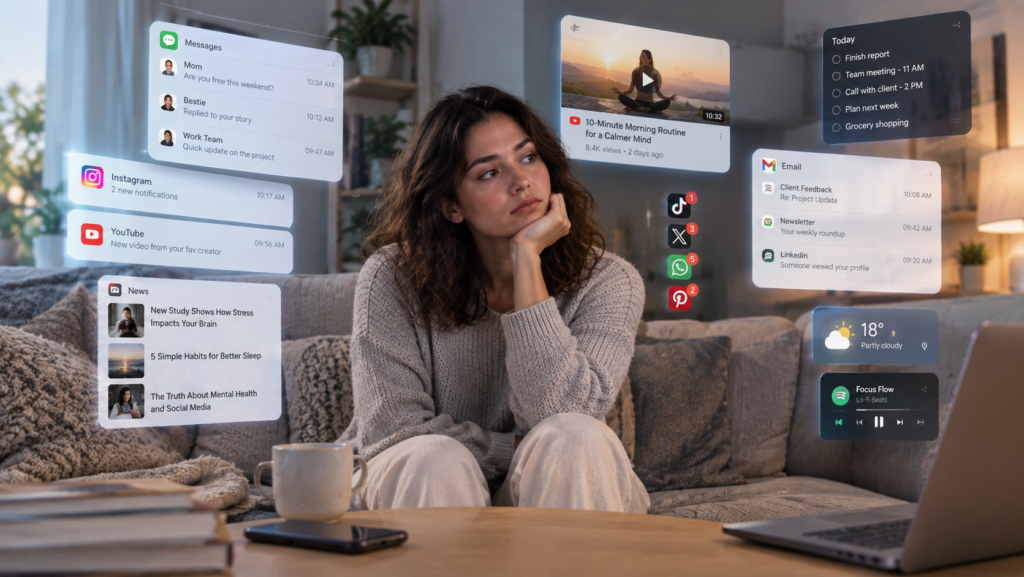
Think about the difference between sitting quietly in a comfortable chair and sitting in that same chair while someone keeps placing different objects in front of you every few seconds.
You aren’t physically doing anything.
But your attention has a job.
Look at this.
Understand that.
Ignore this.
React to that.
What’s this about?
Do I want to keep watching?
Should I swipe?
Should I read the comments?
Should I click?
What’s next?
Scrolling can create a similar pattern.
You’re physically still, but your mind keeps encountering new information.
That’s one reason you can finish a scrolling session feeling mentally tired even though you haven’t done anything physically strenuous.
Physical rest and mental rest aren’t always the same thing.
Every Swipe Changes the Mental Context
Imagine reading a book for 30 minutes.
You stay within one story.
The characters are connected.
The setting is familiar.
The information builds on itself.
Now compare that with a social media feed.
You might see:
A cooking video.
Then a relationship discussion.
Then a celebrity story.
Then a political argument.
Then a productivity tip.
Then someone’s bad day.
Then an advertisement.
Then a cute animal.
Then breaking news.
Your brain isn’t processing one continuous narrative.
It’s repeatedly adjusting to different contexts.
Different subjects.
Different emotions.
Different visual information.
Different voices.
Different expectations.
And then another swipe changes everything again.
That constant novelty is one reason scrolling can feel more mentally stimulating than it appears.

Why You Keep Swiping Even When You're Already Tired
Here’s the strange part.
You may know you’re tired.
You may even be bored with what you’re seeing.
Yet you keep scrolling.
Why?
Because there is always the possibility that the next piece of content will be more interesting.
The next video might be funny.
The next post might answer your question.
The next story might be useful.
The next image might make you feel something.
So you keep going.
This creates an endless loop:
See → evaluate → swipe → see → evaluate → swipe.
You don’t know what comes next.
And that’s exactly what keeps the activity going.
There is no natural ending.
A movie eventually finishes.
A chapter ends.
A conversation comes to a close.
An endless feed doesn’t have to.
There is always another swipe available.

The "Just Five More Minutes" Problem
You might start scrolling because you need a mental break.
That makes sense.
But there is a difference between choosing an activity that helps you recover and automatically consuming whatever appears next.
The first has intention.
The second has momentum.
You open the app.
The feed is already there.
You don’t have to decide what you want to see.
The platform gives you something.
You react.
Then it gives you something else.
You react again.
Before you know it, 30 minutes have passed.
And because there was no clear stopping point, you may not have consciously decided to spend that time there.
You simply continued.
Why You May Feel Mentally Foggy Afterwards
Have you ever finished scrolling and realized you can barely remember what you saw?
You remember the general feeling.
Maybe you saw some funny videos.
Maybe you read several interesting posts.
But ask yourself:
“What did I actually take away from those 30 minutes?”
Sometimes the answer is:
“Honestly, I don’t know.”
That’s because consuming information isn’t the same as deeply processing it.
A rapid feed gives you a succession of small pieces of information.
You see something.
Your attention responds.
Then it disappears.
Something else replaces it.
The previous item doesn’t necessarily get enough time or importance to become a meaningful memory.
So you can end up with a strange combination:
Lots of input.
Very little satisfaction.
And a tired mind.
Scrolling Can Become a Form of Mental Noise
Imagine being in a room where ten people are talking at once.
You aren’t necessarily listening carefully to any single person.
But your brain still notices the noise.
After an hour, you might feel exhausted.
Digital feeds can create a softer version of that experience.
You’re exposed to:
- Other people’s opinions
- Personal stories
- News
- Images
- Advice
- Advertisements
- Arguments
- Humor
- Emotional content
- New information
You don’t consciously process everything.
But your attention is repeatedly asked to notice and evaluate it.
Eventually, your mind can start feeling full.
Not because one particular post was overwhelming.
Because there were simply too many small inputs in succession.
Not All Scrolling Is Equal
This is important.
It would be too simplistic to say:
“Scrolling is bad for your brain.”
That’s not what this article is about.
The experience depends heavily on what you’re doing, why you’re doing it, and how you feel afterward.
For example:
Intentional scrolling
“I’m going to look at my friend’s recent photos.”
You find them.
You interact.
You leave.
There’s a clear purpose.
Open-ended scrolling
“I’ll just see what’s here.”
You keep swiping.
You don’t know what you’re looking for.
One piece of content leads to another.
There’s no clear stopping point.
Purposeful viewing
“I want to watch this 20-minute tutorial.”
You choose it.
You watch it.
You finish.
Endless consumption
“I’ll watch whatever comes next.”
The feed decides what happens next.
You simply continue responding.
These experiences may involve the same phone.
But mentally, they can feel very different.
The Difference Between Entertainment and Stimulation
There’s another distinction worth making.
Entertainment can be genuinely restorative.
You might watch a favorite comedy and feel better afterward.
You might send memes to a friend and laugh together.
You might watch a video about a hobby you genuinely enjoy.
The problem is not necessarily entertainment.
It’s the amount of continuous stimulation.
When one piece of information immediately replaces another, your brain doesn’t get much opportunity to settle.
That’s why you can sometimes say:
“I was relaxing for an hour, but somehow I feel more tired now.”
You were resting physically.
But your attention may have been working the entire time.
Why Scrolling Can Feel Especially Draining When You're Already Stressed
There’s an interesting pattern that many people experience.
You’re stressed.
You feel mentally exhausted.
So you scroll because you want to escape your thoughts.
For a few minutes, it works.
You’re distracted.
You aren’t thinking about your responsibilities.
You aren’t thinking about tomorrow.
You’re focused on the feed.
But eventually, the scrolling stops feeling refreshing.
Now you’re tired and overstimulated.
And because you haven’t actually addressed the need for recovery, you may pick up the phone again.
This can create a cycle:
Stress → scrolling → temporary distraction → continued stimulation → mental fatigue → more scrolling.
This doesn’t mean scrolling causes every episode of mental fatigue.
Stress, poor sleep, anxiety, work demands, and many other factors can contribute to feeling mentally drained.
But when scrolling becomes your automatic response to exhaustion, it can be useful to ask:
“Am I actually resting, or am I just distracting myself?”
Sometimes You Don't Need More Content
This is perhaps the most useful question to take away from this part.
When your mind feels tired, your instinct may be to consume something.
A video.
A podcast.
A post.
A news article.
Another self-improvement tip.
But sometimes your brain doesn’t need another thing to process.
It needs less.
Less information.
Less novelty.
Less switching.
Less comparison.
Less reacting.
Maybe what you actually need is five minutes looking outside a window.
A short walk.
A shower.
Stretching.
A cup of tea without your phone.
Music without another screen.
A conversation.
Or simply sitting somewhere quiet.
These activities may initially feel less exciting than scrolling.
That’s exactly the point.
Your brain isn’t always asking for entertainment.
Sometimes it’s asking for recovery.
A Simple Question to Ask After You Scroll
The next time you finish scrolling, don’t immediately judge yourself.
Instead, pause for ten seconds and ask:
“How do I feel right now compared with when I started?”
Do you feel:
- More relaxed?
- More connected?
- Happier?
- More informed?
- More energized?
Or do you feel:
- Mentally foggy?
- Restless?
- Irritated?
- Emotionally drained?
- Distracted?
- Like you need another break?
There isn’t one universal answer.
But your own pattern can tell you a lot.
If you repeatedly start scrolling because you’re tired and finish feeling even more mentally tired, that is worth noticing.
Your brain may not need another five minutes of content.
It may need a genuine pause.
The Real Reason Scrolling Can Leave You Tired
So, why do you feel mentally tired after scrolling?
Not because every swipe is secretly exhausting.
Not because using a phone automatically harms your mental health.
And not because you need to eliminate technology from your life.
The bigger issue is that endless scrolling repeatedly asks your attention to orient toward something new.
New image.
New idea.
New emotion.
New person.
New topic.
New decision.
Again and again.
Your body may barely move.
But your attention keeps moving.
And when that happens for long enough, you may finish the session feeling like your brain has been busy, even if you can’t explain exactly what it was busy doing.
What Your Brain Is Doing While You Scroll
We looked at why scrolling can feel like rest while still leaving you mentally tired.
Now let’s zoom in.
What is actually happening during those 20, 30, or 60 minutes of scrolling?
You’re sitting still. Your thumb is doing most of the physical work. There isn’t a difficult problem to solve.
Yet your attention is constantly moving.
Every swipe introduces something new.
And that creates a surprisingly busy environment for your mind.
1. Your Brain Is Constantly Looking for What's Next
Open an endless social media feed and you’ll notice something immediately:
You don’t know what is coming next.
Maybe the next post will be funny.
Maybe it will be useful.
Maybe it will be interesting.
Maybe it will be completely irrelevant.
So you swipe.
And then you evaluate what appears.
Interesting? Keep watching.
Not interested? Swipe.
Maybe useful? Save it.
Annoying? Move on.
Interesting but confusing? Read the comments.
Then another post appears.
And the process starts again.
This constant anticipation of something new is one reason scrolling can be difficult to stop.
You’re not simply consuming content.
You’re repeatedly asking your attention:
“Is this worth my attention?”
Then, seconds later:
“What about this?”
Then again:
“What comes next?”
That cycle can continue for as long as the feed does.
2. Every Swipe Creates a Tiny Attention Decision
Most of these decisions are so small that you barely notice them.
You don’t consciously think:
“I am now making another attentional decision.”
You simply swipe.
But your brain still has to respond to the new information.
A face appears.
Then text.
Then music.
Then a headline.
Then a product.
Then a personal story.
Then a joke.
Then something emotionally upsetting.
The content keeps changing.
Your attention has to keep adjusting.
This is different from reading a book for 30 minutes, where the information generally belongs to the same context.
With scrolling, you may experience dozens or hundreds of small shifts in a single session.
The effort of each individual shift is tiny.
The accumulation is what matters.
3. Your Attention Keeps Changing Context
Imagine you’re having ten different conversations at the same time.
One person is talking about relationships.
Another is discussing fitness.
Another is telling you about their vacation.
Someone else is arguing about politics.
Another person is giving you financial advice.
Then someone starts talking about a completely unrelated problem.
Even if you aren’t deeply engaging with every conversation, you’d probably feel mentally overloaded after a while.
Scrolling can create a digital version of this.
One post may be about cooking.
The next about anxiety.
The next about someone’s relationship.
The next about a celebrity.
The next about world events.
The next about productivity.
The next about something completely random.
Your brain keeps switching contexts.
And that’s one reason you may finish scrolling thinking:
“I saw so much, but I don’t actually remember much.”
4. Your Brain Isn't Just Processing Information
It’s also processing emotional signals.
This is particularly relevant when scrolling social media.
One moment you’re laughing.
The next you’re surprised.
Then you’re annoyed.
Then curious.
Then worried.
Then entertained.
Then comparing yourself with someone.
Then emotionally moved by a story.
You may experience all of these reactions within a few minutes.
That doesn’t mean every post has a profound emotional effect.
Most don’t.
But the constant movement between different emotional tones can make scrolling feel more mentally intense than you realize.
A feed isn’t carefully designed around one emotional state.
It’s a mixture.
And your attention has to keep adjusting.
5. Comparison Can Add Another Layer of Mental Work
Social media doesn’t simply show you information.
It shows you other people’s lives.
Someone is traveling.
Someone has finished a major project.
Someone looks incredibly fit.
Someone has a beautiful home.
Someone is celebrating an achievement.
Someone seems to have their life completely figured out.
Even when you consciously understand that social media presents a selective picture of reality, comparison can still happen automatically.
You might think:
“I should be doing more.”
“Why don’t I look like that?”
“Maybe I’m falling behind.”
“Everyone else seems to be doing so well.”
Now you’re no longer simply watching content.
You’re evaluating yourself in relation to it.
And that can make a scrolling session emotionally heavier.

6. Negative Content Can Keep Your Attention Longer
Not all content has the same emotional pull.
A neutral post may disappear from your mind immediately.
Something frightening, controversial, shocking, or emotionally upsetting may hold your attention much longer.
You might stop scrolling.
Read the comments.
Look for more information.
Search for another perspective.
Then return to the feed.
This is one reason doomscrolling can become particularly exhausting.
You may begin scrolling because you want a distraction.
Instead, you become absorbed in increasingly negative information.
Eventually, you stop because you’re tired.
But your mind may still be carrying some of what you just consumed.

7. The Endless Feed Removes the Natural Stopping Point
This may be one of the biggest differences between scrolling and many other forms of entertainment.
A book has pages.
A movie has credits.
A podcast has an ending.
A television episode finishes.
An endless feed doesn’t.
There is always another post.
That means you don’t naturally reach a point where the activity says:
“We’re done.”
Instead, you have to create the stopping point yourself.
And that can be surprisingly difficult when every swipe offers the possibility of something more interesting.
This creates a pattern:
Maybe the next one.
Then:
Maybe the next one.
Then:
Just one more.
Until you suddenly realize that you’ve been scrolling for much longer than you intended.

8. Your Brain Gets Used to Rapid Novelty
Imagine spending an hour moving through constantly changing content.
Every few seconds, something new appears.
Then you put your phone away and try to read something longer.
The experience feels slow.
You read a paragraph.
Nothing changes.
You read another.
Still nothing changes.
Your mind wanders.
You feel tempted to check your phone.
This doesn’t mean your attention has been permanently damaged.
But it illustrates an important behavioral principle:
What you repeatedly practice can become what your attention expects.
If you repeatedly give yourself rapid changes in information, slower activities may initially feel less stimulating.
That’s one reason rebuilding your ability to tolerate slower experiences can be useful.
9. Scrolling Can Create the Illusion of Multitasking
You may scroll while:
- Eating
- Watching television
- Talking to someone
- Taking a break
- Sitting in bed
- Working
- Waiting for something
Now your attention isn’t simply moving through one digital feed.
It’s moving between the feed and your physical environment.
Someone speaks.
You look at your phone.
The television changes.
You glance up.
A message arrives.
You check it.
Then you return to the video.
This creates another layer of attention switching.
You’re physically in one place while mentally moving between several sources of information.
That’s why putting the phone away during one activity can sometimes feel surprisingly calming.
You’re removing one competing stream.
10. The Content Doesn't Have to Be Important to Be Stimulating
This is an easy point to miss.
You might think:
“I was only watching funny videos. How could that make me mentally tired?”
Because mental stimulation isn’t limited to serious information.
Funny videos still require you to:
- Notice what’s happening
- Understand context
- Predict what comes next
- React emotionally
- Decide whether to continue
The same applies to memes, celebrity content, sports clips, cooking videos, tutorials, and countless other forms of entertainment.
Again, none of this automatically makes them harmful.
The point is simply that effortless physically doesn’t mean completely inactive mentally.
11. Why You Can Feel Mentally Full Without Learning Anything
This is perhaps the strangest part.
After an hour of scrolling, you may have consumed hundreds of pieces of information.
Yet you may not feel more knowledgeable.
You may not even remember most of it.
Instead, you feel:
full.
It’s similar to eating lots of small snacks without having a proper meal.
You’ve consumed plenty.
But you don’t necessarily feel satisfied.
Digital feeds can create a similar experience.
You’re constantly taking in small pieces of information without necessarily giving your mind enough time to engage deeply with any one of them.
So the result can be:
High input + low depth + little sense of completion.
And that combination can leave you feeling strangely unsatisfied.
12. Your Brain May Continue Processing the Feed After You Stop
Sometimes the scrolling session ends, but the mental activity doesn’t immediately stop.
You may suddenly remember something you saw.
A worrying headline.
Someone’s comment.
An argument.
A comparison.
A product you want.
A video you found interesting.
A question you want to search later.
The feed has moved on.
But your mind may still be carrying pieces of it.
This becomes particularly noticeable when you scroll shortly before trying to sleep.
Your body is in bed.
But your mind has just spent the last hour reacting to new information.
That doesn’t mean scrolling automatically causes poor sleep.
But if you notice that you feel mentally activated after late-night scrolling, that’s useful feedback.
Your evening may need more low-input time rather than more content.
The Important Distinction: Stimulation vs. Recovery
This brings us to the central idea of this article.
When you’re tired, you don’t always need stimulation.
Sometimes you need recovery.
Those are different things.
Stimulation might look like:
- Scrolling
- Watching short videos
- Checking news
- Reading comments
- Jumping between apps
- Consuming endless content
Recovery might look like:
- Taking a quiet walk
- Stretching
- Sitting outside
- Having a conversation
- Listening to calming music
- Taking a shower
- Reading slowly
- Doing something with your hands
- Simply being still
Neither category is automatically good or bad.
But if you repeatedly use stimulation when what you actually need is recovery, you may finish your “break” feeling more tired.

Why You Reach for Your Phone When You're Already Exhausted
There’s a reason this pattern can become so persistent.
When you’re mentally exhausted, making a complicated decision about how to relax can itself feel like work.
Your phone offers an immediate option.
You don’t have to plan anything.
You don’t have to decide what to do.
Just unlock it.
The content is already waiting.
Swipe.
Swipe.
Swipe.
That makes scrolling an extremely easy escape from uncomfortable feelings such as:
- Boredom
- Stress
- Loneliness
- Restlessness
- Overthinking
- Mental fatigue
The problem is that easy distraction isn’t always effective recovery.
You can successfully escape your thoughts for an hour and still end up needing rest.
A Better Question Than "How Much Do I Scroll?"
Instead of focusing only on the number of minutes, try asking:
“What happens to me while I’m scrolling, and how do I feel afterward?”
Notice the pattern.
Before scrolling
Are you bored?
Stressed?
Lonely?
Overwhelmed?
Tired?
Avoiding something?
During scrolling
Are you enjoying yourself?
Or are you automatically swiping?
Are you interested?
Or simply looking for something more interesting?
After scrolling
Do you feel:
Calmer?
Happier?
Connected?
Or:
Foggy?
Restless?
Irritated?
Mentally drained?
Your answers can tell you much more than a generic rule about screen time.
The Problem May Not Be the Phone
This is worth emphasizing.
If you feel mentally tired after scrolling, it doesn’t automatically mean you need to eliminate social media.
The more useful question is:
What role is scrolling playing in your life?
Is it something you deliberately enjoy?
Or is it what you automatically do whenever you have an uncomfortable moment?
Is it helping you recover?
Or helping you avoid being bored?
Is it connecting you with people?
Or leaving you comparing yourself with everyone?
Is it giving you something meaningful?
Or simply giving you something new?
Those distinctions matter.
Because the goal isn’t to make you afraid of your phone.
It’s to make your relationship with your attention more intentional.
Your Brain May Be Asking for Less
When scrolling leaves you mentally tired, the instinct is often to find another form of stimulation.
Maybe a different app will feel better.
Maybe another video.
Maybe a podcast.
Maybe another article about productivity.
But sometimes the solution isn’t finding better content.
It’s finding a period with no new content at all.
A few minutes where nothing is asking:
“Look at me.”
“Read this.”
“React to this.”
“Buy this.”
“Think about this.”
“Here’s what’s happening next.”
Just quiet.
That can feel strangely unfamiliar at first.
But it may be exactly the kind of break your attention has been missing.
One Small Experiment
Try this the next time you finish scrolling.
Don’t immediately open another app.
Put your phone down.
Wait for five minutes.
No podcast.
No television.
No news.
No replacement activity.
Just walk, sit, stretch, or look outside.
Then ask yourself:
“What was I actually looking for when I picked up my phone?”
Maybe you wanted entertainment.
Maybe connection.
Maybe distraction.
Maybe rest.
Maybe you were simply bored.
There isn’t a wrong answer.
The goal is to start recognizing the difference between what you reach for automatically and what actually helps you recover.

The Bigger Picture
Scrolling can be deceptively simple.
Your thumb moves.
Your eyes move.
The content changes.
And minutes disappear.
But underneath that simple behavior, your attention may be constantly evaluating new information, shifting contexts, reacting emotionally, comparing, deciding, and anticipating what’s next.
That’s why you can finish scrolling without having done anything physically demanding and still think:
“My brain feels exhausted.”
And once you recognize that pattern, you can start changing the experience, not by banning your phone, but by becoming more deliberate about when you scroll, what you’re looking for, and when it’s time to stop.
The Signs Scrolling Is Leaving You Mentally Drained
Sometimes the clearest clue isn’t how long you’ve been on your phone.
It’s how you feel after you put it down.
You may have started scrolling because you wanted a quick break. But instead of feeling refreshed, you notice that your mind feels foggy, restless, emotionally flat, or strangely tired.
And then, almost without thinking, you pick the phone up again.
That pattern can be easy to miss because scrolling doesn’t always feel tiring while you’re doing it. The exhaustion often becomes more noticeable when the stimulation stops.
Here are some of the signs worth paying attention to.
1. Your Brain Feels Foggy After You Stop
You close the app and suddenly realize you don’t feel refreshed at all.
You feel mentally blurry.
Maybe you were scrolling through short videos, posts, news, comments, or random recommendations. None of it seemed particularly demanding. Yet afterward, concentrating on something simple feels harder.
You might think:
“Why am I so tired? I wasn’t even doing anything.”
But your brain was still processing information, shifting attention, evaluating content, and responding to whatever appeared next.
This is one reason mental fatigue from scrolling can feel confusing.
Your body may have been sitting still while your attention was constantly moving.
2. You Feel Restless Instead of Relaxed
Another sign is that you don’t actually feel calmer after scrolling.
You feel stimulated.
You might put your phone down, walk around, change rooms, check something else, or immediately look for another source of entertainment.
This can happen because scrolling keeps your attention engaged through constant novelty.
Every few seconds, something new appears.
A different face.
A different opinion.
A different video.
A different problem.
A different joke.
A different piece of information.
Your brain doesn’t get much opportunity to settle.
So when you finally stop, the contrast can feel uncomfortable.
The strange part?
You may interpret that restlessness as a reason to keep scrolling.
But more stimulation isn’t necessarily the same thing as recovery.
3. You Keep Thinking About What You Just Saw
Sometimes the feed follows you after you close it.
You might remember a disturbing story.
Replay a conversation from a video.
Think about someone’s lifestyle.
Wonder about a comment.
Feel irritated by something you saw.
Or simply keep jumping mentally from one piece of content to another.
This is particularly noticeable when the content carries emotional weight.
Your brain doesn’t process every post in exactly the same way. Some information is emotionally neutral. Other information grabs your attention much more strongly.
And emotionally engaging content can be harder to simply switch off from.
This is one reason you can feel mentally tired after scrolling even when you weren’t consciously trying to think deeply.
4. You Start Comparing Your Life With Other People's
This is especially common when scrolling through highly curated social content.
You see someone’s holiday.
Someone’s relationship.
Someone’s career.
Someone’s home.
Someone’s body.
Someone else’s productivity.
Someone’s apparently perfect morning routine.
Most of the time, you know intellectually that you’re seeing a small and carefully selected part of someone’s life.
But knowing that doesn’t always prevent comparison.
Your mind can still ask:
“Am I doing enough?”
“Why doesn’t my life look like that?”
“Should I be further ahead?”
“What am I missing?”
The comparison itself becomes additional mental work.
And if you’re already stressed or emotionally tired, even small moments of comparison can feel heavier.
If you’ve noticed that social media leaves you questioning yourself more than before, that’s useful information, not a reason to criticize yourself.
5. You Have Trouble Returning to What You Were Doing
Here’s another surprisingly practical sign.
You open your phone for a few minutes.
Then you put it down and try to return to work.
But your mind doesn’t immediately come back with you.
You reread the same sentence.
Forget what you were about to do.
Switch between tasks.
Feel impatient with anything that requires sustained attention.
Or suddenly find your original task incredibly boring.
This doesn’t necessarily mean scrolling has permanently damaged your attention. It’s more useful to think about attention switching.
During an open-ended feed, your attention repeatedly moves from one stimulus to another.
Returning immediately to a slower, more demanding task can therefore feel like a sharp change in mental pace.
And that’s where the familiar cycle can begin:
Scroll → stop → struggle to focus → feel bored → scroll again.
6. You Feel Emotionally Tired, Not Just Mentally Tired
Not all scrolling fatigue feels like brain fog.
Sometimes it feels emotional.
You might finish scrolling and feel:
- Irritated
- Flat
- Overwhelmed
- Sad
- Anxious
- Envious
- Numb
- Mentally “full”
This can happen when your feed contains a rapid mixture of emotional experiences.
One moment you’re laughing.
The next you’re reading something upsetting.
Then you’re watching someone’s success.
Then you’re seeing an argument.
Then you’re consuming something frightening.
Then something entertaining.
Your brain has little control over the emotional sequence.
You aren’t necessarily processing these experiences deeply, but you’re still being exposed to them.
And if you’re already experiencing mental overload, that additional stream of emotional input may feel exhausting.
7. You Feel Tired but Still Want to Keep Scrolling
This is one of the most important signs.
You’re tired.
You know you’re tired.
You don’t even particularly enjoy what you’re seeing anymore.
But you keep swiping.
You tell yourself:
“Just one more.”
Then another.
Then another.
Eventually you’re scrolling without really remembering what you’ve seen.
This isn’t necessarily about lacking willpower.
Scrolling provides something extremely easy to access: continuous stimulation without requiring a clear decision about what to do next.
When you’re bored, stressed, lonely, mentally exhausted, or avoiding an uncomfortable thought, the feed gives you somewhere else to place your attention.
That’s why the question isn’t always:
“Why can’t I stop scrolling?”
Sometimes the better question is:
“What am I trying not to feel, think about, or experience right now?”
The answer might be boredom.
It might be stress.
It might be loneliness.
It might simply be that your brain doesn’t want to deal with the next task.
Understanding the reason can be more useful than blaming yourself.
8. Silence Feels Uncomfortable
Have you ever put your phone down and immediately felt the urge to pick it back up because the room suddenly seemed too quiet?
That’s worth noticing.
When your attention is repeatedly fed new information, silence can initially feel unusually empty.
You may reach for your phone while:
- Waiting for something
- Sitting alone
- Eating
- Standing in a queue
- Riding in a car
- Taking a short break
- Lying in bed
Every empty moment becomes an opportunity for stimulation.
Over time, you may become less comfortable simply allowing your mind to have nothing new to process.
But boredom isn’t necessarily a problem that needs to be eliminated.
Sometimes a quiet moment is exactly what your attention needs.
9. You Scroll During Other Activities Without Really Enjoying Either
You might watch television while scrolling.
Scroll while eating.
Scroll while talking to someone.
Scroll while waiting for a meeting.
Scroll while listening to a podcast.
The problem isn’t simply that you’re doing two things.
It’s that your attention is repeatedly divided.
You may not fully engage with either activity, yet both continue demanding pieces of your attention.
The result can be a strange feeling at the end:
“I spent an hour doing things, but I don’t feel like I actually did anything.”
That’s different from genuine rest.
A real break doesn’t have to be productive.
But it should give your attention somewhere quieter to go.
10. You Reach for Your Phone Almost Automatically
Perhaps the biggest clue is that you don’t consciously decide to scroll anymore.
Your hand simply reaches for the phone.
You unlock it.
Open the app.
Swipe.
You might not even remember what you originally intended to check.
This can happen because repeated behaviors become increasingly automatic.
A trigger appears:
Bored → phone.
Waiting → phone.
Stress → phone.
Awkward moment → phone.
Tired → phone.
Can’t sleep → phone.
The phone becomes the default response to almost every small gap in attention.
And when that happens, scrolling stops being something you deliberately choose and becomes something you automatically fall into.
A Simple Check-In: How Do You Feel After Scrolling?
Instead of obsessing over your daily screen-time number, try paying attention to the after-effect.
The next time you finish scrolling, pause for 30 seconds and ask:
Question
|
Do I feel calmer? |
|
Do I feel refreshed? |
|
Is my attention clearer? |
|
Do I feel satisfied? |
|
Am I ready to return to my task? |
|
How do I feel emotionally? |
Notice
|
Or more stimulated? |
|
Or mentally tired? |
|
Or scattered? |
|
Or do I want more? |
|
Or avoiding it? |
|
Neutral, positive, anxious, irritated, flat? |
There isn’t a correct answer.
You’re simply collecting information about your own experience.
And you may discover something important:
The problem isn’t necessarily that you scroll. It’s that certain kinds of scrolling leave you feeling worse afterward.
That distinction gives you something much more useful to work with.
Not All Scrolling Has the Same Effect
This is worth emphasizing because the goal isn’t to turn your phone into an enemy.
Scrolling through a few photos from friends may feel completely different from spending an hour jumping between emotionally intense videos.
Looking up something specific may feel different from opening an app with no particular intention.
Messaging someone you care about may feel different from repeatedly refreshing an endless feed.
The context, content, duration, intention, and emotional state you start with can all change the experience.
So rather than asking:
“Is scrolling bad?”
Try asking:
“Which kinds of scrolling actually leave me feeling better, and which leave me feeling mentally drained?”
That question is much more personal, and much more useful.
The Bigger Pattern: When Scrolling Becomes Your Default Escape
The most important thing to notice isn’t necessarily one long scrolling session.
It’s the pattern underneath it.
You feel stressed → you scroll.
You feel overwhelmed → you scroll.
You finish a difficult task → you scroll.
You don’t know what to do next → you scroll.
You feel uncomfortable → you scroll.
Then the scrolling leaves you mentally tired.
And because you’re mentally tired, you don’t feel like doing anything demanding.
So you scroll again.
This can quietly turn into a scrolling–fatigue loop.
Breaking that loop doesn’t require deleting every social media app or creating an unrealistic digital detox.
It starts by creating a small gap between the feeling and the automatic response.
Because once you can recognize why you’re reaching for your phone, you have more choices about what happens next.
And that’s where the solution begins.
How to Scroll Without Feeling Mentally Drained
The goal isn’t to stop using your phone.
And it doesn’t have to be a dramatic digital detox where you delete every app, turn off your Wi-Fi, and promise yourself you’ll never scroll again.
For most people, that isn’t realistic.
A more useful goal is to make scrolling more intentional and less exhausting.
The question becomes:
How can I use my phone without letting every spare moment automatically become another stream of stimulation?
Here are some practical ways to start.
1. Know Why You're Picking Up Your Phone
Before opening an app, take two seconds and ask:
“What am I here to do?”
Maybe you’re checking a message.
Looking something up.
Watching a specific video.
Checking an update.
That’s different from opening an app simply because you’re bored or uncomfortable.
You don’t have to stop yourself every time.
Just noticing your intention creates a small pause between the trigger and the behavior.
And sometimes that pause is enough to realize:
“Actually, I don’t need more stimulation right now.”
2. Give Scrolling a Natural Stopping Point
One reason endless feeds can be difficult to leave is that they don’t have an obvious ending.
There’s always another post.
Another video.
Another recommendation.
Another update.
So instead of relying entirely on willpower, create your own stopping point.
For example:
“I’ll scroll for 10 minutes.”
Or:
“I’ll watch five videos and then stop.”
Or:
“I’ll check this once, then put my phone away.”
The exact number isn’t important.
The important part is creating an ending where the app doesn’t provide one.
3. Don't Scroll Every Time You're Mentally Tired
This may be one of the most useful changes you can make.
When you’re exhausted, your brain naturally looks for something easy.
Scrolling provides exactly that.
But easy stimulation isn’t necessarily the same as recovery.
The next time you’re tired, experiment with doing something that requires less input, rather than different input.
Try:
- Sitting somewhere quiet
- Taking a short walk
- Stretching
- Drinking water
- Looking outside
- Taking several slow breaths
- Listening to calm music
- Closing your eyes for a few minutes
- Doing nothing for a moment
At first, doing nothing may feel strangely difficult.
That’s okay.
Your brain doesn’t always need something new.
Sometimes it needs space.
4. Create a Transition After Scrolling
If you’ve been scrolling for 20 or 30 minutes and immediately expect yourself to concentrate deeply, the transition can feel uncomfortable.
Instead, create a small reset.
Put the phone down.
Stand up.
Take a few breaths.
Walk around for a minute.
Drink some water.
Then return to your task.
This gives your attention a chance to shift gears rather than moving directly from rapid stimulation into focused work.
Think of it as an attention reset, not a productivity trick.
5. Make Your Feed Less Mentally Expensive
You don’t have complete control over what appears on a social platform.
But you usually have some control over what you follow, mute, hide, or interact with.
Pay attention to the accounts and content that consistently leave you feeling:
- Anxious
- Angry
- Inadequate
- Overstimulated
- Drained
- Distracted
That doesn’t mean you need to remove everything uncomfortable.
But if your entire feed repeatedly triggers emotional reactions, scrolling is unlikely to feel very restorative.
Your digital environment is still an environment.
It affects what your attention encounters.
6. Stop Using Scrolling as the Default Break
Imagine you finish a difficult task.
Your brain wants a break.
You automatically open social media.
Ten minutes later, you close it.
Then you return to work.
Then you repeat the process several times throughout the day.
You’ve technically taken breaks, but your attention may never have experienced much quiet.
Try replacing some scrolling breaks with genuinely low-input breaks.
For example:
Work → 5-minute walk → work
instead of:
Work → 5-minute scrolling → work
You don’t have to eliminate scrolling.
Just give your brain different types of breaks.
7. Protect the First and Last Part of Your Day
Morning and nighttime scrolling can be particularly easy to turn into open-ended sessions.
You wake up.
Check your phone.
See one thing.
Then another.
Then another.
Before you know it, your attention has already been pulled into dozens of different topics before your day has really begun.
At night, the pattern can be similar.
You’re tired and want to relax, so you start scrolling.
But instead of becoming quieter, your mind continues receiving new information.
You don’t need a perfect phone-free morning or evening.
Even a small boundary can help.
Try creating the first 15–30 minutes of your morning without scrolling.
And consider creating a similar buffer before bed.
If sleep, stress, and mental clarity are already connected for you, this can be especially useful. You can also explore our guide on How Sleep Affects Stress, Anxiety, and Mental Clarity for the bigger picture.
8. Use the “One More Thing” Test
This is a simple way to recognize when you’re no longer enjoying the experience.
Ask yourself:
“If I saw one more post right now, would I actually feel better?”
If the answer is no, that’s useful information.
You may not be enjoying the content anymore.
You may simply be continuing because stopping feels slightly uncomfortable.
That’s your cue to close the app.
Not because you’ve reached some perfect screen-time limit.
Because the experience has stopped giving you what you originally wanted.
9. Replace the Habit, Not Just the App
If you remove scrolling without replacing what it was doing for you, the empty space can be surprisingly uncomfortable.
So ask what scrolling was providing.
If you scroll when you’re bored:
Try music, a short walk, reading, or simply allowing yourself to be bored.
If you scroll when you’re stressed:
Try breathing, stretching, journaling, or stepping outside.
If you scroll when you’re lonely:
Message someone directly rather than consuming other people’s lives passively.
If you scroll when you’re avoiding work:
Take one tiny step toward the task instead of trying to finish everything.
If you scroll when your mind won’t stop:
Try a mental reset rather than adding more information.
This is where the habits from Simple Mental Wellness Routines That Actually Work can become useful. The goal isn’t to build a complicated routine. It’s to have a few alternatives ready when your brain automatically reaches for stimulation.
10. Give Yourself Short Periods of “Nothing”
This may be the hardest strategy, and one of the most valuable.
Sit for five minutes without:
- Scrolling
- Watching something
- Listening to something
- Checking messages
- Searching for information
Just let the moment exist.
At first, your mind may immediately say:
“This is boring.”
That’s fine.
You don’t have to make the experience productive.
Your attention doesn’t need to be occupied every second.
A quiet moment can be a form of recovery precisely because nothing new is demanding your attention.
Try This: The 10-Minute Mental Reset
The next time you notice that you’re mentally tired after scrolling, don’t immediately open another app.
Try this instead:
Minute 1 , Put the phone away
Place it somewhere slightly out of reach.
Not beside your hand.
Not face-down on your lap.
Actually create some distance.
Minutes 2–4 , Move
Stand up.
Stretch.
Walk around your room.
Look outside.
Let your body change position.
Minutes 5–7 , Reduce input
No phone.
No news.
No videos.
No multitasking.
Just allow your attention to settle.
Minutes 8–10 , Choose what comes next
Ask:
“What do I actually need right now?”
Maybe it’s food.
Rest.
Sleep.
A conversation.
A shower.
A walk.
A focused work session.
Or simply another five minutes of quiet.
The important part is that you choose, rather than automatically reaching for the next piece of content.

The Goal Isn't Less Phone. It's More Recovery.
It’s easy to reduce this entire conversation to:
“I should spend less time on my phone.”
But that’s not really the point.
You can spend 20 minutes scrolling and feel perfectly fine.
You can spend 10 minutes scrolling and feel mentally scattered afterward.
The more useful question is:
“Does the way I’m using my phone help me recover, or does it keep my attention switched on?”
That’s the distinction worth paying attention to.
Because your brain doesn’t only need entertainment.
It also needs periods when it isn’t being asked to evaluate, compare, react, choose, consume, and move on to the next thing.
Sometimes the best mental break isn’t another interesting video.
It’s nothing happening for a while.
Final Thoughts
Feeling mentally tired after scrolling doesn’t mean there’s something wrong with you.
And it doesn’t mean every minute spent on social media is harmful.
It may simply be a sign that your brain has been receiving more stimulation than it actually needed in that moment.
Scrolling can feel effortless because your body isn’t doing much.
But your attention may still be working.
You’re seeing.
Evaluating.
Switching.
Reacting.
Comparing.
Choosing.
Then doing it again.
And again.
And again.
The next time you finish scrolling and wonder why you feel strangely exhausted, don’t immediately blame yourself for having “wasted time.”
Pause instead.
Ask how you feel.
Ask what you were looking for.
And ask whether your mind needs more content, or less.
Sometimes that tiny moment of awareness is the beginning of a much healthier relationship with your screen.
Frequently Asked Questions
Why do I feel mentally tired after scrolling?
Scrolling exposes your attention to a continuous stream of changing information. Even when the activity feels effortless, your brain is repeatedly orienting toward new content and processing emotional or social signals. This can leave you feeling mentally drained afterward.
Why does scrolling make me feel tired but still want to continue?
Scrolling provides easy, continuous stimulation, which can make it appealing when you’re bored, stressed, lonely, or mentally exhausted. Feeling tired doesn’t necessarily remove the desire for stimulation. That’s why you can want to keep scrolling even when you’re no longer enjoying it.
Is scrolling actually a form of rest?
It can be relaxing in some situations, but scrolling isn’t always the same as mental rest. Your body may be physically inactive while your attention remains highly engaged. Quiet activities that involve less incoming information may provide a different kind of recovery.
Why do I feel foggy after looking at social media?
A rapidly changing feed can require frequent shifts in attention. If you’ve been consuming lots of different pieces of information, returning to a slower task may initially feel difficult. This can contribute to the experience of brain fog or mental fatigue.
Can scrolling increase mental overload?
It can contribute to mental overload when you’re already dealing with a high amount of information, stress, or competing demands. The issue isn’t simply the existence of a phone or social media. It’s the combination of ongoing stimulation and your existing mental load.
Why do I automatically check my phone when I'm stressed?
Your brain can learn to associate certain situations, such as boredom, stress, or waiting, with checking your phone. Over time, reaching for the phone can become an automatic response rather than a deliberate decision. Recognizing the trigger creates an opportunity to choose a different response.
Should I stop using social media completely if it makes me tired?
Not necessarily. A more practical approach is to notice which types of scrolling leave you feeling drained and which uses feel positive or purposeful. You can then introduce boundaries around the habits that consistently leave you feeling worse.
How can I stop scrolling when I'm already exhausted?
Start by making the stopping point easier rather than relying entirely on willpower. Put your phone out of reach, close the app, and give yourself a low-input alternative such as walking, stretching, or sitting quietly. The goal is to replace stimulation with actual recovery.
Why does silence feel boring after scrolling?
Fast-changing content can make quiet moments feel unusually empty by comparison. If you’re accustomed to filling every pause with stimulation, doing nothing may initially feel uncomfortable. Allowing short periods of boredom can help you become more comfortable with unoccupied attention.
How long should I take a break from scrolling?
There isn’t one universally necessary break length. Even a few minutes without new digital input can create a useful transition, especially when repeated throughout the day. Focus less on a perfect number and more on whether the break leaves you feeling calmer, clearer, and ready for what comes next.

Art of Wellness Team is a collective of mental wellness writers and researchers focused on stress, anxiety, and mental clarity. We create practical, evidence-informed content to help readers better understand their mental well-being and build healthier habits for everyday life.





No Comment! Be the first one.