




Have you ever had one of those days when your brain feels like it has too many tabs open at once?
Table Of Content
- What Is Mental Overload?
- Why Does Your Mind Feel So Overloaded?
- What Is Mindfulness?
- Mindfulness Isn't the Same as "Emptying Your Mind"
- Mindfulness Technique 1: The One-Minute Pause
- Mindfulness Technique 2: The 5-4-3-2-1 Grounding Exercise
- 5 things you can see
- 4 things you can physically feel
- 3 things you can hear
- 2 things you can smell
- 1 thing you can taste
- Mindfulness Technique 3: Mindful Breathing
- Mindfulness Technique 4: The "One Thing at a Time" Practice
- Mindfulness Technique 5: The STOP Technique
- S – Stop
- T – Take a Breath
- O – Observe
- P – Proceed
- Mindfulness Technique 6: Mindful Walking
- Mindfulness Technique 7: Mindful Eating
- Mindfulness Technique 8: Notice Your Thoughts Without Following Them
- Mindfulness Technique 9: Create a Digital Pause
- Mindfulness Technique 10: The Body Scan
- Common Mindfulness Mistakes to Avoid
- Trying to Stop All Your Thoughts
- Expecting to Feel Calm Every Time
- Practicing for Too Long Too Soon
- Turning Mindfulness Into Another Performance
- What If Mindfulness Makes You More Aware of Your Stress?
- What If You Don't Have Time for Mindfulness?
- Mindfulness and Mental Overload: What Really Helps?
- When Mental Overload May Need More Support
- Final Thoughts
- Frequently Asked Questions
You have emails to answer.
Messages waiting for a reply.
Work that needs to be finished.
A list of things you forgot to do.
Something you said earlier that you keep replaying.
Something happening tomorrow that you’re already worrying about.
And somewhere in the middle of all that, you realise you haven’t actually been fully present for anything.
You’re physically sitting at your desk.
But your mind is somewhere else.
Then somewhere else again.
And then somewhere else entirely.
If that sounds familiar, you may be experiencing mental overload.
It’s that feeling when your mind seems full, crowded, or simply unable to process one more thing.
You might find yourself thinking:
“I just need a break.”
But when you finally get one, your mind doesn’t actually switch off.
You pick up your phone.
Scroll through social media.
Check your messages.
Think about tomorrow.
Remember something you forgot.
And suddenly, your “break” has become another source of information for your already overloaded brain.
This is where mindfulness can be helpful.
Not as a magical way to empty your mind completely.
That’s not really the goal.
Instead, mindfulness can help you notice what’s happening right now without getting pulled into every thought that appears.
And sometimes, that small shift can make a surprisingly big difference.
In this guide, we’ll explore simple mindfulness techniques you can use when your mind feels crowded, scattered, or overwhelmed.
You don’t need to sit cross-legged for an hour.
You don’t need a perfectly quiet house.
And you don’t need to become an expert meditator.
You can start with a few minutes.
Sometimes, you can start with a few seconds.
Let’s begin by understanding what’s actually happening when your mind feels overloaded.
What Is Mental Overload?
Mental overload happens when the amount of information, decisions, responsibilities, and thoughts you’re trying to process feels greater than your ability to comfortably manage them.
Think about your brain like a computer.
You open one application.
Then another.
Then another.
Then another.
Eventually, everything starts slowing down.
Your computer isn’t necessarily broken.
It simply has too many things running at once.
Your mind can feel similar.
You’re trying to:
- Remember an appointment
- Finish a work project
- Respond to messages
- Make decisions
- Manage relationships
- Think about finances
- Plan the future
- Keep up with news
- Stay healthy
- Get enough sleep
And you’re expected to somehow do all of this while remaining calm and focused.
It’s no wonder your mind sometimes says:
“That’s enough.”
Mental overload isn’t always obvious.
Sometimes it looks like exhaustion.
Sometimes it’s irritability.
Sometimes it’s procrastination.
Sometimes you sit down to work and suddenly can’t remember what you were supposed to be doing.
You might read the same paragraph three times.
Open your phone without knowing why.
Walk into a room and forget what you came for.
Or spend 20 minutes trying to decide which tiny task you should do first.
If you’ve been experiencing persistent mental exhaustion, you may also want to read Mental Fatigue: Symptoms, Causes, and 10 Science-Backed Recovery Tips, which explores how prolonged mental demands can affect your energy, concentration, and everyday functioning.

Why Does Your Mind Feel So Overloaded?
There isn’t always one single reason.
Sometimes, mental overload comes from having too many responsibilities.
Sometimes, it’s caused by constant digital stimulation.
Sometimes, it’s the result of prolonged stress.
And sometimes, it’s simply the accumulation of dozens of small things that never get properly processed.
Think about how often your attention is interrupted during an average day.
Your phone vibrates.
An email arrives.
A notification pops up.
Someone sends you a message.
You check the news.
You switch between tasks.
Then you try to return to what you were doing.
Each interruption may seem insignificant.
But constantly shifting your attention can leave you feeling mentally scattered.
And when your brain doesn’t get enough uninterrupted time to rest and recover, even simple tasks can begin to feel overwhelming.
That’s why mental overload isn’t always about how much you’re doing.
Sometimes, it’s also about how often your attention is being pulled in different directions.
What Is Mindfulness?
At its simplest, mindfulness means paying attention to your present experience with greater awareness and without immediately judging it.
Right now, for example, you might notice:
The feeling of your feet against the floor.
The sound of something happening around you.
The sensation of your breathing.
The temperature of the room.
The thoughts moving through your mind.
The important thing is that you’re noticing.
You’re not necessarily trying to change anything.
You’re not trying to force yourself to feel happy.
You’re not trying to eliminate every thought.
You’re simply becoming aware of what’s happening right now.
That can be surprisingly difficult.
We’re often physically present in one place while mentally living somewhere else.
Your body is sitting at your desk.
Your mind is replaying yesterday.
Then worrying about tomorrow.
Then remembering something from last week.
Mindfulness gives you a way to gently return to the present.
And when your mind feels overloaded, that can be a useful place to start.
Mindfulness Isn't the Same as "Emptying Your Mind"
This is one of the biggest misconceptions about mindfulness.
You might think:
“I’m terrible at meditation because I can’t stop thinking.”
But here’s the thing.
You’re not supposed to stop thinking.
Your brain is designed to produce thoughts.
Even experienced meditators have thoughts.
The goal isn’t to create a completely blank mind.
Instead, mindfulness helps you notice when you’ve become caught up in a thought and then gently return your attention to the present.
Imagine you’re sitting beside a river.
Thoughts are like leaves floating past.
You notice one.
Then another.
You don’t have to jump into the river and follow every leaf downstream.
You can simply notice:
“There’s a thought.”
And let it pass.
Then you return your attention to what’s happening right now.
That skill can become particularly useful when you’re dealing with overthinking.
If your mind tends to get caught in repetitive thought loops, Overthinking at Night: Why Your Mind Won’t Switch Off explores why your thoughts may become especially active when you’re trying to rest.
Mindfulness Technique 1: The One-Minute Pause
Let’s start with something extremely simple.
You don’t need a meditation cushion.
You don’t need a timer.
You don’t even need to close your eyes.
Just stop for one minute.
That’s it.
Take a moment to notice:
What can I see?
Look around you.
Notice the colours, shapes, and objects in your environment.
Then ask:
What can I hear?
Maybe there’s traffic outside.
A fan running.
Someone talking.
Birds.
Or perhaps the room is quiet.
Now notice:
What can I feel?
Your feet touching the floor.
Your clothes against your skin.
The chair supporting your body.
Your hands resting somewhere.
Finally, notice your breathing.
Don’t change it.
Just observe it.
You have just spent one minute paying attention to the present moment.
That’s mindfulness.
And you can do it almost anywhere.
Try it:
- Before opening your laptop
- Between meetings
- While waiting for your coffee
- Before answering a difficult message
- When you feel your thoughts becoming scattered
The purpose isn’t to make your problems disappear.
It’s to give your mind a brief opportunity to stop chasing everything at once.

Mindfulness Technique 2: The 5-4-3-2-1 Grounding Exercise
If your mind feels particularly scattered or overwhelmed, try grounding yourself through your senses.
Look around you and identify:
5 things you can see
Notice their colours, shapes, and details.
4 things you can physically feel
Maybe your feet on the floor.
The texture of your clothing.
The chair beneath you.
The temperature of the air.
3 things you can hear
Listen carefully.
You might notice sounds you hadn’t been paying attention to.
2 things you can smell
Maybe coffee.
Fresh air.
Soap.
Or simply the scent of the room around you.
1 thing you can taste
Notice whatever sensation is present in your mouth.
There’s no need to rush.
Take your time.
This exercise works by deliberately shifting your attention away from the endless stream of thoughts in your head and toward what’s happening around you.
It’s particularly useful when you’re feeling mentally scattered or caught in a cycle of worry.
And if stress is a major reason your mind feels overloaded, you may also benefit from How Stress Affects Your Nervous System (And How to Calm It Naturally), which explains how prolonged stress can keep your body in a heightened state of alertness.
Mindfulness Technique 3: Mindful Breathing
You’ve already learned about breathing exercises in our guide Breathing Exercises to Reduce Stress and Anxiety, but mindfulness adds a slightly different element.
Instead of trying to change your breathing, simply observe it.
Sit comfortably.
Notice the sensation of air entering your nose.
Feel your chest or abdomen gently move.
Notice the air leaving your body.
That’s all.
Your mind will wander.
It might happen after three seconds.
That’s okay.
When you notice that you’ve become distracted, gently bring your attention back to your breath.
You don’t need to criticise yourself.
You don’t need to think:
“I’m terrible at this.”
Simply notice:
“My mind wandered.”
And return.
Then it happens again.
And you return again.
That’s the practice.
The moment you realise your mind has wandered isn’t a failure.
That’s the moment you’re actually practicing mindfulness.

Mindfulness Technique 4: The "One Thing at a Time" Practice
This might be one of the most useful techniques for modern life.
Because multitasking can feel productive.
But sometimes, it’s simply attention switching.
You’re answering an email while listening to a podcast.
Checking your phone while eating lunch.
Thinking about tomorrow while trying to finish today’s work.
Your attention is constantly divided.
So try something different.
Choose one activity.
And for the next few minutes, do only that.
If you’re drinking coffee, drink the coffee.
Notice the warmth of the cup.
The smell.
The taste.
The temperature.
If you’re walking, walk.
Notice your feet touching the ground.
The movement of your body.
The air around you.
If you’re working, work on one task.
Close unnecessary tabs.
Put your phone away.
Give that one task your attention.
You don’t have to do this all day.
Start with five minutes.
The goal is to remind your brain what focused attention feels like.

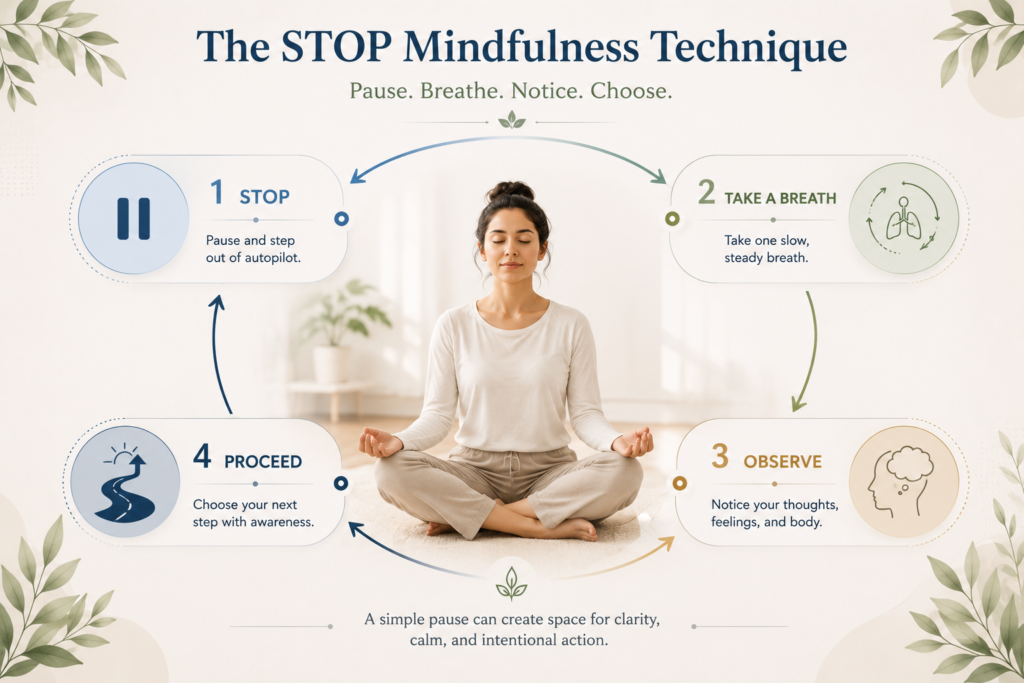
Mindfulness Technique 5: The STOP Technique
When your mind feels overloaded, you may feel like you need to keep moving.
Finish this.
Answer that.
Check your phone.
Reply to the message.
Start the next task.
But sometimes, the most helpful thing you can do is stop for a moment.
That’s exactly what the STOP technique encourages.
It stands for:
S – Stop
Pause whatever you’re doing.
You don’t need to solve anything yet.
Just stop.
T – Take a Breath
Take one slow, comfortable breath.
Notice the sensation of breathing.
O – Observe
Ask yourself:
What am I feeling right now?
What thoughts are running through my mind?
What sensations do I notice in my body?
You don’t need to judge your answers.
Just notice them.
P – Proceed
Now ask:
“What is the next helpful thing I can do?”
Not the next ten things.
Just the next one.
Maybe it’s answering an important email.
Maybe it’s taking a break.
Maybe it’s asking someone for help.
Maybe it’s doing absolutely nothing for five minutes.
The point is to create a small gap between your reaction and your response.
That gap can be incredibly valuable when you’re overwhelmed.
Mindfulness Technique 6: Mindful Walking
You don’t have to sit still to practice mindfulness.
In fact, if sitting quietly makes your mind feel even busier, walking may be a better place to start.
The next time you go for a walk, try leaving your phone in your pocket.
Don’t listen to a podcast.
Don’t scroll through messages.
Just walk.
Notice your feet touching the ground.
Feel the movement of your legs.
Notice the rhythm of your steps.
Pay attention to the air against your skin.
Look at what’s around you.
Notice the colours.
The sounds.
The movement.
If your thoughts wander, that’s okay.
Simply return your attention to your surroundings.
You might be surprised by how different a five-minute walk feels when you’re actually present for it.
And if you’re dealing with mental overload, movement can be particularly useful as a way to step away from your usual environment and give your attention a change of focus.
You don’t need to turn every walk into a mindfulness session.
Just occasionally, try walking without filling every second with information.
Let your mind breathe.
Mindfulness Technique 7: Mindful Eating
When was the last time you actually paid attention while eating?
Not eating while checking your phone.
Not eating while answering emails.
Not eating while watching television.
Just eating.
For your next meal or snack, try this.
Before taking your first bite, pause.
Look at your food.
Notice its colour and texture.
Take a moment to smell it.
Then take a bite.
Pay attention to the taste.
The texture.
The temperature.
Notice how your body responds.
You don’t have to eat slowly for an hour.
Even taking the first few bites mindfully can be enough to bring you back into the present.
This can also help break the habit of constantly consuming information while you’re consuming food.
Sometimes, your brain needs a break from input.
And a meal can be one of those natural pauses.

Mindfulness Technique 8: Notice Your Thoughts Without Following Them
This technique can be particularly helpful when your mind feels crowded.
Imagine you’re sitting quietly.
Suddenly, a thought appears:
“I need to reply to that email.”
Then another:
“Did I remember to pay that bill?”
Then:
“What if tomorrow’s meeting goes badly?”
Then:
“Why did I say that yesterday?”
One thought leads to another.
And before you know it, you’ve spent ten minutes mentally travelling through your entire life.
Instead of following each thought, try labelling it.
You might say:
“Planning.”
“Worrying.”
“Remembering.”
“Judging.”
Then gently return your attention to the present.
You don’t need to argue with the thought.
You don’t need to prove it wrong.
You don’t need to solve it.
Just notice it.
“That’s a thought.”
And let it pass.
This can be particularly useful if you tend to overthink.
You’re not trying to stop thoughts from appearing.
You’re practicing the skill of not automatically following every thought wherever it leads.
Mindfulness Technique 9: Create a Digital Pause
Let’s talk about something that contributes to mental overload for many people:
constant digital input.
Your phone is always nearby.
Notifications appear.
Emails arrive.
News updates change.
Social media feeds never end.
Even when you’re technically resting, your brain may still be processing information.
So try creating a small digital pause.
Choose one period of your day.
Maybe it’s:
- The first 15 minutes after waking up
- During your lunch break
- The last 30 minutes before bed
- While you’re having dinner
During that time, put your phone away.
Not face down beside you.
Away.
Give yourself permission not to respond immediately.
You might be surprised by how uncomfortable this feels at first.
That’s okay.
You may reach for your phone automatically.
Notice that urge.
Then pause.
Ask yourself:
“Do I actually need to check this right now?”
Sometimes the answer will be yes.
Sometimes it won’t.
The goal isn’t to reject technology.
It’s to remind yourself that you are allowed to choose when you give something your attention.
If your mind feels constantly tired from switching between tasks, notifications, and information, this small practice can be a surprisingly powerful starting point.

Mindfulness Technique 10: The Body Scan
Sometimes, mental overload isn’t just happening in your mind.
Your body may be carrying it too.
Your shoulders are tense.
Your jaw is tight.
Your forehead feels tense.
Your stomach feels uncomfortable.
You may not even realise how much tension you’re holding until you stop and check.
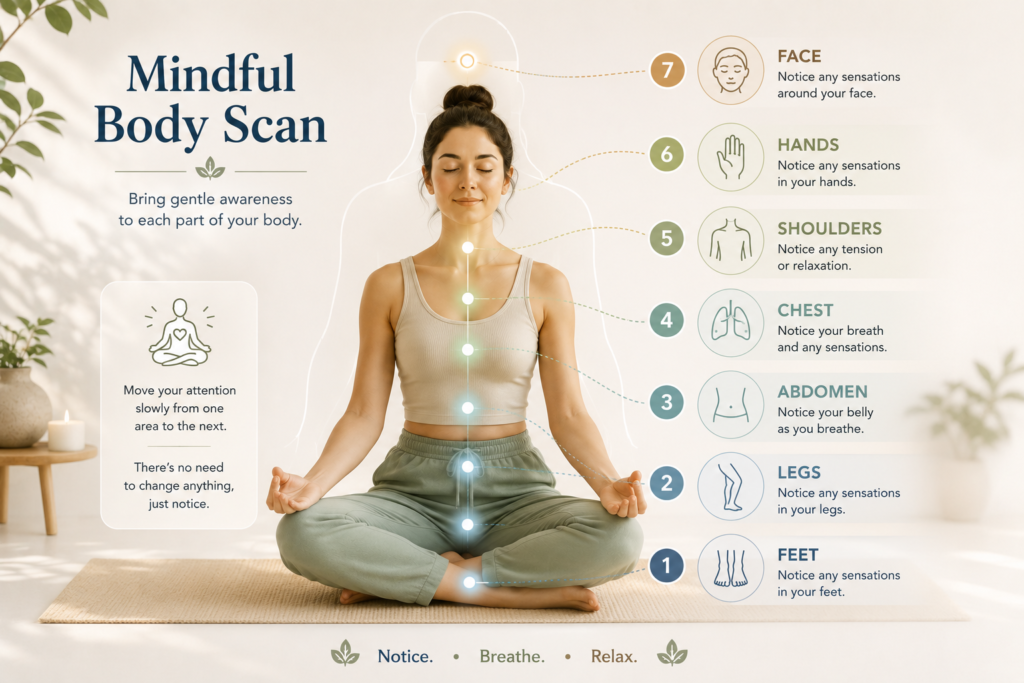
A body scan is a simple way to bring your attention back to physical sensations.
You can do it sitting or lying down.
Start with your feet.
Notice how they feel.
Then slowly move your attention upward.
Your ankles.
Your legs.
Your hips.
Your stomach.
Your chest.
Your shoulders.
Your arms.
Your hands.
Your neck.
Your face.
You don’t need to change anything.
Just notice.
If you find tension somewhere, see if you can soften that area slightly.
Relax your jaw.
Drop your shoulders.
Unclench your hands.
Take a comfortable breath.
Then continue.
This practice can help you notice the physical side of stress that you may otherwise ignore.
If you’ve been feeling physically and mentally exhausted for a long time, you may also want to explore How Stress Affects Your Nervous System (And How to Calm It Naturally) to better understand the relationship between prolonged stress and your body’s response.
Common Mindfulness Mistakes to Avoid
Mindfulness is simple.
But that doesn’t mean it’s always easy.
Here are a few mistakes that can make the practice feel more difficult than it needs to be.
Trying to Stop All Your Thoughts
Your brain will think.
That’s what it does.
Don’t measure your success by how empty your mind becomes.
Instead, notice how often you can recognise that you’ve become distracted and gently return your attention.
That’s the practice.
Expecting to Feel Calm Every Time
Sometimes mindfulness will feel calming.
Other times, you may notice how stressed you actually are.
You might become aware of tension you hadn’t noticed.
You might realise your thoughts are racing.
That isn’t necessarily a failure.
Awareness comes before change.
You can’t respond to something you haven’t noticed.
Practicing for Too Long Too Soon
If you’re new to mindfulness, you don’t need to start with a 30-minute session.
Start with one minute.
Then five.
If you enjoy it, gradually increase your practice.
There’s no need to rush.
Turning Mindfulness Into Another Performance
You don’t have to do it perfectly.
You don’t need the perfect meditation cushion.
You don’t need the perfect room.
You don’t need to sit in a particular position.
You don’t need to feel peaceful every time.
Mindfulness isn’t a performance.
It’s a practice of noticing.
What If Mindfulness Makes You More Aware of Your Stress?
This can happen.
Sometimes, we’re so busy that we don’t realise how much stress we’re carrying.
Then we finally stop.
And suddenly, we notice everything.
The tight shoulders.
The racing thoughts.
The exhaustion.
The worry we’ve been avoiding.
If this happens, don’t assume you’ve done something wrong.
You may simply be becoming more aware of what’s already there.
However, if mindfulness consistently increases your distress or makes you feel significantly worse, you don’t have to force yourself to continue.
Try something more grounding.
Take a walk.
Talk to someone you trust.
Listen to calming music.
Focus on your surroundings.
Or seek guidance from a qualified professional.
Mindfulness is a tool.
It isn’t something you have to tolerate if it consistently makes you feel unsafe or distressed.
What If You Don't Have Time for Mindfulness?
Let’s be realistic.
You may genuinely be busy.
You have work.
Family responsibilities.
Appointments.
Household tasks.
Life doesn’t always leave you with a peaceful hour to yourself.
That’s why mindfulness can be useful in small moments.
Try this:
While washing your hands:
Notice the temperature of the water.
While drinking coffee:
Notice the smell and taste.
While walking:
Notice your feet touching the ground.
While waiting for an elevator:
Take one slow breath.
Before sending a difficult message:
Pause for five seconds.
While eating lunch:
Put your phone away for the first few minutes.
These moments may seem tiny.
But they add up.
Mindfulness doesn’t always need to be something you schedule.
Sometimes, it’s simply a way of paying attention to the life you’re already living.
Mindfulness and Mental Overload: What Really Helps?
If your mind feels overloaded, mindfulness may help you create space.
But it’s worth asking a deeper question:
Why are you overloaded in the first place?
Maybe you’re saying yes to too many things.
Maybe you’re constantly connected to your phone.
Maybe you’re not getting enough sleep.
Maybe you’re trying to multitask all day.
Maybe you’re carrying emotional stress that you’ve never had the opportunity to process.
Maybe you’re simply exhausted.
Mindfulness can help you notice these patterns.
But noticing is only the beginning.
You may also need to make practical changes.
That could mean:
- Setting boundaries
- Taking genuine breaks
- Reducing unnecessary notifications
- Getting enough sleep
- Moving your body regularly
- Spending time with supportive people
- Asking for help when you need it
If you’re experiencing prolonged stress, Early Signs of Chronic Stress You Shouldn’t Ignore can help you recognise some of the signs that your body and mind may be asking for a change.
When Mental Overload May Need More Support
Everyone feels mentally overwhelmed sometimes.
A busy week.
A difficult project.
A stressful life event.
These experiences can temporarily make your mind feel crowded.
But if mental overload is becoming your everyday experience, it’s worth paying attention.
Consider seeking professional support if you’re consistently experiencing:
- Persistent anxiety or worry
- Significant difficulty concentrating
- Ongoing sleep problems
- Emotional exhaustion
- Loss of interest in things you usually enjoy
- Difficulty managing everyday responsibilities
- Feelings of hopelessness or helplessness
Mindfulness can be a helpful self-care tool, but it isn’t a replacement for professional mental health support.
You don’t have to wait until you’re completely overwhelmed to ask for help.
Sometimes, reaching out earlier can make it easier to understand what’s happening and find the right support.
Final Thoughts
Mental overload can make you feel as though your mind is constantly running.
One thought becomes another.
One task becomes five.
One notification leads to another.
And before you know it, you’ve spent the entire day reacting instead of actually being present.
Mindfulness won’t make your responsibilities disappear.
It won’t stop your phone from buzzing.
It won’t magically remove every stressful situation from your life.
But it can help you create something that often gets lost when you’re overwhelmed:
A moment of space.
Space to notice.
Space to breathe.
Space to think.
Space to choose what comes next.
And you don’t need to start with a complicated routine.
Start with one minute.
Put your phone down.
Notice your surroundings.
Feel your feet on the floor.
Take a breath.
Notice what’s happening in your mind.
Then come back to the moment you’re actually living.
Do it again tomorrow.
And the day after that.
Over time, these tiny pauses can become reminders that you don’t have to give your attention to every thought, every notification, or every demand that appears.
You can choose where your attention goes.
And when your mind feels overloaded, that choice can be a powerful place to begin.
You don’t have to clear your entire mind today.
You just have to give it a little more space to breathe.
Frequently Asked Questions
What is the best mindfulness technique for mental overload?
There isn’t one technique that works best for everyone. A simple starting point is the one-minute pause, mindful breathing, or the 5-4-3-2-1 grounding exercise. Try different approaches and see which one feels most natural and helpful for you.
Can mindfulness help with an overwhelmed mind?
Mindfulness may help you become more aware of your thoughts, emotions, and surroundings and reduce the tendency to become caught up in every thought. However, it doesn’t remove the underlying causes of mental overload. If you’re overwhelmed because of ongoing stress or excessive responsibilities, practical changes may also be necessary.
How long should I practice mindfulness each day?
You can start with just one to five minutes. There’s no requirement to practice for a specific amount of time. A short practice you can maintain consistently may be more realistic than a long routine that quickly becomes difficult to continue.
What should I do if I can't stop thinking during mindfulness?
You don’t need to stop thinking. Thoughts are a normal part of the experience. When you notice that your attention has wandered, simply acknowledge the thought and gently return your attention to your breathing, body, or surroundings.
Can I practice mindfulness while working?
Yes. Mindfulness can be incorporated into everyday activities. You can focus on one task at a time, pause between meetings, take a mindful walk, or spend a minute noticing your breathing before starting a new task.
Is mindfulness the same as meditation?
Not exactly. Meditation is one way to practice mindfulness, but mindfulness can also happen during everyday activities such as walking, eating, or washing dishes. The central idea is to pay attention to your present experience with greater awareness.
Can mindfulness reduce stress and anxiety?
Mindfulness may help some people manage stress and become more aware of anxious thoughts without immediately reacting to them. However, it isn’t a cure for anxiety disorders or a replacement for professional treatment when anxiety is persistent or significantly affects daily life.
Why does mindfulness sometimes make me feel more stressed?
When you slow down, you may become more aware of thoughts, emotions, or physical tension that were previously being ignored. If mindfulness consistently increases your distress, consider trying a shorter practice or a more externally focused grounding technique. If you’re struggling significantly, professional support may be appropriate.

Art of Wellness Team is a collective of mental wellness writers and researchers focused on stress, anxiety, and mental clarity. We create practical, evidence-informed content to help readers better understand their mental well-being and build healthier habits for everyday life.






No Comment! Be the first one.