


Have you ever noticed what happens to your breathing when you’re stressed?
Table Of Content
- Why Does Your Breathing Change When You're Stressed or Anxious?
- Can Breathing Exercises Really Help With Stress and Anxiety?
- Before You Start: A Few Things to Know
- 1. The Gentle Slow-Breathing Exercise
- 2. The 4–6 Breathing Technique
- 3. Box Breathing
- Why the Exhale Matters
- A Small Reminder About Breathing Exercises
- What If You Start Feeling More Anxious When You Focus on Your Breathing?
- Breathing Exercises to Reduce Stress and Anxiety
- 4. Diaphragmatic Breathing
- 5. The Physiological Sigh
- 6. Alternate-Nostril Breathing
- 7. Pursed-Lip Breathing
- 8. Resonant or Coherent Breathing
- Which Breathing Exercise Should You Try?
- If you’re feeling generally stressed
- If you need something to focus your attention
- If your breathing feels shallow or tense
- If you experience a sudden moment of tension
- If you enjoy meditation and mindfulness
- If you want a steady daily practice
- Breathing Exercises for Different Moments in Your Day
- Before checking your emails
- During a stressful workday
- Before an important meeting
- When you’re stuck in a worry spiral
- Before bed
- Don't Turn Breathing Into Another Task You Have to Perfect
- A Simple 2-Minute Breathing Routine to Start With
- A Note About Breathing and Anxiety
- When Breathing Exercises Aren't Enough
- How to Build a Simple Breathing Routine
- How Long Should You Practice Breathing Exercises?
- Common Breathing Mistakes to Avoid
- Trying to Take Extremely Deep Breaths
- Forcing Your Breath
- Worrying About Getting the Timing Perfect
- Holding Your Breath When It Feels Uncomfortable
- Expecting Instant Results
- What If Breathing Exercises Make You Dizzy?
- What If Your Anxiety Doesn't Go Away?
- When Breathing Problems Need Medical Attention
- A Simple Breathing Practice You Can Try Right Now
- The Bigger Picture: Breathing Is One Piece of Your Mental Wellness
- Final Thoughts
- Frequently Asked Questions
Maybe you start breathing a little faster.
Your chest feels tight.
You take a deep breath, but somehow it doesn’t feel satisfying.
Or perhaps you’re sitting at your desk, completely overwhelmed, and suddenly realise you’ve been holding your breath without even noticing.
It’s easy to overlook breathing because it’s something your body does automatically.
You don’t have to remind yourself to breathe.
You don’t have to set an alarm.
It just happens.
But here’s something interesting.
Although breathing happens automatically, you can also consciously change the way you breathe.
And that gives you a simple tool you can use when you’re feeling stressed, overwhelmed, or anxious.
You don’t need special equipment.
You don’t need an expensive app.
You don’t even need a quiet room.
Sometimes, all you need is a few minutes and a little awareness of your breath.
That doesn’t mean breathing exercises are a cure for anxiety or a replacement for professional treatment.
They’re simply one tool that may help you manage moments of stress and support a calmer state.
In this guide, we’ll explore 10 simple breathing exercises for stress and anxiety, how to practice them, and which techniques may be useful in different situations.
But before we get into the exercises, let’s talk about why breathing can change when you’re stressed in the first place.
Why Does Your Breathing Change When You're Stressed or Anxious?
Think about the last time you were suddenly startled.
Maybe someone slammed a door.
Maybe you received an unexpected phone call.
Or perhaps you were running late for something important.
What happened to your breathing?
Chances are, it changed.
Your breath may have become faster or shallower.
Your heart may have started beating more quickly.
Your muscles may have tightened.
You may have felt more alert.
That’s your body’s natural stress response.
When your brain perceives a threat or significant challenge, your nervous system can shift into a state of heightened alertness.
This is often described as the fight-or-flight response.
It’s an incredibly useful system.
If you were facing immediate physical danger, your body would need to respond quickly.
The problem is that your brain can activate this response to situations that aren’t physically dangerous.
A difficult email.
An upcoming presentation.
A stressful conversation.
A worrying thought.
A financial concern.
Your body may react as though it needs to prepare for action.
And your breathing can become part of that response.
If you’ve been experiencing prolonged stress, you may find How Stress Affects Your Nervous System (And How to Calm It Naturally) helpful for understanding the bigger picture of what’s happening inside your body.
Can Breathing Exercises Really Help With Stress and Anxiety?
This is where it’s important to be realistic.
Breathing exercises aren’t magic.
They won’t make every problem disappear.
They won’t solve the source of chronic stress.
And they aren’t a substitute for professional care when anxiety is persistent or severe.
But they can be useful.
Slow, controlled breathing may help you shift your attention away from racing thoughts and toward something happening in the present moment.
For some people, that simple change can create a sense of calm.
Think of it as pressing the pause button.
The stressful situation might still be there.
The difficult conversation might still need to happen.
The deadline hasn’t magically disappeared.
But you’ve given yourself a moment to stop, breathe, and respond rather than immediately react.
That’s often where breathing exercises can be most helpful.
Before You Start: A Few Things to Know
You don’t need to force your breathing.
In fact, trying too hard can sometimes make you feel more uncomfortable.
Instead, aim for breathing that feels:
- Slow
- Gentle
- Comfortable
- Natural
You should never feel like you’re struggling for air.
If a particular breathing exercise makes you dizzy, lightheaded, uncomfortable, or more anxious, stop and return to your normal breathing.
And if you have a respiratory condition or another health concern that affects your breathing, it’s a good idea to check with a healthcare professional before beginning new breathing practices.
The goal isn’t to breathe “perfectly.”
The goal is to become more aware of your breath and use it as a tool for relaxation.
1. The Gentle Slow-Breathing Exercise
Let’s start with the simplest technique.
You don’t need to remember a complicated pattern.
You don’t need to count perfectly.
You simply slow your breathing down and make your exhale slightly longer than your inhale.
Here’s how.
Sit comfortably.
Relax your shoulders.
Breathe in gently through your nose.
Then slowly breathe out.
Let your exhale feel comfortable and unforced.
Repeat for a few minutes.
That’s it.
This can be particularly useful when you’re feeling overwhelmed and don’t want to think about complicated instructions.
The important thing is to avoid taking exaggeratedly deep breaths.
Think slow and gentle, rather than big and forceful.
Try this when:
- You’re feeling overwhelmed at work.
- Your thoughts are racing.
- You’re dealing with a stressful conversation.
- You need a moment to reset.
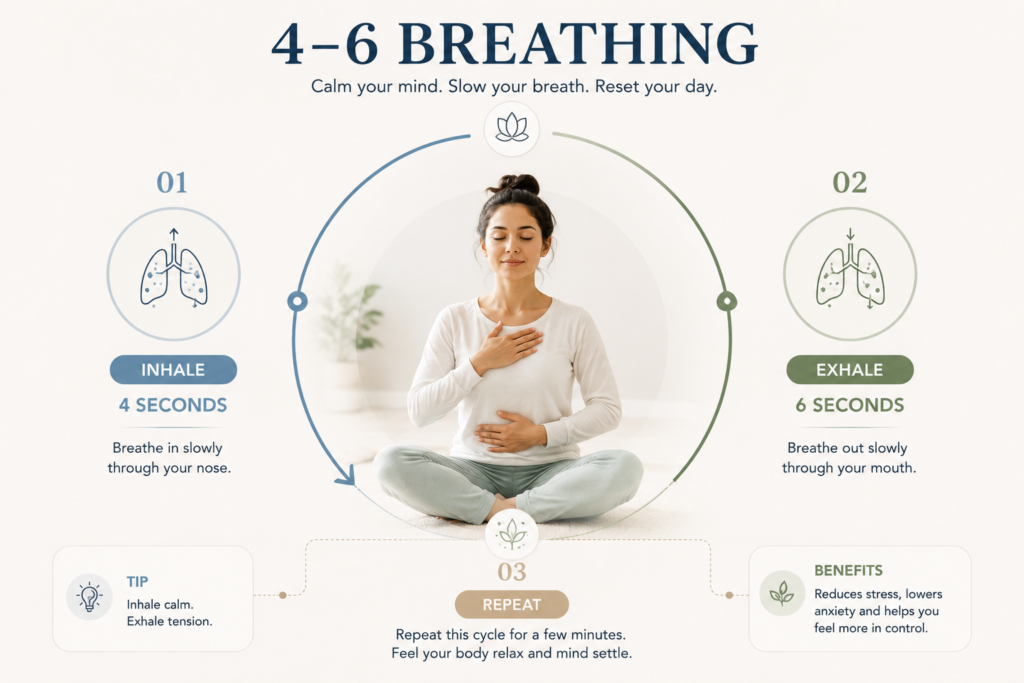
2. The 4–6 Breathing Technique
This is a simple variation of slow breathing.
The idea is to inhale for approximately four seconds and exhale for approximately six seconds.
Here’s what it looks like:
Inhale: 1…2…3…4
Exhale: 1…2…3…4…5…6
Then repeat.
You don’t have to follow the numbers exactly.
If four seconds feels too long, shorten it.
If six seconds feels uncomfortable, make the exhale shorter.
The goal is simply to create a comfortable rhythm where the exhale is a little longer than the inhale.
Try practicing for two to five minutes.
You may find this useful when your body feels tense or your mind is moving too quickly.
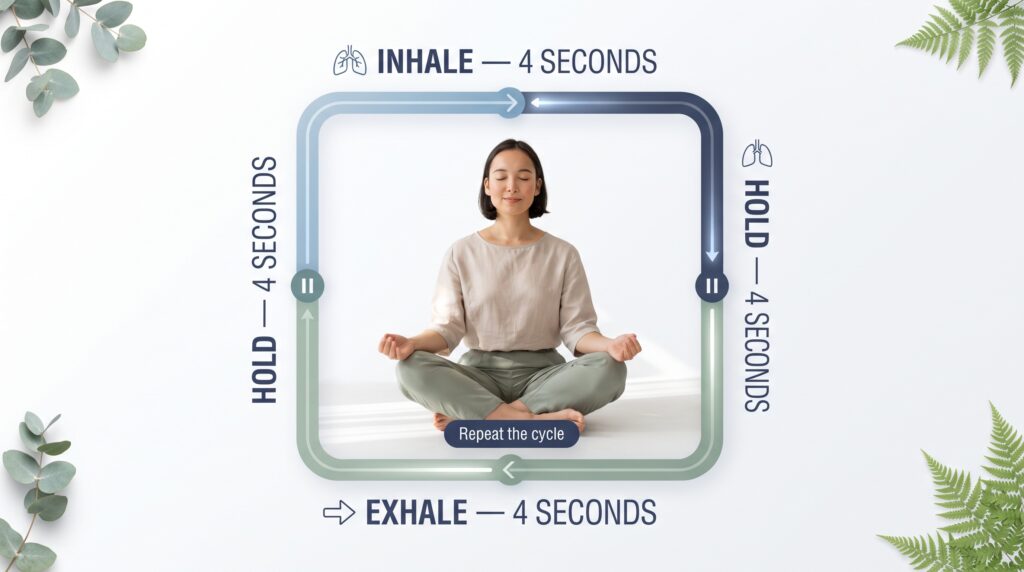
3. Box Breathing
You’ve probably heard of box breathing before.
It’s sometimes called square breathing because the technique uses four equal parts.
The basic pattern is:
Inhale for 4 seconds.
Hold for 4 seconds.
Exhale for 4 seconds.
Hold for 4 seconds.
Then repeat.
Imagine drawing a square in your mind.
Each side represents one part of the breathing pattern.
This technique can give your mind something specific to focus on.
And that can be useful when you’re feeling distracted or overwhelmed.
For example, instead of thinking:
“What if this goes wrong?”
Your attention becomes:
“Breathe in… hold… breathe out… hold.”
You’re giving your mind a simple task in the present moment.
However, breath-holding isn’t comfortable for everyone.
If holding your breath makes you feel anxious, dizzy, or uncomfortable, don’t force it.
You can simply return to gentle breathing or try a technique that doesn’t involve holding your breath.
Why the Exhale Matters
You may have noticed something about the first two techniques.
Both involve a relatively gentle inhale followed by a longer or slower exhale.
There’s a reason these techniques are popular.
The exhale is closely connected to the body’s relaxation response, and slow breathing practices may influence autonomic nervous system activity.
The science is still evolving, and breathing exercises shouldn’t be presented as a cure for anxiety.
But research into slow-paced breathing suggests that it may have beneficial effects on measures related to stress and autonomic regulation.
That’s why many people find slow breathing useful as part of a broader stress-management routine.
Think of it as one piece of the puzzle.
Not the entire solution.
If you’re dealing with persistent stress, breathing exercises work best alongside other supportive habits, such as regular movement, quality sleep, and healthy boundaries.
A Small Reminder About Breathing Exercises
You might be tempted to think:
“If breathing exercises work, why do I still feel anxious?”
That’s an important question.
The answer is that breathing exercises aren’t designed to erase every difficult emotion.
You can still feel anxious after breathing slowly.
You can still feel stressed.
You can still have problems that need solving.
And that’s okay.
The purpose is to create a little more space between what you’re feeling and how you respond.
Sometimes, that space is enough to help you think more clearly.
You may decide to take a walk instead of sending an angry message.
You may realise you need to ask for help.
You may notice that you’re exhausted and need rest rather than pushing yourself harder.
Breathing doesn’t necessarily change the situation.
It can simply help you meet the situation from a slightly calmer place.
And sometimes, that’s exactly what you need.
What If You Start Feeling More Anxious When You Focus on Your Breathing?
This can happen.
And if it does, you’re not doing anything wrong.
For some people, paying close attention to their breathing can initially make them more aware of physical sensations.
If you’re already anxious, you might suddenly notice your heartbeat.
Your chest.
Your breathing pattern.
And that awareness can feel uncomfortable.
If this happens, don’t force yourself to continue.
Try shifting your attention outward instead.
Look around the room.
Notice five things you can see.
Listen for sounds around you.
Feel your feet against the floor.
You can also try taking a gentle walk.
The goal is not to “master” breathing exercises.
It’s to find a technique that helps you feel more grounded.
And sometimes, that means choosing a different approach.
Breathing Exercises to Reduce Stress and Anxiety
Above, we covered three simple techniques:
- Gentle slow breathing
- 4–6 breathing
- Box breathing
Now let’s explore a few more.
The important thing to remember is that you don’t need to practice all 10 techniques.
In fact, you probably shouldn’t.
Think of these exercises as a small toolbox.
You can try different techniques and notice which ones feel most comfortable for you.
One might work well when you’re stressed at work.
Another might help you settle down before bed.
And another might be useful when your thoughts suddenly start racing.
Let’s continue.
4. Diaphragmatic Breathing
You’ve probably heard someone say:
“Take a deep breath from your belly.”
That’s essentially what diaphragmatic breathing encourages.
Instead of focusing on lifting your chest as you breathe, you allow your diaphragm to do more of the work.
Here’s a simple way to practice.
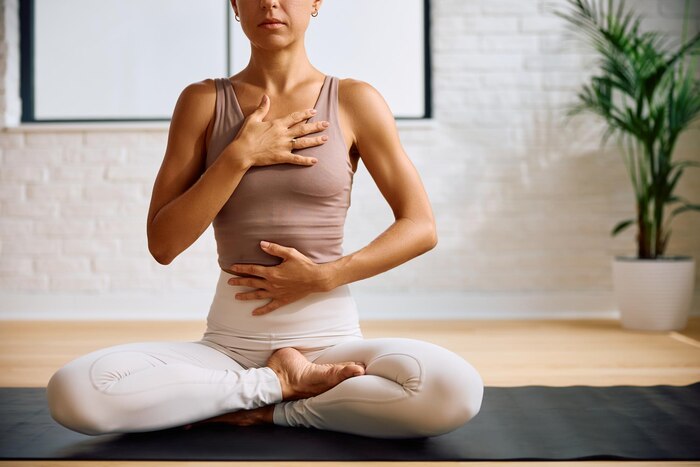
Lie down comfortably or sit with your back supported.
Place one hand on your chest.
Place your other hand gently on your abdomen.
Now breathe in slowly through your nose.
Try to allow the hand on your abdomen to rise gently while the hand on your chest remains relatively still.
Then breathe out slowly.
Don’t force your stomach outward.
Don’t try to take the biggest breath possible.
Just allow the breath to feel natural and comfortable.
Practice for a few minutes.
This technique can be particularly helpful when you notice that your breathing has become shallow or tense.
You might try it:
- After a stressful day
- During a quiet break
- Before going to sleep
- While lying down and relaxing
The goal is to become more aware of how you’re breathing and encourage a slower, more comfortable pattern.
5. The Physiological Sigh
Here’s an interesting technique you may have heard about recently.
The physiological sigh involves taking two inhales followed by a long exhale.
The basic pattern is:
Take one inhale through your nose.
Then take a second, shorter inhale.
Then slowly exhale through your mouth.
You can think of it as:
Inhale → Small second inhale → Long exhale
Repeat once or twice.
The technique has attracted attention because of research exploring how certain breathing patterns may influence physiological arousal and stress.
But here’s the important part:
You don’t need to force the technique or repeat it excessively.
If it feels uncomfortable, simply return to your normal breathing.
This can be a quick technique to try when you feel a sudden surge of tension and want to pause for a moment.
For example, perhaps you just received an upsetting message.
Or you’re about to walk into a difficult meeting.
Or you notice that your body suddenly feels tense.
One or two gentle cycles may give you a moment to pause before responding.
6. Alternate-Nostril Breathing
This technique comes from traditional yogic breathing practices and is sometimes known as Nadi Shodhana.
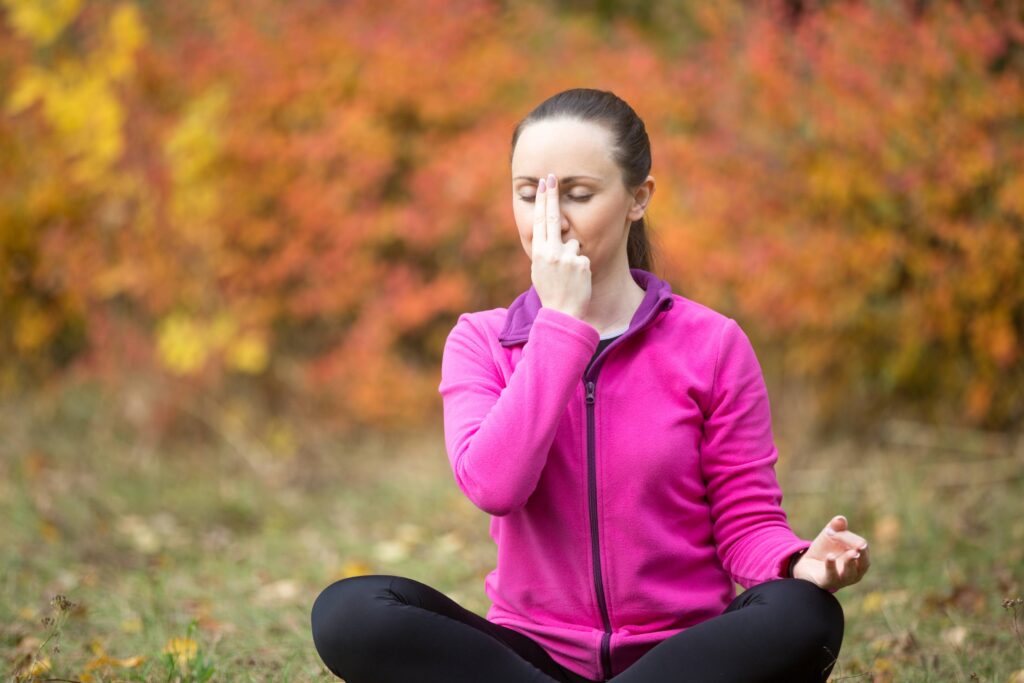
The basic practice involves gently breathing through one nostril at a time in an alternating pattern.
A simplified version looks like this:
- Sit comfortably.
- Close one nostril gently with a finger.
- Breathe in slowly through the open nostril.
- Switch sides.
- Breathe out through the other nostril.
- Breathe in through that same side.
- Switch again.
- Exhale through the opposite nostril.
Continue for a few comfortable rounds.
You don’t need to rush.
And you don’t need to force yourself to hold your breath.
If the technique feels confusing, start with just a few gentle cycles.
Some people enjoy alternate-nostril breathing as part of a mindfulness or meditation routine because it gives the mind something specific to focus on.
If you’re interested in incorporating breathing into a broader mental wellness practice, you may also enjoy Simple Mental Wellness Routines That Actually Work, which explores small habits that can support your emotional wellbeing without making your routine feel overwhelming.
7. Pursed-Lip Breathing
This is another simple technique that focuses on making the exhale slower and more controlled.
Here’s how to try it:
Breathe in gently through your nose.
Then purse your lips as though you’re slowly blowing out a candle.
Exhale slowly through your gently pursed lips.
Try to make the exhale longer than the inhale, without forcing it.
Repeat for several breaths.
This technique is often taught in respiratory care for certain breathing difficulties, so it’s important not to assume that it is appropriate for everyone or that it treats anxiety directly.
However, the basic pattern of slowing and controlling your exhalation can be a useful breathing practice for some people.
If you have a lung condition or regularly experience shortness of breath, speak with a healthcare professional about which breathing exercises are appropriate for you.
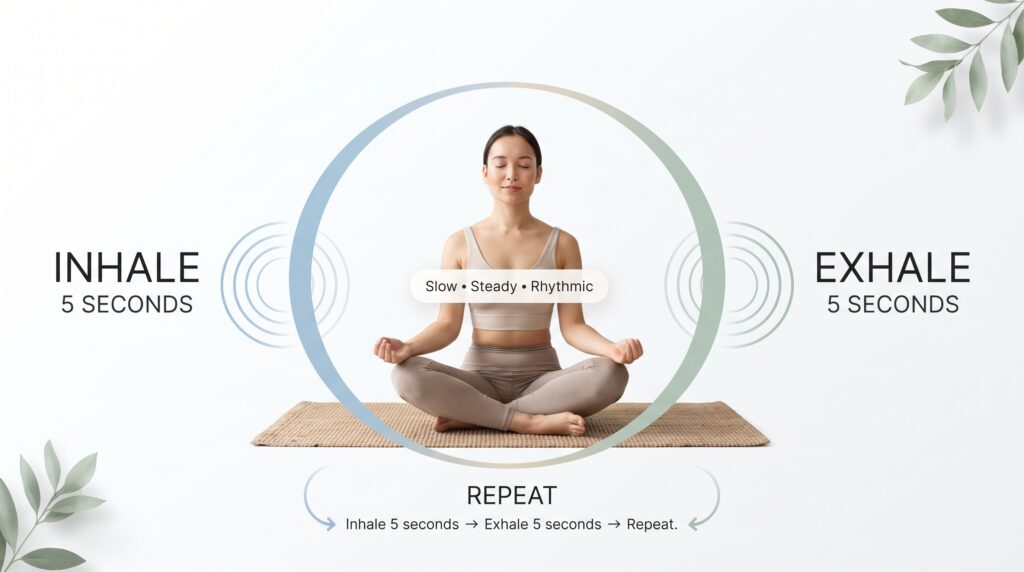
8. Resonant or Coherent Breathing
This technique involves slowing your breathing to a steady, comfortable rhythm.
A commonly used pattern is approximately five to six breaths per minute, although the ideal pace can vary between individuals.
One simple approach is:
Inhale gently for about 5 seconds.
Exhale gently for about 5 seconds.
Repeat.
Again, these numbers aren’t a strict requirement.
If five seconds feels too long, shorten it.
The most important thing is to avoid forcing your breath.
You should feel comfortable throughout the exercise.
This can be a useful practice when you have a few quiet minutes available.
Try it while:
- Sitting at your desk
- Taking a break from work
- Sitting outdoors
- Preparing for meditation
- Winding down in the evening
Think of it as creating a steady rhythm that your attention can gently follow.
Which Breathing Exercise Should You Try?
At this point, you might be thinking:
“Okay, but which one should I actually do?”
That’s a fair question.
Here’s a simple starting point.
If you’re feeling generally stressed:
Try gentle slow breathing or 4–6 breathing.
These are simple and don’t require you to remember a complicated pattern.
If you need something to focus your attention:
Try box breathing.
The structured pattern gives your mind something specific to follow.
If your breathing feels shallow or tense:
Try diaphragmatic breathing.
Spend a few minutes simply noticing how your breath moves through your body.
If you experience a sudden moment of tension:
Try one or two physiological sighs and then return to normal breathing.
If you enjoy meditation and mindfulness:
Try alternate-nostril breathing.
It can become part of a larger relaxation routine.
If you want a steady daily practice:
Try resonant or coherent breathing at a comfortable pace.
Remember:
The best breathing exercise is the one you can practice comfortably and consistently.
You don’t need to find the “perfect” technique.
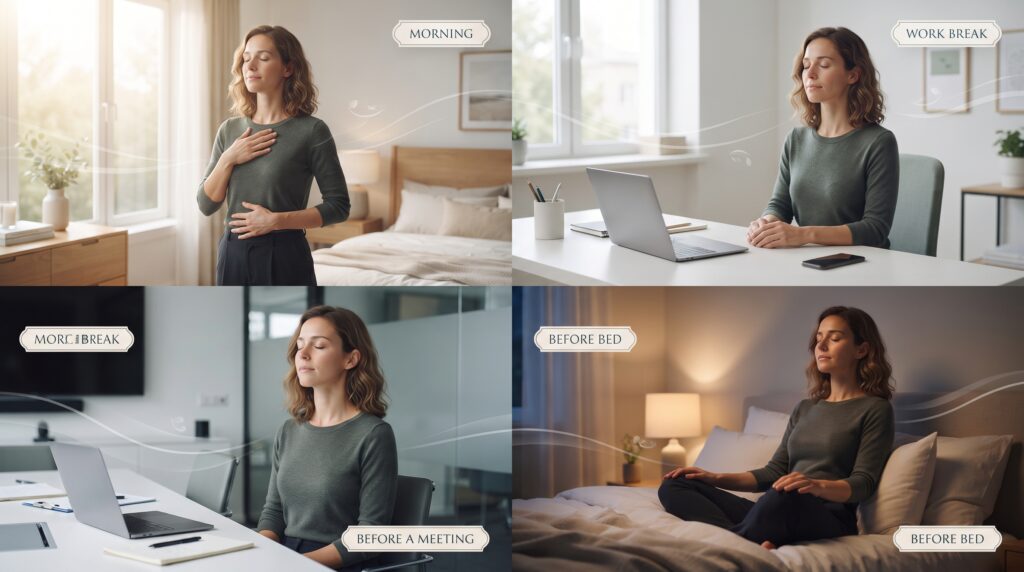
Breathing Exercises for Different Moments in Your Day
One of the easiest ways to make breathing exercises a habit is to connect them with something you already do.
For example:
Before checking your emails
Take five slow breaths.
This gives you a moment to pause before starting your workday.
During a stressful workday
Try two minutes of 4–6 breathing.
Step away from your screen if possible.
Before an important meeting
Take a few gentle breaths and relax your shoulders.
You don’t need to perform a long meditation.
Just pause.
When you’re stuck in a worry spiral
Try slow breathing while noticing your feet against the floor.
Bring your attention back to the present moment.
Before bed
Practice a few minutes of comfortable, slow breathing.
Keep the lights low and let your body begin to wind down.
If your thoughts tend to become particularly active at bedtime, Overthinking at Night: Why Your Mind Won’t Switch Off may also help you understand why your mind can feel busier when you’re finally trying to rest.
Don't Turn Breathing Into Another Task You Have to Perfect
This is something I really want you to remember.
If you’re already stressed, the last thing you need is another wellness routine that makes you feel like you’re failing.
You don’t have to meditate for 30 minutes.
You don’t have to practice breathing exercises every hour.
You don’t have to follow every technique perfectly.
Start with one minute.
That’s enough.
Maybe tomorrow, you try two minutes.
Eventually, you might find that taking a few slow breaths becomes something you naturally do when you notice stress building.
That’s when a technique becomes a tool you can actually use.
Not another item on your to-do list.
A Simple 2-Minute Breathing Routine to Start With
If you don’t know where to begin, try this.
Sit comfortably.
Let your shoulders relax.
Take a gentle breath in through your nose for about four seconds.
Then slowly breathe out for about six seconds.
Continue for one to two minutes.
Don’t force the breath.
Don’t worry if your mind wanders.
If you notice a thought, simply bring your attention back to your breathing.
That’s all.
You can do this at your desk.
In your car before going inside somewhere.
Sitting on the edge of your bed.
Or even standing quietly in the kitchen.
You don’t need a special environment to take a moment for yourself.
A Note About Breathing and Anxiety
If focusing on your breathing makes you feel more anxious, don’t force yourself to continue.
This is particularly important if you already feel very aware of physical sensations such as your heartbeat or breathing.
Instead, try an external grounding exercise.
Look around your environment.
Notice the colours you see.
Feel your feet on the ground.
Listen to the sounds around you.
Or take a slow walk.
Different techniques work for different people.
The goal isn’t to force yourself into calmness.
It’s to find a way of responding to stress that feels safe and manageable for you.
When Breathing Exercises Aren't Enough
Breathing exercises can be useful.
But let’s be honest.
Sometimes, breathing deeply isn’t going to solve what’s actually causing your stress.
If you’re working 12-hour days, constantly overwhelmed, not sleeping, and dealing with ongoing problems, you may need more than a two-minute breathing exercise.
You may need rest.
You may need to change your schedule.
You may need to set boundaries.
You may need to talk to someone.
And sometimes, you may need professional support.
Breathing exercises should be viewed as one tool within a bigger approach to mental wellbeing.
If you’re experiencing persistent stress, you may want to explore Early Signs of Chronic Stress You Shouldn’t Ignore.
And if your mind feels constantly exhausted, Mental Fatigue: Symptoms, Causes, and 10 Science-Backed Recovery Tips can help you understand the difference between simply having a busy day and experiencing ongoing mental exhaustion.
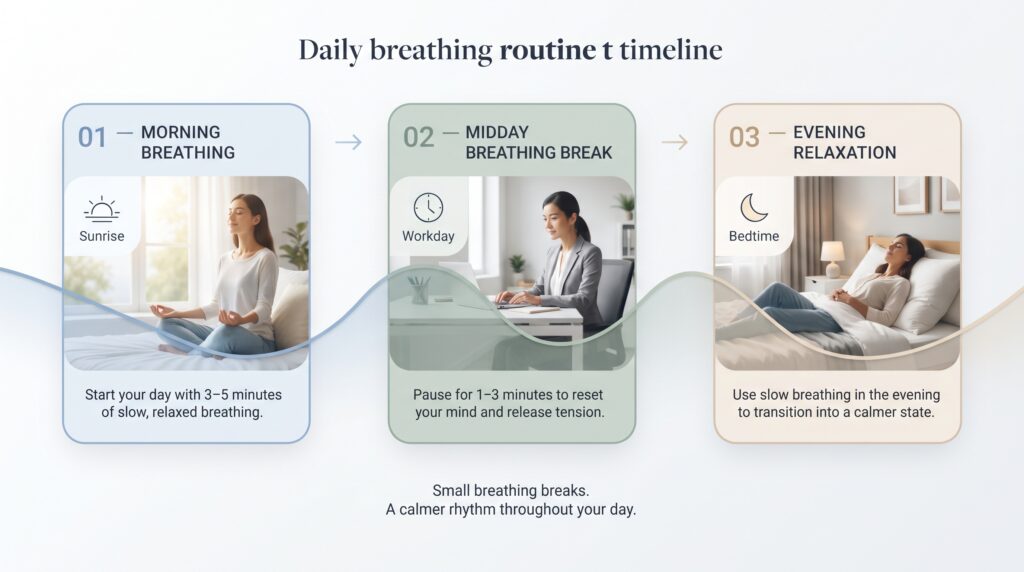
How to Build a Simple Breathing Routine
The biggest mistake people make with wellness habits is trying to do too much too quickly.
You don’t need a 30-minute breathing session.
Start with two minutes.
That’s it.
Choose one technique that feels comfortable.
For example:
Morning
After waking up, sit comfortably and practice gentle slow breathing for two minutes.
During the day
When you notice tension building, pause for five slow breaths.
Evening
Before getting into bed, try two to five minutes of comfortable 4–6 breathing.
That’s already enough to start building awareness.
Over time, you may naturally begin noticing when your breathing changes.
You might catch yourself holding your breath during a stressful email.
Or breathing quickly while rushing through your morning.
Or tightening your shoulders during a difficult conversation.
That awareness is valuable.
Because you can’t change a pattern you don’t notice.
How Long Should You Practice Breathing Exercises?
There’s no universal number of minutes that everyone needs.
Some people may benefit from a few slow breaths during a stressful moment.
Others may prefer a longer practice as part of meditation or relaxation.
If you’re just starting, try:
1–2 minutes:
A quick reset during a busy day.
5 minutes:
A more intentional relaxation session.
10 minutes:
A longer practice when you have time and find it comfortable.
The key is consistency and comfort, not duration.
Five minutes of breathing that you actually enjoy is more useful than a 30-minute routine that you dread and eventually abandon.
Common Breathing Mistakes to Avoid
Breathing exercises sound simple.
But there are a few things to watch out for.
Trying to Take Extremely Deep Breaths
More isn’t always better.
Taking repeated, exaggerated breaths can sometimes make you feel lightheaded or uncomfortable.
Instead, aim for slow, gentle, and comfortable breathing.
Forcing Your Breath
If a technique feels difficult, don’t force it.
You don’t have to hold your breath for a specific amount of time.
You don’t have to inhale as deeply as possible.
Adapt the exercise to your comfort level.
Worrying About Getting the Timing Perfect
Maybe you were supposed to inhale for four seconds but only managed three.
That’s okay.
Your body isn’t keeping score.
The numbers are simply guidelines to help create a rhythm.
If a different pace feels more natural, use it.
Holding Your Breath When It Feels Uncomfortable
Some techniques include breath holds.
But they’re not necessary for everyone.
If holding your breath makes you feel uncomfortable or increases your anxiety, choose another technique.
There’s no prize for pushing through discomfort.
Expecting Instant Results
This may be the biggest mistake of all.
You try a breathing exercise once.
You don’t immediately feel completely calm.
So you decide:
“This doesn’t work.”
But breathing exercises aren’t necessarily about creating an instant transformation.
They’re about developing a skill you can return to.
Sometimes you’ll feel a difference immediately.
Sometimes you won’t.
And that’s okay.
What If Breathing Exercises Make You Dizzy?
If you feel dizzy, lightheaded, or uncomfortable while practicing a breathing exercise, stop.
Return to your normal breathing.
Sit or lie down if necessary and allow yourself to feel steady again.
This can happen if someone breathes too deeply or too quickly, which can alter carbon dioxide levels in the blood and cause symptoms such as lightheadedness.
You don’t need to push through it.
Breathing exercises should feel comfortable.
If you regularly experience dizziness, shortness of breath, chest pain, or other concerning symptoms, don’t assume they’re simply caused by stress or anxiety. Speak with a healthcare professional for appropriate evaluation.
What If Your Anxiety Doesn't Go Away?
This is an important question.
You might practice breathing.
You might take walks.
You might improve your sleep.
And yet, you still feel anxious.
That doesn’t mean you’ve failed.
It may simply mean that your anxiety needs more support than self-care techniques alone can provide.
Breathing exercises can help you manage a moment.
But they can’t necessarily address the underlying causes of persistent anxiety.
If you’re constantly worried, avoiding situations because of fear, struggling to sleep, or finding that anxiety is interfering with your relationships or everyday life, consider speaking with a qualified mental health professional.
There’s nothing wrong with needing more support.
In fact, knowing when you need help is an important part of taking care of yourself.
When Breathing Problems Need Medical Attention
It’s also important not to assume that every breathing problem is caused by stress.
If you’re experiencing:
- Persistent shortness of breath
- Chest pain
- Fainting
- Severe difficulty breathing
- New or unexplained breathing changes
seek appropriate medical attention.
Breathing exercises are wellness tools.
They aren’t a substitute for medical evaluation when you have concerning physical symptoms.
And if you have a known respiratory condition, ask your healthcare professional which breathing exercises are appropriate for you.
A Simple Breathing Practice You Can Try Right Now
Let’s finish the practical section with something you can do immediately.
You don’t need to sit in a perfect meditation position.
You don’t need candles.
You don’t need music.
Just find a comfortable position.
Relax your shoulders.
Let your jaw soften.
Now:
Breathe in gently through your nose for about four seconds.
Breathe out slowly for about six seconds.
Repeat.
Again.
And again.
If counting feels distracting, forget the numbers.
Simply breathe in gently.
Then breathe out slowly.
Continue for one or two minutes.
If your mind wanders, that’s completely normal.
Notice the thought.
Then gently return your attention to your breath.
You don’t have to fight your thoughts.
You don’t have to force yourself to feel calm.
Just give yourself a moment to pause.
The Bigger Picture: Breathing Is One Piece of Your Mental Wellness
Here’s something I want you to take away from this article.
Breathing exercises are useful.
But they’re only one piece of a much bigger picture.
If you’re constantly stressed because you’re overloaded with responsibilities, breathing exercises won’t solve the workload.
If you’re exhausted because you’re not sleeping, you may need to address your sleep habits.
If you’re experiencing anxiety because of an ongoing situation, you may need support in dealing with the underlying issue.
And if your anxiety is persistent or significantly affecting your life, professional help may be the most appropriate next step.
Think of breathing as a tool.
A small one.
But a useful one.
It’s something you can carry with you wherever you go.
No equipment.
No special location.
No expensive subscription.
Just your breath.
And sometimes, when life feels like it’s moving too quickly, that small pause can be incredibly valuable.
Final Thoughts
Your breath is something you carry with you everywhere.
You don’t have to remember to pack it.
You don’t have to charge it.
You don’t have to buy anything.
It’s simply there.
And while breathing exercises aren’t a solution to every stressful situation, they can give you something incredibly valuable:
A moment to pause.
When your thoughts are racing, you can pause.
When your shoulders are tense, you can pause.
When you’re about to react to something in anger or fear, you can pause.
Take a breath.
Then another.
You may not be able to control everything happening around you.
But you can sometimes create a small space between the situation and your response.
And that space matters.
So don’t worry about finding the perfect breathing technique.
Start with one.
Practice for a minute or two.
Notice how it feels.
If you like it, keep going.
If you don’t, try something else.
And remember that your mental wellbeing is about more than any single technique.
Sleep.
Movement.
Connection.
Healthy boundaries.
Professional support when needed.
And yes, sometimes, simply taking a slow breath and reminding yourself:
“I don’t have to solve everything right now.”
That may be enough for this moment.
And sometimes, one calm moment is exactly where you need to begin.
Frequently Asked Questions
What is the best breathing exercise for anxiety?
There isn’t one breathing technique that is best for everyone. Many people find gentle slow breathing or breathing with a slightly longer exhale comfortable. The best technique is one you can practice without discomfort and that helps you feel more grounded.
How long should I do breathing exercises for stress?
You can start with just one or two minutes. If you find the practice comfortable, you can gradually increase the duration. Consistency and comfort are generally more important than practicing for a specific amount of time.
Can deep breathing stop a panic attack?
Breathing exercises may help some people manage the physical sensations associated with anxiety or panic, but they aren’t guaranteed to stop a panic attack. If you experience recurrent panic attacks, consider speaking with a qualified healthcare or mental health professional about appropriate support.
Should I breathe through my nose or mouth?
For many slow-breathing exercises, breathing gently through the nose is commonly encouraged when comfortable. However, the most important thing is that you can breathe comfortably. If you have difficulty breathing through your nose or have a respiratory condition, speak with a healthcare professional about what’s appropriate for you.
Why do I feel dizzy when I practice deep breathing?
Feeling dizzy or lightheaded can happen when you breathe too deeply or too quickly, which can alter carbon dioxide levels in your blood. If this happens, stop the exercise and return to normal breathing. If dizziness happens frequently or without a clear reason, seek medical advice.
Can breathing exercises help with stress?
Breathing exercises may help some people feel calmer during stressful moments and can be used as one part of a broader stress-management routine. However, they don’t remove the source of chronic stress and shouldn’t replace professional care when it’s needed.
Can I practice breathing exercises before bed?
Yes. Many people use gentle, slow breathing as part of a wind-down routine before sleep. Try choosing a comfortable technique and avoiding forceful breathing or anything that makes you feel more alert or uncomfortable.
If your mind becomes particularly active at night, you may also find Overthinking at Night: Why Your Mind Won’t Switch Off helpful.
What should I do if breathing exercises make me more anxious?
Stop the exercise if it makes you uncomfortable. Some people become more aware of physical sensations when they focus closely on their breathing. You could try an external grounding technique instead, such as noticing objects around you, listening to sounds, or taking a gentle walk.
Are breathing exercises a treatment for anxiety disorders?
Breathing exercises can be a helpful coping strategy, but they aren’t a standalone treatment for anxiety disorders. If anxiety is persistent, severe, or interfering with your everyday life, speak with a qualified mental health professional about appropriate treatment and support.

Art of Wellness Team is a collective of mental wellness writers and researchers focused on stress, anxiety, and mental clarity. We create practical, evidence-informed content to help readers better understand their mental well-being and build healthier habits for everyday life.





No Comment! Be the first one.