




Have you ever noticed that even after finishing a stressful day, your body still refuses to relax?
Table Of Content
- Understanding Your Nervous System
- The Sympathetic Nervous System
- The Parasympathetic Nervous System
- The Fight-or-Flight Response Explained
- Why Modern Life Keeps Your Nervous System Switched On
- What Happens During Chronic Stress?
- Signs Your Nervous System May Be Overloaded
- 1. Constant Muscle Tension
- 2. Brain Fog and Poor Concentration
- 3. Feeling Emotionally Reactive
- 4. Your Mind Won’t Slow Down
- 5. You’re Always Tired, Even After Sleeping
- Can Chronic Stress Affect Digestion?
- How to Calm Your Nervous System Naturally
- 1. Practice Slow, Deep Breathing
- 2. Move Your Body Regularly
- 3. Give Your Brain Regular Breaks
- 4. Improve Your Sleep Habits
- 5. Spend More Time in Nature
- 6. Build Recovery Into Your Everyday Routine
- How Long Does It Take to Calm an Overloaded Nervous System?
- When Should You Seek Professional Support?
- Final Thoughts
- Frequently Asked Questions
Maybe you’re lying in bed, completely exhausted, yet your mind keeps replaying conversations, tomorrow’s to-do list, or worst-case scenarios.
Or perhaps you finally sit down after work, hoping to unwind, only to realize your shoulders are still tense, your jaw is clenched, and your heart feels like it’s racing for no obvious reason.
If this sounds familiar, you’re not imagining it.
Your nervous system may still be operating as though you’re facing a threat—even when the stressful situation has already passed.
This is one of the most common effects of chronic stress.
While stress is a normal part of life, prolonged stress can keep your body’s natural alarm system switched on for far longer than it was designed to be. Over time, this can affect your sleep, concentration, mood, digestion, energy levels, and overall mental wellbeing.
Understanding how your nervous system works isn’t just interesting—it’s empowering.
When you know why your body reacts the way it does, you’re better equipped to calm it and recover.
In this guide, you’ll learn:
- How the nervous system responds to stress
- What happens during the fight-or-flight response
- Why chronic stress can leave you feeling constantly “on edge”
- The signs your nervous system may be overwhelmed
- Practical, science-backed ways to help your body return to a calmer, more balanced state
By the end of this article, you’ll have a clearer understanding of what’s happening inside your body, and what you can do to support your mental and physical wellbeing.
Understanding Your Nervous System
Your nervous system is your body’s communication network.
Think of it as the control center that constantly sends and receives messages between your brain and the rest of your body.
It helps regulate nearly everything you do, often without you even realizing it.
Your breathing.
Your heartbeat.
Your digestion.
Your emotions.
Your movement.
Your ability to notice danger.
Every second of every day, your nervous system is working behind the scenes to keep you alive and functioning.
One of its most important jobs is deciding whether you’re safe—or whether you need to prepare for danger.
To understand stress, it’s helpful to know about a specific part of this system called the autonomic nervous system.
The autonomic nervous system controls many automatic functions that happen without conscious effort, such as:
- Heart rate
- Blood pressure
- Breathing
- Digestion
- Body temperature
- Pupil dilation
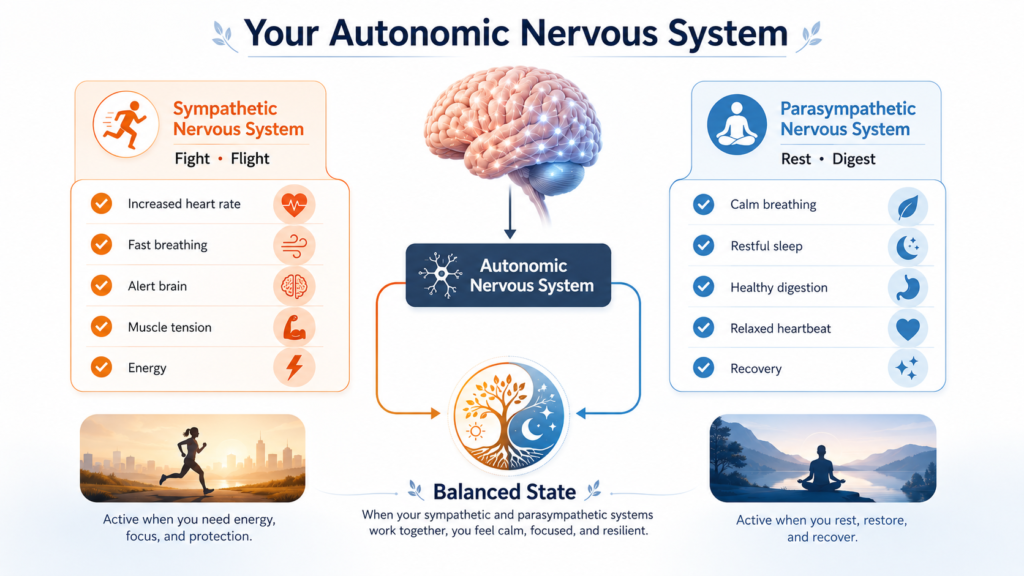
Within this system are two branches that work together to keep your body balanced.
The Sympathetic Nervous System
This is often described as your body’s accelerator.
When your brain detects a challenge or threat, the sympathetic nervous system prepares you to respond quickly.
It increases your heart rate, speeds up your breathing, and redirects energy toward muscles that help you react.
This is the beginning of the famous fight-or-flight response.
The Parasympathetic Nervous System
Think of this as your body’s brake pedal.
Once the stressful situation has passed, the parasympathetic nervous system helps slow your heart rate, relax your muscles, support digestion, and restore balance.
This is sometimes called the rest-and-digest response because it allows your body to recover.
In a healthy nervous system, these two branches work together like teammates.
One prepares you for action.
The other helps you recover.
Problems arise when the accelerator stays pressed for too long.
If you’re unfamiliar with how stress activates these systems, understanding what stress is and how it affects your mind and body provides helpful context before exploring what happens during prolonged stress.
The Fight-or-Flight Response Explained
Imagine you’re walking through a parking lot at night.
Suddenly, you hear a loud noise behind you.
Before you’ve even identified what caused the sound, your body has already started reacting.
Your heart beats faster.
Your breathing becomes quicker.
Your muscles tighten.
Your pupils widen.
Your brain becomes intensely focused.
This entire sequence happens within seconds.
You didn’t consciously decide to make these changes.
Your nervous system did it automatically.
This rapid response evolved to protect humans from danger.
Although modern life rarely involves escaping predators, your brain still reacts to perceived threats in much the same way.
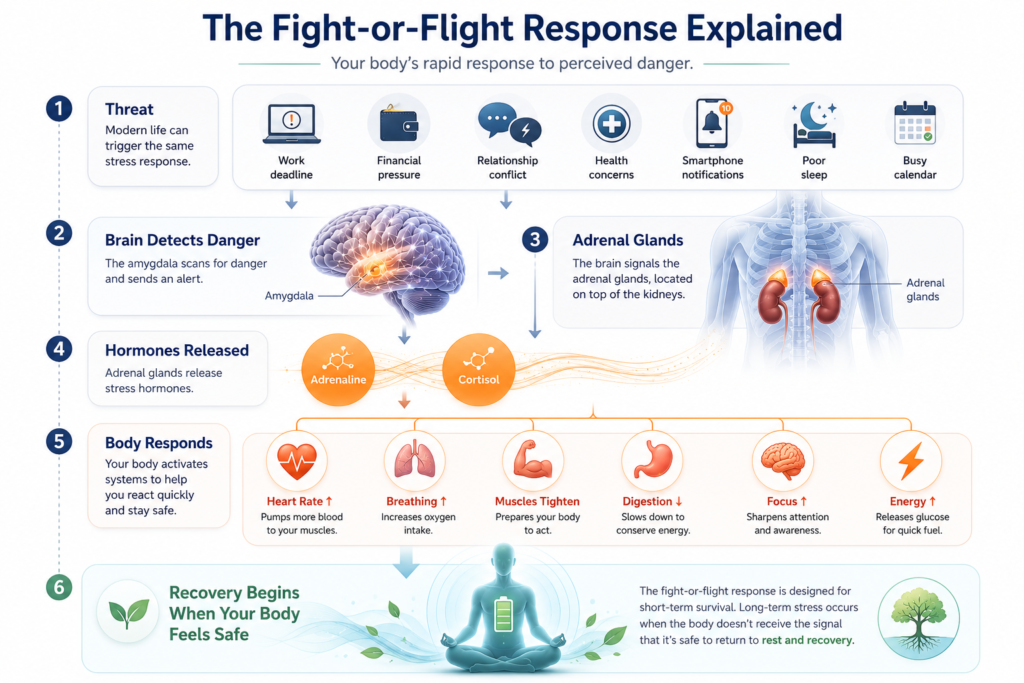
The “threat” today might be:
- An overwhelming workload
- Financial uncertainty
- Relationship conflict
- Health concerns
- Constant smartphone notifications
- Lack of sleep
- An overflowing calendar
From your nervous system’s perspective, many of these situations trigger similar biological responses.
Once your brain senses danger, it signals the adrenal glands to release hormones such as adrenaline and cortisol.
These hormones prepare your body by:
- Increasing heart rate
- Raising blood pressure
- Releasing glucose for energy
- Improving reaction speed
- Sharpening short-term focus
- Temporarily slowing digestion
- Reducing functions that aren’t immediately necessary for survival
For short periods, this response is incredibly useful.
It helps you react quickly, solve problems, and stay alert.
The problem isn’t the stress response itself.
The problem is when your body never gets the message that it’s safe to switch it off.
Why Modern Life Keeps Your Nervous System Switched On
Our ancestors experienced stress differently.
A dangerous situation might last a few minutes.
Once the danger passed, their bodies had time to recover.
Today, stress often looks very different.
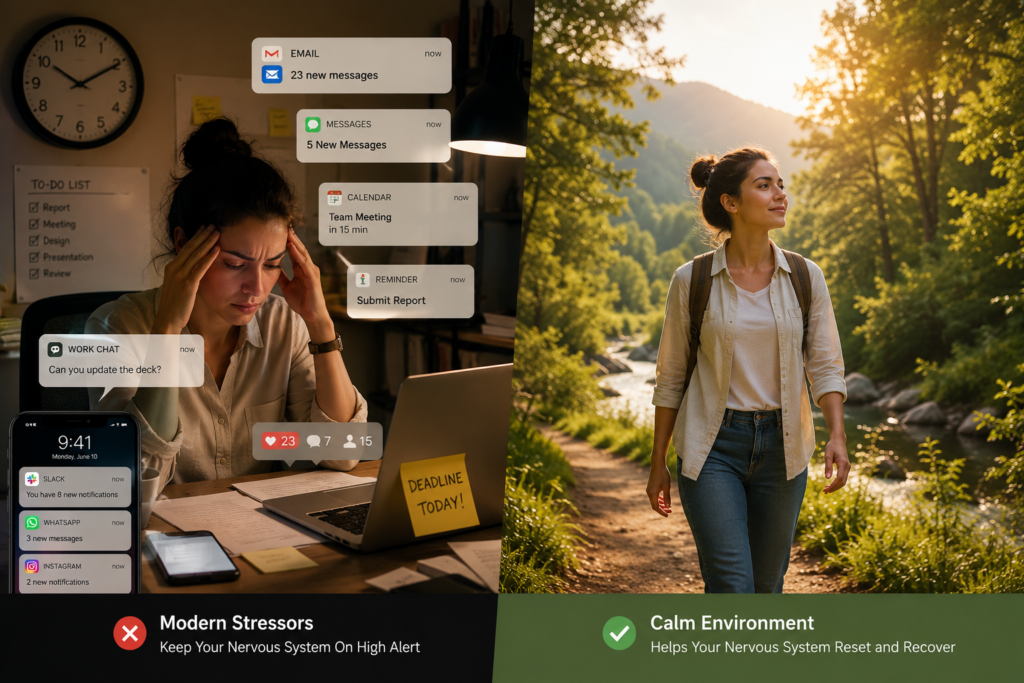
Instead of one major event, many people experience dozens of small stressors throughout the day.
An overflowing inbox.
Traffic.
News alerts.
Phone notifications.
Financial concerns.
Family responsibilities.
Poor sleep.
Social media.
Each one may seem minor on its own.
But together, they create what researchers sometimes call “chronic low-grade stress.”
Your brain doesn’t always distinguish between a life-threatening danger and a nonstop stream of psychological pressures.
As a result, your nervous system may spend far more time in fight-or-flight mode than it was ever designed to.
This is why so many people describe feeling:
- Constantly “on edge”
- Unable to relax
- Mentally exhausted
- Emotionally reactive
- Physically tense
If these experiences sound familiar, they may also reflect the early signs of chronic stress, which often develop gradually before becoming more noticeable.
What Happens During Chronic Stress?
Your body’s stress response is designed to protect you—but only for short periods.
Imagine driving your car with the accelerator pressed all the way down for hours without stopping.
Eventually, the engine would overheat.
The fuel would run low.
The parts would wear out much faster than they were designed to.
Your nervous system works in a similar way.
When stress becomes chronic, your brain keeps telling your body that it needs to stay alert. Instead of moving smoothly between periods of activity and recovery, your nervous system remains stuck in a heightened state of readiness.
Over time, this constant activation can affect nearly every system in your body.
You may notice changes in your:
- Energy levels
- Sleep quality
- Mood
- Digestion
- Memory
- Immune function
- Ability to focus
- Emotional resilience
This doesn’t happen because your body is “failing.” It’s actually doing exactly what it was designed to do—protect you from danger. The problem is that modern stress often doesn’t have a clear ending, so your nervous system doesn’t receive the signal that it’s safe to relax.
Many people dismiss these changes as simply being “busy” or “getting older.” In reality, they can be early signs of chronic stress that deserve attention before they develop into more persistent problems.

Signs Your Nervous System May Be Overloaded
One of the challenges with chronic stress is that its symptoms often develop gradually.
Instead of one dramatic change, you experience dozens of small changes that slowly become your “new normal.”
Let’s look at some of the most common signs.
1. Constant Muscle Tension
Do your shoulders always feel tight?
Do you frequently clench your jaw without realizing it?
Do you wake up with neck pain or tension headaches?
When your nervous system believes you’re under threat, it prepares your muscles for action.
This is helpful if you need to react quickly to danger.
However, if your muscles stay tense day after day, they never have a chance to fully recover.
Persistent muscle tightness, headaches, jaw clenching, and unexplained body aches are some of the most common physical symptoms of stress. Many people spend months treating these symptoms without realizing that chronic stress may be contributing to them.

2. Brain Fog and Poor Concentration
Have you ever opened your laptop and completely forgotten what you intended to do?
Or perhaps you read the same paragraph several times because your mind keeps wandering.
This experience is often called brain fog.
Although brain fog can have many causes, chronic stress is one of the most common contributors.
When your brain is focused on monitoring potential threats, it has fewer mental resources available for learning, planning, and concentrating.
As a result, you may notice that:
- You’re more forgetful than usual.
- It takes longer to complete simple tasks.
- You struggle to stay focused during conversations.
- You lose track of what you’re doing.
Many people also experience decision fatigue, where even choosing what to eat for dinner or replying to a simple email feels mentally exhausting. As your brain becomes overloaded with constant demands, making decisions requires far more energy than it normally would.

3. Feeling Emotionally Reactive
Have you noticed yourself becoming impatient over things that normally wouldn’t bother you?
Maybe a minor inconvenience suddenly feels overwhelming.
Perhaps you’re more easily frustrated with coworkers, family members, or even yourself.
This happens because chronic stress reduces your emotional capacity.
Think of it like a phone battery.
When it’s fully charged, small tasks barely affect it.
But when the battery is already at 10%, even opening another app can drain it completely.
Your emotional resilience works much the same way.
After weeks or months of ongoing stress, you have less mental energy available for handling everyday challenges.
You may also notice mental overload, where your thoughts feel crowded, your attention constantly shifts, and your mind struggles to slow down. This isn’t a lack of motivation—it’s often a sign that your brain has been processing too much information for too long.

4. Your Mind Won’t Slow Down
One of the clearest signs of an overwhelmed nervous system is a mind that never seems to switch off.
Even when you’re resting, your thoughts keep moving.
You replay conversations.
You imagine future problems.
You mentally rehearse situations that haven’t happened yet.
This pattern often develops into overthinking, where your brain repeatedly analyzes the same situations without reaching a solution. While it may feel productive, overthinking usually increases mental fatigue rather than solving the problem.
Many people notice these thoughts becoming even louder after dark. If your mind becomes especially active at bedtime, overthinking at night may be preventing your nervous system from entering the restful state needed for quality sleep.

5. You’re Always Tired, Even After Sleeping
One of the most confusing symptoms of chronic stress is persistent fatigue.
You may sleep for seven or eight hours and still wake up feeling exhausted.
This happens because your body doesn’t fully recover while your nervous system remains in a heightened state of alertness.
Even though you’re physically resting, your brain may continue processing stress throughout the night.
Poor-quality sleep creates a cycle:
Stress → Poor Sleep → Fatigue → Reduced Resilience → More Stress
Breaking this cycle requires more than simply sleeping longer.
It requires helping your nervous system feel safe enough to enter deeper stages of restorative sleep.

Can Chronic Stress Affect Digestion?
Surprisingly, yes.
When your body believes you’re facing danger, digestion becomes a lower priority.
During the fight-or-flight response, blood flow is redirected toward the muscles and brain rather than the digestive system.
If this happens occasionally, it’s not usually a problem.
But when stress becomes chronic, some people notice:
- Stomach discomfort
- Changes in appetite
- Bloating
- Nausea
- Digestive irregularities
This is one example of how closely your brain and body work together.
Stress isn’t “just in your head.”
Its effects can be experienced throughout the entire body.

How to Calm Your Nervous System Naturally
The encouraging news is that your nervous system is remarkably adaptable.
Just as repeated stress can train your body to stay on high alert, consistent healthy habits can gradually teach it that it’s safe to relax again.
Recovery doesn’t happen overnight, especially if you’ve been under pressure for months or years. However, small actions repeated consistently often have a greater impact than occasional dramatic changes.
Let’s look at some practical, science-backed ways to support your nervous system.
1. Practice Slow, Deep Breathing
Breathing is one of the few body functions you can consciously control, making it one of the fastest ways to influence your nervous system.
When you’re stressed, breathing naturally becomes faster and shallower.
By intentionally slowing your breath, you activate the parasympathetic nervous system—the part responsible for helping your body rest, recover, and restore balance.
Try this simple exercise:
- Sit comfortably with both feet on the floor.
- Inhale gently through your nose for 4 seconds.
- Hold your breath for 2 seconds.
- Exhale slowly through your mouth for 6 seconds.
- Repeat for 5–10 minutes.
You don’t have to wait until you’re overwhelmed to practice this. A few minutes each morning, during a work break, or before bed can help regulate your stress response over time.
One of the easiest ways to make this a daily habit is by building simple mental wellness routines into your schedule. These small, consistent practices help your body recover more effectively than relying on stress relief only when you’re already overwhelmed.

2. Move Your Body Regularly
Exercise isn’t just about improving physical fitness.
Movement also helps your body process stress hormones like cortisol and adrenaline more efficiently.
You don’t need intense workouts to experience these benefits.
Simple activities can make a meaningful difference, including:
- Walking
- Cycling
- Yoga
- Swimming
- Stretching
- Dancing
- Gardening
The goal isn’t perfection.
It’s consistency.
Even a 20-minute walk outdoors can help your nervous system transition away from constant fight-or-flight mode while supporting better sleep, improved mood, and greater emotional resilience.

3. Give Your Brain Regular Breaks
Many people believe productivity means staying busy from morning until night.
Ironically, the opposite is often true.
Your brain needs short recovery periods throughout the day to process information efficiently.
Without them, mental fatigue builds until even simple tasks feel overwhelming.
Taking five minutes to stretch, step outside, drink water without checking your phone, or simply look away from a screen can reduce mental overload, giving your brain the opportunity to reset before returning to demanding work.
Small recovery moments aren’t distractions.
They’re an essential part of sustainable productivity and long-term wellbeing.

4. Improve Your Sleep Habits
Sleep is when your brain and nervous system perform much of their repair and recovery.
Unfortunately, chronic stress often makes restful sleep more difficult.
If you’re constantly checking emails late at night, scrolling social media, or replaying tomorrow’s tasks in your mind, your nervous system may struggle to recognize that it’s time to rest.
Simple habits that support better sleep include:
- Going to bed at a consistent time.
- Reducing screen exposure before bed.
- Keeping your bedroom cool, quiet, and dark.
- Avoiding excessive caffeine later in the day.
- Reading a book or practicing gentle breathing before sleeping.
If racing thoughts regularly interrupt your evenings, understanding overthinking at night can help you create a healthier bedtime routine and improve your sleep quality over time.

5. Spend More Time in Nature
Modern life surrounds us with noise, notifications, traffic, and constant stimulation.
Nature provides the opposite.
Even spending 20–30 minutes in a park, near trees, or beside water can help reduce mental fatigue and support nervous system recovery.
You don’t have to hike through mountains.
A quiet neighborhood walk can be enough.
Many people also notice improved mental clarity after spending time outdoors because their attention naturally shifts away from constant digital stimulation and toward the present moment.

6. Build Recovery Into Your Everyday Routine
Many people wait until they’re completely exhausted before thinking about self-care.
A more sustainable approach is to include small recovery habits throughout your day.
These might include:
- Drinking water regularly.
- Eating meals without distractions.
- Practicing gratitude.
- Listening to calming music.
- Journaling.
- Calling a friend.
- Taking mindful breaks between meetings.
These simple actions become powerful daily habits that reduce mental stress, helping your nervous system recover little by little instead of waiting for weekends or vacations to reset.

How Long Does It Take to Calm an Overloaded Nervous System?
This is one of the most common questions people ask.
The honest answer is:
It depends.
Recovery isn’t a race, and there’s no universal timeline.
If your stress has lasted only a few days, you may notice improvements relatively quickly once you’ve had time to rest.
If you’ve been living with chronic stress for months or years, your nervous system may need more time to adjust.
What’s most important isn’t how fast recovery happens—it’s whether you’re consistently supporting your body with healthy habits.
Many people begin noticing gradual improvements in:
- Sleep quality
- Concentration
- Mood
- Energy
- Emotional resilience
The key word is gradual.
Healing usually happens through repeated small improvements rather than one dramatic breakthrough.
When Should You Seek Professional Support?
While lifestyle habits can make a meaningful difference, they aren’t always enough.
Consider speaking with a qualified healthcare or mental health professional if:
- Your stress feels overwhelming most days.
- Symptoms continue for several weeks or months.
- Anxiety interferes with work or relationships.
- You’re unable to sleep consistently.
- You’re finding it difficult to manage daily responsibilities.
- You feel emotionally exhausted despite making healthy changes.
Seeking support isn’t a sign that you’ve failed.
It’s a proactive way to understand what’s happening and receive personalized guidance.
If you’re unsure whether your symptoms are more closely related to stress or anxiety, learning the difference between stress and anxiety can help you better understand your experiences and identify the most appropriate coping strategies.
Final Thoughts
Your nervous system isn’t working against you.
It’s working to protect you.
The challenge is that modern life often exposes us to ongoing stress rather than short bursts of danger, making it difficult for our internal alarm system to fully switch off.
By understanding how stress affects your nervous system, you can begin responding with greater awareness instead of frustration.
Simple practices like slow breathing, regular movement, quality sleep, mindful breaks, and time in nature won’t remove every source of stress – but they can help your body recover more effectively.
Remember, recognizing the early signs of chronic stress gives you the opportunity to make small changes before they grow into larger challenges. Combining that awareness with simple mental wellness routines creates a strong foundation for long-term emotional resilience and overall wellbeing.
Most importantly, don’t ignore the signals your body is sending.
Persistent fatigue, muscle tension, racing thoughts, and emotional exhaustion aren’t character flaws.
They’re often your nervous system’s way of asking for rest, recovery, and care.
The earlier you respond, the easier it becomes to restore balance and protect your long-term mental wellbeing.







No Comment! Be the first one.