




Have you ever reached the end of the day feeling completely drained—even though nothing particularly dramatic happened?
Table Of Content
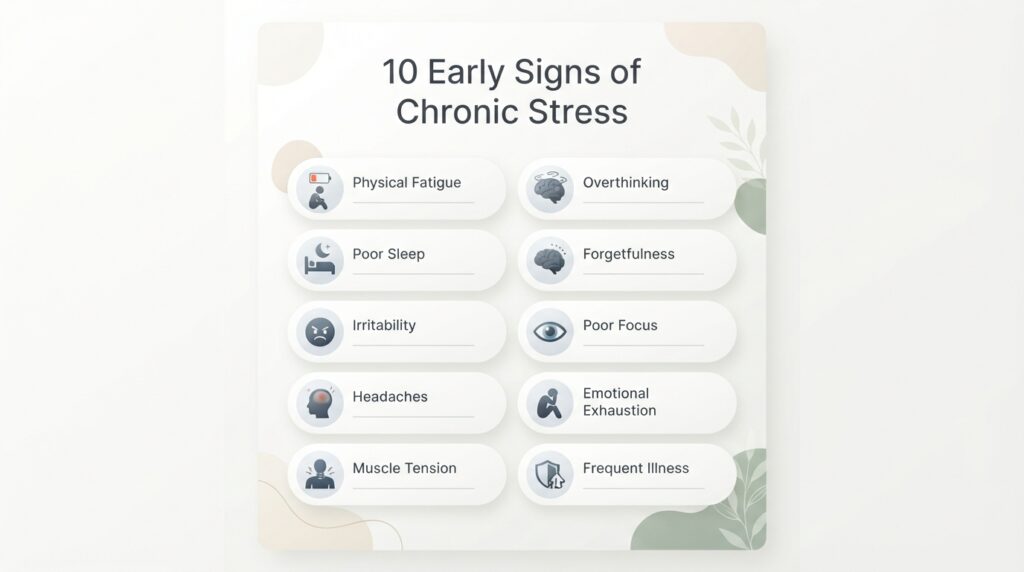
- What Is Chronic Stress?
- Why Chronic Stress Often Goes Unnoticed
- 1. You Feel Constantly Tired – Even After Sleeping
- 2. Small Problems Feel Much Bigger Than They Used To
- 3. You’re Forgetting Simple Things
- 4. Your Body Feels Tense Most of the Time
- 5. You Find It Hard to Focus
- 6. You’re Overthinking Everything
- 7. You Feel Emotionally Drained
- 8. Your Sleep Doesn’t Feel Restful
- 9. You Get Sick More Often
- 10. You No Longer Feel Like Yourself
- When Should You Take These Signs Seriously?
- Simple Ways to Reduce Chronic Stress Before It Becomes Burnout
- Final Thoughts
- Frequently Asked Questions
Maybe you’ve been snapping at people you care about, struggling to concentrate at work, or waking up tired despite getting a full night’s sleep.
At first, it’s easy to dismiss these changes.
“I’m just busy.”
“Things will calm down next week.”
“Everyone feels like this sometimes.”
Sometimes that’s true.
But when these feelings continue for weeks or even months, your body may be trying to tell you something important.
Stress isn’t always loud.
It doesn’t always arrive as a panic attack or emotional breakdown.
More often, chronic stress develops quietly. It builds gradually through work pressure, family responsibilities, financial concerns, poor sleep, or simply carrying too much mental load for too long.
Because the changes happen slowly, many people don’t recognize the warning signs until stress begins affecting their physical health, relationships, or daily functioning.
The good news is that your body usually sends signals long before you reach burnout.
Learning to recognize those early signs gives you the opportunity to slow down, make small adjustments, and protect your long-term mental wellbeing.
In this guide, we’ll explore the most common early signs of chronic stress, why they happen, and practical steps you can take before stress becomes overwhelming.
What Is Chronic Stress?
Stress itself isn’t always harmful.
In fact, short-term stress is part of how the human body protects you.
When you face a challenge – whether it’s giving a presentation, avoiding danger, or meeting an important deadline – your brain activates the fight-or-flight response.

This response releases hormones such as adrenaline and cortisol, increasing your heart rate, sharpening your focus, and preparing your body to respond.
Normally, once the challenge passes, these hormone levels return to normal.
Chronic stress is different.
Instead of switching off, your body’s stress response remains activated for weeks or months.
Your nervous system stays on high alert, even when there’s no immediate danger.
Over time, this constant state of alertness can affect:
- your sleep
- your mood
- your concentration
- your immune system
- your digestion
- your energy levels
This is why recognizing early warning signs matters.
The earlier you respond, the easier it often is to restore balance.
Related reading: Learn what stress actually is and how it affects the mind and body in our guide: What Is Stress? Causes, Symptoms, and How It Affects the Mind.
Why Chronic Stress Often Goes Unnoticed
One of the biggest challenges with chronic stress is that it rarely appears overnight.
Instead, your brain gradually adapts to operating under constant pressure.
What once felt exhausting slowly starts to feel “normal.”
You might tell yourself:
- “I’m just tired.”
- “It’s been a busy month.”
- “I’ll rest later.”
Weeks become months.
Months become years.
Because the symptoms develop gradually, many people don’t realize how much stress they’re carrying until their body forces them to pay attention.
That’s why awareness is one of the most powerful tools for protecting your mental health.
1. You Feel Constantly Tired – Even After Sleeping
Everyone feels tired occasionally.
Chronic stress feels different.
You may sleep for seven or eight hours and still wake up feeling mentally and physically exhausted.
Why?
When your nervous system remains activated for long periods, your body doesn’t enter deep restorative states as effectively.
Your sleep becomes less refreshing, even if you spend enough time in bed.
Over time, this can create a cycle:
Stress → Poor-quality sleep → Lower energy → More stress
If you’ve been feeling unusually tired for several weeks, don’t ignore it.
Persistent fatigue can be one of the earliest signs that your body is struggling to recover from ongoing stress.
2. Small Problems Feel Much Bigger Than They Used To
Have you noticed yourself becoming unusually impatient?
Maybe a delayed email, heavy traffic, or a minor mistake suddenly feels overwhelming.
This isn’t a personality change.
It’s often a sign that your mental resources are already stretched.
When chronic stress keeps your brain in a heightened state of alertness, your emotional “buffer” becomes smaller.
You have less capacity to deal with everyday frustrations.
As a result, even small inconveniences can trigger stronger emotional reactions than they normally would.
3. You’re Forgetting Simple Things
Do you walk into a room and forget why?
Misplace your keys more often?
Lose track of conversations?
Occasional forgetfulness is completely normal.
However, chronic stress can temporarily affect attention and working memory.
From a neurological perspective, elevated cortisol levels may interfere with areas of the brain involved in learning, memory, and decision-making.
That doesn’t mean stress is causing permanent damage.
It simply means your brain is using much of its energy managing stress instead of storing and processing information efficiently.
If you’re noticing this regularly, it’s worth paying attention.
Related reading: Explore Decision Fatigue: Why Simple Choices Feel Exhausting to understand how prolonged stress can drain your mental energy.
4. Your Body Feels Tense Most of the Time
Stress isn’t only experienced in the mind.
It often shows up physically long before people recognize it emotionally.
Common signs include:
- tight shoulders
- jaw clenching
- neck pain
- frequent headaches
- muscle stiffness
This happens because your muscles naturally tighten when your brain perceives a threat.
If that stress response stays active for weeks, the tension can become constant.
Many people begin treating the symptoms without realizing stress is the underlying cause.
Related reading: Learn more in Physical Symptoms of Stress You Might Mistake for Illness.
5. You Find It Hard to Focus
Have you ever opened your laptop to complete an important task, only to realize you’ve spent the last 20 minutes jumping between emails, social media, and random tabs?
You’re not lazy.
Your brain may simply be overwhelmed.
One of the earliest cognitive signs of chronic stress is reduced concentration.
When the brain is constantly monitoring for potential threats—whether they’re real or perceived, it has fewer mental resources available for sustained attention.
In simple terms, your mind becomes busy trying to keep you safe instead of helping you stay productive.
You might notice that:
- Reading takes longer than usual.
- You have to reread the same paragraph several times.
- You struggle to stay engaged in conversations.
- Simple tasks suddenly feel mentally exhausting.
- You’re easily distracted by notifications or background noise.
Many people assume they’re losing motivation when, in reality, they’re experiencing the effects of prolonged stress.
The encouraging news is that concentration often improves as stress levels decrease.
Related reading: Learn how prolonged stress contributes to Mental Overload: When Your Mind Feels Too Full and why it becomes difficult to think clearly.
6. You’re Overthinking Everything
Overthinking is more than simply thinking deeply.
It’s when your mind keeps replaying conversations, imagining worst-case scenarios, or analyzing every possible outcome without reaching a conclusion.
Chronic stress often puts the brain into “problem-solving mode.”
While this response is helpful during genuine emergencies, it becomes exhausting when it stays switched on all day.
You may find yourself asking:
- Did I say the wrong thing?
- What if something goes wrong tomorrow?
- Why can’t I stop thinking about this?
These repetitive thought patterns consume mental energy and leave little room for rest.
Instead of solving problems, they often create more mental tension.
One helpful strategy is to write your thoughts down before bed or after a stressful event. Externalizing your thoughts reduces the mental effort required to keep replaying them.
Related reading: Discover why repetitive thinking happens in Overthinking: Why Your Mind Won’t Switch Off.
7. You Feel Emotionally Drained
Physical tiredness and emotional exhaustion are not the same thing.
You may have enough energy to get through your day, but feel emotionally “empty.”
Activities you once enjoyed no longer feel rewarding.
Conversations feel like work.
Even making small decisions seems overwhelming.
This happens because chronic stress continuously demands emotional energy.
Over time, your brain has fewer psychological resources available for creativity, connection, and enjoyment.
Many people describe this feeling as:
- Running on autopilot
- Feeling emotionally numb
- Losing enthusiasm
- Not caring as much as they used to
These are not signs of weakness.
They’re signs that your mind has been working overtime for too long.
8. Your Sleep Doesn’t Feel Restful
Sleep and stress influence each other in both directions.
Stress can make it difficult to fall asleep.
Poor sleep makes stress harder to manage.
Even if you sleep for eight hours, you may wake up feeling like you hardly rested at all.
Common signs include:
- Waking up multiple times during the night.
- Racing thoughts before bed.
- Feeling alert when you should be sleepy.
- Waking earlier than intended and struggling to fall back asleep.
From a scientific perspective, elevated stress hormones can interfere with the body’s natural sleep-wake cycle.
The nervous system remains more alert than it should, making deep restorative sleep harder to achieve.
If this continues for several weeks, it’s worth paying attention.
Related reading: If your thoughts become louder after dark, read Overthinking at Night: Why Your Mind Won’t Switch Off.
9. You Get Sick More Often
Have you noticed that you seem to catch every cold going around?
Or perhaps small illnesses take longer to recover from than they used to.
While many factors influence the immune system, prolonged stress can play a role.
When cortisol remains elevated for extended periods, it can influence how the immune system responds.
This doesn’t mean stress directly causes illness.
However, ongoing stress may reduce the body’s ability to recover efficiently, making it easier to feel run down over time.
Supporting your mental wellbeing isn’t only about feeling calmer.
It’s also about supporting your overall health.
10. You No Longer Feel Like Yourself
Perhaps the most important warning sign is the hardest to describe.
You simply don’t feel like yourself anymore.
Maybe you’ve become:
- Less patient
- Less optimistic
- Less social
- Less motivated
- Less interested in hobbies you once enjoyed
Friends or family may even comment that you seem different.
This is often the cumulative effect of many small stress responses building over time.
The good news is that this doesn’t have to become your “new normal.”
Recognizing the change is the first step toward improving it.
When Should You Take These Signs Seriously?
Everyone experiences stress from time to time.
The concern isn’t occasional stress – it’s persistent stress that continues for weeks or months and begins affecting your daily life.
Consider taking action if you notice:
- Constant fatigue despite adequate sleep
- Ongoing irritability or mood changes
- Difficulty concentrating
- Frequent headaches or muscle tension
- Persistent overthinking
- Emotional exhaustion
- Reduced enjoyment in everyday life
If these symptoms become severe, continue for a long time, or significantly interfere with work, relationships, or daily functioning, it’s important to speak with a qualified healthcare professional or mental health professional. Early support can make a meaningful difference.
Simple Ways to Reduce Chronic Stress Before It Becomes Burnout
The goal isn’t to eliminate stress completely.
That’s neither realistic nor necessary.
Instead, focus on giving your nervous system regular opportunities to recover.
Start with small, consistent habits:
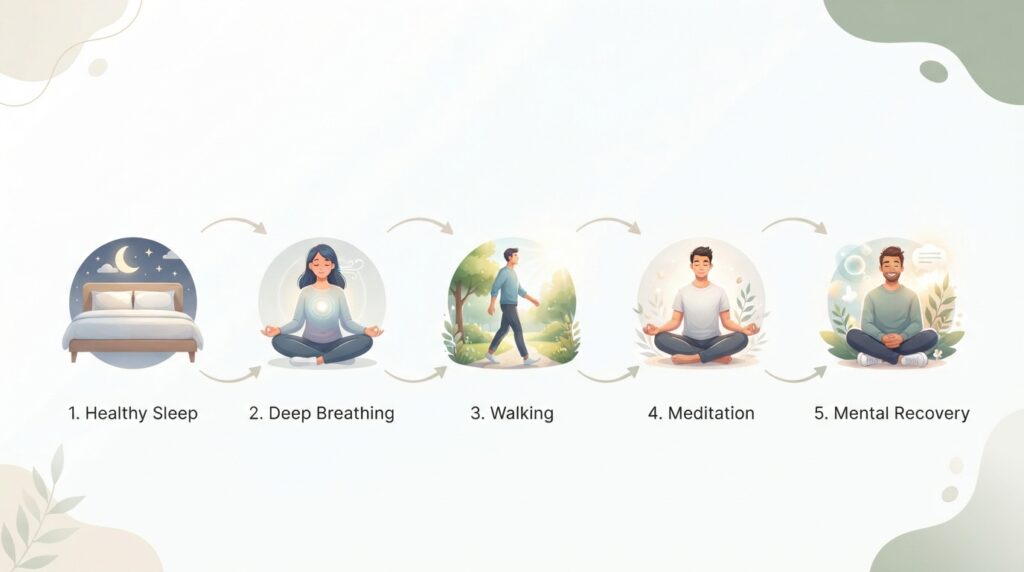
- Practice 5–10 minutes of slow breathing each day.
- Spend a few minutes outdoors whenever possible.
- Reduce screen time before bed.
- Prioritize consistent sleep and wake times.
- Move your body with gentle exercise or walking.
- Write down repetitive thoughts instead of carrying them mentally.
- Build small moments of mindfulness into your daily routine.
These habits may seem simple, but consistency is what creates lasting change.
Related reading: Explore Simple Mental Wellness Routines That Actually Work for practical daily habits that help reduce stress and improve emotional wellbeing.
Final Thoughts
Chronic stress rarely arrives all at once.
It often begins with subtle changes—feeling a little more tired, a little less focused, or a little more irritable than usual.
Because these changes develop gradually, they’re easy to overlook.
The sooner you recognize these early warning signs, the sooner you can take steps to support your mental wellbeing.
Remember, mental wellness isn’t about living a stress-free life.
It’s about learning to notice what your mind and body are telling you—and responding with care before stress grows into something more difficult to manage.
By making small, sustainable changes today, you’re investing in a healthier, calmer future.







No Comment! Be the first one.