




Have you ever reached the end of the day and felt like you had nothing left to give—not physically, but emotionally?
Table Of Content
- What Is Emotional Exhaustion?
- Emotional Exhaustion vs Normal Tiredness
- Why Emotional Exhaustion Is Becoming More Common
- Signs You’re Emotionally Exhausted
- 1. You Feel Emotionally Drained Most of the Time
- 2. Small Problems Feel Much Bigger Than They Really Are
- 3. You Feel Constantly Overwhelmed
- 4. You Lose Interest in Things You Normally Enjoy
- 5. Your Mind Never Stops Thinking
- 6. Your Body Starts Showing Signs of Stress
- What Causes Emotional Exhaustion?
- Chronic Workplace Stress
- Caregiving Responsibilities
- Relationship Challenges
- Financial Pressure
- Perfectionism
- Emotional Exhaustion vs Burnout
- How Emotional Exhaustion Affects Your Brain and Body
- Your Nervous System
- Your Memory and Focus
- Your Sleep
- Your Immune System
- How to Recover from Emotional Exhaustion
- 1. Give Yourself Permission to Rest
- 2. Create Healthy Boundaries
- 3. Build Simple Daily Habits
- 4. Spend Time Moving and Connecting
- 5. Practice Self-Compassion
- When Should You Seek Professional Support?
- Final Thoughts
- Frequently Asked Questions
Perhaps you’ve noticed that small problems now feel overwhelming.
Conversations that once brought you joy seem exhausting.
Even answering a text message or making simple decisions feels like more effort than it should.
Many people describe this feeling as being “emotionally drained.”
While everyone experiences occasional tiredness, emotional exhaustion is different.
It isn’t simply about needing a good night’s sleep.
It’s the feeling that your emotional energy has been depleted after carrying stress, responsibilities, or difficult emotions for far too long.
In today’s fast-paced world, emotional exhaustion has become increasingly common. Constant notifications, demanding work schedules, financial pressures, caregiving responsibilities, and information overload can leave little time for genuine recovery.
The challenge is that emotional exhaustion often develops so gradually that many people don’t recognize it until it begins affecting their relationships, work, health, and overall quality of life.
If you’ve recently noticed changes in your mood, motivation, or ability to cope with everyday challenges, your mind and body may be asking for rest—not because you’re weak, but because you’ve been carrying too much for too long.
Understanding emotional exhaustion is the first step toward recovering from it.
In this guide, you’ll learn:
- What emotional exhaustion really is
- Common signs and symptoms
- Why it happens
- How it differs from burnout
- Practical, science-backed ways to recover and protect your emotional wellbeing
What Is Emotional Exhaustion?
Emotional exhaustion is a state of feeling mentally and emotionally depleted after prolonged periods of stress.
Think of your emotional energy like the battery on your phone.
Every conversation, responsibility, challenge, and stressful situation uses a little bit of that battery.
Normally, rest, sleep, enjoyable activities, and supportive relationships help recharge it.
But when life becomes consistently demanding without enough time to recover, that battery gradually drains.
Eventually, even simple daily tasks begin to feel overwhelming.
Unlike ordinary tiredness, emotional exhaustion doesn’t always improve after a weekend off or a full night’s sleep.
Instead, it can linger for weeks or even months if the underlying causes aren’t addressed.
Many people first experience emotional exhaustion after months of juggling demanding workloads, caring for family members, navigating relationship difficulties, or living with ongoing uncertainty.
Although it may feel like something is “wrong” with you, emotional exhaustion is often your nervous system’s natural response to prolonged pressure.
If you’re unfamiliar with how stress builds over time, understanding what stress is and how it affects your mind and body can help explain why emotional exhaustion develops gradually rather than all at once.
Likewise, many people overlook the early signs of chronic stress, assuming they’re simply busy or tired. Recognizing these warning signs early can help prevent emotional exhaustion from becoming more severe.

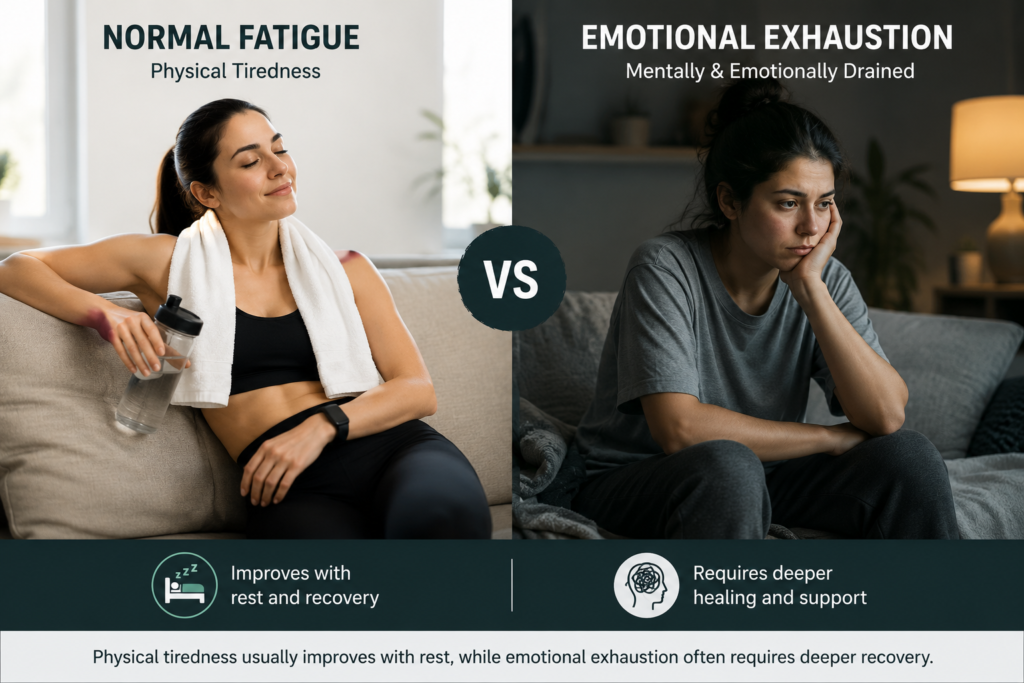
Emotional Exhaustion vs Normal Tiredness
It’s easy to confuse emotional exhaustion with being tired after a busy week.
However, there are important differences.
After normal fatigue, you usually feel refreshed after resting.
After emotional exhaustion, you may wake up feeling just as drained as when you went to bed.
Normal tiredness tends to affect your physical energy.
Emotional exhaustion affects the way you think, feel, and respond to everyday life.
You may notice that you’re:
- Less patient than usual.
- Easily overwhelmed by small tasks.
- Emotionally numb.
- Less interested in hobbies you once enjoyed.
- Struggling to stay motivated.
- Feeling disconnected from people around you.
Many people also describe feeling as though they’re “running on autopilot.”
They’re still completing their responsibilities, but they’re no longer experiencing much enjoyment or emotional connection while doing them.
This is one reason emotional exhaustion often goes unnoticed.
From the outside, everything may appear normal.
Inside, however, you’re using far more emotional energy just to get through the day.
Why Emotional Exhaustion Is Becoming More Common
Our brains evolved to handle short periods of stress followed by recovery.
Modern life rarely works that way.
Instead of facing one challenge and then resting, many people experience dozens of smaller stressors every day.
Work deadlines.
Family responsibilities.
Financial concerns.
Constant emails.
Social media notifications.
News updates.
Relationship pressures.
Sleep deprivation.
Each one may seem manageable on its own.
Together, however, they place continuous demands on your emotional resources.
Over time, your nervous system begins operating as though it’s always preparing for the next challenge.
As you learned in how stress affects your nervous system, prolonged activation of the body’s stress response makes it more difficult to relax, recover, and regulate emotions.
This ongoing pressure also contributes to mental overload, making it harder to focus, process information, and think clearly.
Eventually, your emotional energy becomes depleted—even if you’re still managing to keep up with your daily responsibilities.

Signs You’re Emotionally Exhausted
Emotional exhaustion rarely appears overnight.
For most people, it develops gradually after weeks or months of carrying responsibilities without enough time to recover.
Because the changes happen slowly, it’s easy to dismiss them as “just stress” or assume you’ll feel better after a good night’s sleep.
However, emotional exhaustion affects far more than your energy levels. It can influence your emotions, thinking, physical health, relationships, and even how you respond to everyday situations.
Recognizing these signs early allows you to take action before emotional exhaustion progresses into burnout.
1. You Feel Emotionally Drained Most of the Time
One of the most noticeable signs is a constant feeling of emotional depletion.
It’s difficult to explain unless you’ve experienced it.
You’re not necessarily sad.
You’re not always anxious.
You simply feel like you’ve run out of emotional energy.
Tasks that once felt manageable now seem overwhelming because every interaction requires more effort than it used to.
You may find yourself thinking:
“I just don’t have the energy to deal with this today.”
Unlike ordinary tiredness, this feeling often persists even after resting.

2. Small Problems Feel Much Bigger Than They Really Are
Have you ever found yourself becoming unusually upset over something minor?
Perhaps a delayed email, unexpected traffic, or a simple misunderstanding suddenly feels overwhelming.
This isn’t because you’ve become less capable.
It’s often because your emotional resources have been depleted.
When your mind is already carrying a heavy emotional load, even small challenges can feel disproportionately stressful.
Imagine trying to carry one extra shopping bag after you’ve already been carrying ten.
The final bag isn’t heavy by itself.
It’s simply more than your body, or your mind, can comfortably manage.
Many people also notice increasing decision fatigue, where making ordinary choices requires far more mental effort than before. Even deciding what to cook for dinner or responding to simple messages may begin to feel exhausting.

3. You Feel Constantly Overwhelmed
One responsibility becomes five.
Five become ten.
Eventually, your mind struggles to process everything at once.
Instead of thinking clearly, your thoughts begin competing for attention.
You may notice:
- Difficulty focusing.
- Forgetting small tasks.
- Starting projects without finishing them.
- Feeling mentally scattered.
- Trouble prioritizing responsibilities.
This often reflects mental overload, where your brain has been processing more information than it has had time to recover from.
When this happens consistently, productivity usually decreases—not because you’re lazy, but because your mind is trying to cope with too much stimulation.

4. You Lose Interest in Things You Normally Enjoy
One of the more subtle signs of emotional exhaustion is losing enthusiasm for activities that previously brought you happiness.
You may stop reading.
Avoid hobbies.
Cancel social plans.
Lose motivation to exercise.
Or simply feel indifferent toward things you once looked forward to.
This doesn’t necessarily mean you’ve stopped caring.
Instead, your brain may be conserving emotional energy because it has very little left to give.
Many people describe this as feeling emotionally “flat.”
Life continues, but the excitement seems to fade.

5. Your Mind Never Stops Thinking
Even when your body is resting, your brain keeps working.
You replay conversations.
Analyze mistakes.
Plan tomorrow’s schedule.
Imagine future problems.
Question decisions you’ve already made.
This constant mental activity often develops into overthinking, making it difficult for your nervous system to fully relax.
Unfortunately, many people experience this most intensely at bedtime.
Instead of preparing for sleep, the brain continues solving problems that may not even exist.
If you’ve ever wondered why you feel exhausted yet can’t fall asleep, overthinking at night is often a major contributor.

6. Your Body Starts Showing Signs of Stress
Emotional exhaustion doesn’t stay in your mind.
It often affects your body as well.
Common physical symptoms include:
- Frequent headaches
- Tight shoulders
- Neck pain
- Jaw clenching
- Fatigue
- Digestive discomfort
- Increased heart rate
- Poor sleep
- Muscle tension
Many people are surprised to learn that these are common physical symptoms of stress, especially when the nervous system has remained activated for long periods.
Your body and mind are constantly communicating with one another.
When emotional stress continues for weeks or months, physical symptoms often begin appearing as well.

What Causes Emotional Exhaustion?
Emotional exhaustion rarely has a single cause.
Instead, it usually develops after prolonged exposure to multiple stressors without enough opportunities to recover.
Some of the most common contributors include:
Chronic Workplace Stress
Long working hours.
High expectations.
Constant deadlines.
Lack of work-life balance.
Feeling undervalued.
Over time, these pressures can gradually drain emotional energy.
Caregiving Responsibilities
Caring for children, aging parents, or a loved one with a chronic illness can be deeply meaningful.
It can also be emotionally demanding.
When you’re constantly focused on supporting others, it’s easy to overlook your own emotional needs.
Relationship Challenges
Conflict, emotional distance, unresolved disagreements, or unhealthy relationship patterns can quietly consume emotional energy over time.
Financial Pressure
Money worries affect more than bank accounts.
They create ongoing uncertainty that keeps the brain alert and makes it difficult to fully relax.
Perfectionism
Many emotionally exhausted people set extremely high expectations for themselves.
They feel guilty resting.
They struggle to say no.
They believe they should always be productive.
Over time, these patterns create a cycle of chronic stress that becomes increasingly difficult to break.
If this sounds familiar, understanding the difference between stress and anxiety can help you recognize whether you’re responding to real-world pressures, persistent worry, or a combination of both.

Emotional Exhaustion vs Burnout
People often use the terms emotional exhaustion and burnout interchangeably, but they aren’t exactly the same.
Think of emotional exhaustion as an early warning signal.
Burnout is what can happen when that signal is ignored for a prolonged period.
Emotional exhaustion primarily affects your emotional energy. You may feel mentally drained, overwhelmed, or disconnected, but you’re often still able to carry out your daily responsibilities—even if it takes more effort than before.
Burnout, on the other hand, is a more advanced state of physical, emotional, and mental exhaustion. It can affect your motivation, confidence, work performance, relationships, and even your sense of purpose.
The good news is that emotional exhaustion is often easier to reverse when it’s recognized early.
By paying attention to your body’s signals and making small, consistent changes, you may prevent it from progressing further.

How Emotional Exhaustion Affects Your Brain and Body
Your emotions don’t exist separately from your body.
Everything is connected.
When emotional stress continues for long periods, your brain remains focused on managing perceived threats rather than supporting rest and recovery.
This ongoing stress response can influence several important body systems.
Your Nervous System
When stress becomes chronic, the how stress affects your nervous system becomes easier to understand.
Instead of smoothly switching between periods of activity and recovery, your nervous system may remain in a heightened state of alertness.
This can make it difficult to relax, concentrate, or feel emotionally balanced, even during peaceful moments.
Your Memory and Focus
Many people experiencing emotional exhaustion describe forgetting appointments, losing track of conversations, or struggling to stay focused.
This isn’t because you’ve suddenly become forgetful.
It’s because your brain is prioritizing survival over higher-level thinking.
When emotional resources are stretched too thin, mental clarity often declines, making it harder to solve problems, make decisions, or stay productive.
Your Sleep
A tired body doesn’t always mean a restful mind.
Emotional exhaustion frequently interferes with healthy sleep patterns.
Some people struggle to fall asleep because their thoughts won’t slow down.
Others wake frequently during the night or feel exhausted despite spending enough time in bed.
Quality sleep is one of the most important parts of emotional recovery because it’s when the brain processes emotions, repairs neural connections, and restores energy.
Your Immune System
Although stress itself doesn’t directly cause illness, prolonged activation of the body’s stress response may influence immune function over time.
That’s one reason people experiencing long-term emotional exhaustion sometimes notice they feel run down more often or take longer to recover from everyday illnesses.
Supporting your emotional wellbeing also supports your overall physical health.

How to Recover from Emotional Exhaustion
Recovery doesn’t happen because you finally take one day off.
It happens through consistent habits that allow your mind and body to restore themselves over time.
The goal isn’t to eliminate every source of stress.
It’s to increase your ability to recover from it.
1. Give Yourself Permission to Rest
Many people treat rest as something they have to earn.
In reality, rest is a biological necessity.
Recovery isn’t laziness.
It’s part of maintaining emotional health.
Even short moments of intentional rest throughout the day can reduce emotional fatigue.
2. Create Healthy Boundaries
Learning to say “no” doesn’t mean you care less.
It means you’re protecting the energy you need to continue showing up for the people and responsibilities that matter most.
Healthy boundaries reduce unnecessary stress while helping prevent emotional overload.
3. Build Simple Daily Habits
Recovery is rarely about one dramatic change.
It’s usually the result of small actions repeated consistently.
Practicing simple mental wellness routines such as mindful breathing, gentle movement, journaling, or gratitude exercises helps create regular opportunities for emotional recovery.
4. Spend Time Moving and Connecting
Gentle physical activity supports both your body and your mind.
Equally important is spending time with supportive people.
A meaningful conversation, shared laughter, or simply feeling understood can help replenish emotional energy in ways that productivity alone never can.
5. Practice Self-Compassion
One of the biggest obstacles to recovery is self-criticism.
Many emotionally exhausted people believe they should be doing more.
Working harder.
Trying harder.
Being stronger.
Instead of asking yourself,
“Why can’t I keep up?”
Try asking,
“What do I need right now?”
This simple shift encourages recovery rather than guilt.

When Should You Seek Professional Support?
While lifestyle changes can make a significant difference, there are times when additional support is the healthiest choice.
Consider speaking with a qualified healthcare or mental health professional if:
- Emotional exhaustion continues for several weeks.
- Daily responsibilities become difficult to manage.
- You lose interest in nearly everything you once enjoyed.
- Sleep problems continue despite healthy habits.
- Anxiety or sadness begins interfering with your relationships or work.
- You feel emotionally overwhelmed most days.
Seeking help isn’t a sign of weakness.
It’s a proactive step toward understanding what you’re experiencing and finding strategies that are tailored to your situation.
Final Thoughts
Feeling emotionally exhausted doesn’t mean you’ve failed.
More often, it means you’ve been carrying more than your mind and body have had time to recover from.
The encouraging news is that emotional exhaustion isn’t permanent.
By recognizing the signs early, understanding how chronic stress affects your emotional wellbeing, and practicing healthy recovery habits, you can gradually rebuild your emotional resilience.
Remember that recovery doesn’t happen through perfection.
It happens through consistency.
Simple changes, such as improving your sleep, setting healthy boundaries, moving your body, practicing mindfulness, and recognizing the early signs of chronic stress, can have a meaningful impact over time.
Every small step you take today helps create a stronger, calmer, and more resilient version of yourself tomorrow.







No Comment! Be the first one.