




Have you ever finished a full night’s sleep but still felt completely exhausted the next morning?
Table Of Content
- What Is Burnout?
- Burnout Doesn’t Happen Overnight
- Early Burnout Symptoms You Should Never Ignore
- 1. You Feel Constantly Exhausted
- 2. Your Motivation Starts Disappearing
- 3. You Struggle to Concentrate
- Emotional Symptoms of Burnout
- 1. You Feel Emotionally Numb
- 2. Small Problems Trigger Big Reactions
- 3. You Stop Enjoying Things You Once Loved
- Physical Symptoms of Burnout
- What Causes Burnout?
- Chronic Workplace Pressure
- Always Being Available
- Perfectionism
- Caring for Others
- Lack of Recovery Time
- The Five Stages of Burnout
- Stage 1: Enthusiasm
- Stage 2: Increasing Stress
- Stage 3: Persistent Stress
- Stage 4: Burnout
- Stage 5: Habitual Burnout
- Burnout vs. Everyday Stress
- How to Recover from Burnout
- 1. Accept That Burnout Is a Signal, Not a Failure
- 2. Prioritize High-Quality Rest
- 3. Rebuild Healthy Daily Habits
- 4. Calm Your Nervous System
- 5. Set Healthier Boundaries
- 6. Reconnect With Meaningful Activities
- When Should You Seek Professional Support?
- Final Thoughts
- Frequently Asked Questions
Maybe work feels harder than it used to.
Simple tasks take longer.
Your motivation has disappeared.
Even activities you once enjoyed now feel like obligations.
If this sounds familiar, you might be experiencing more than everyday stress.
You could be dealing with burnout.
Burnout isn’t simply about being busy or having a difficult week.
It’s a state of emotional, mental, and physical exhaustion that develops after prolonged periods of unmanaged stress.
While burnout is commonly associated with demanding jobs, it can also affect parents, caregivers, students, healthcare professionals, business owners, and anyone who spends long periods giving more energy than they have time to recover.
One reason burnout is so difficult to recognize is that it rarely happens overnight.
Instead, it develops gradually.
At first, you may notice small changes—feeling slightly more tired than usual, becoming impatient more easily, or struggling to concentrate.
Because these symptoms seem manageable, many people continue pushing themselves without realizing that their emotional and physical reserves are slowly becoming depleted.
Over time, those early warning signs can begin affecting your productivity, relationships, sleep, and overall wellbeing.
The encouraging news is that burnout is preventable and treatable, especially when it’s recognized early.
By understanding the symptoms and learning how burnout develops, you can take meaningful steps toward recovery before it begins having a more serious impact on your health.
In this article, you’ll learn:
- What burnout really is
- Common emotional, mental, and physical symptoms
- Why burnout happens
- The different stages of burnout
- Practical ways to recover
- When it’s time to seek professional support
What Is Burnout?
Most people think burnout simply means feeling extremely tired.
In reality, burnout is much more complex.
The World Health Organization (WHO) defines burnout as an occupational phenomenon that results from chronic workplace stress that has not been successfully managed. Although this definition specifically relates to the workplace, similar patterns of prolonged stress and exhaustion can also develop in caregiving, parenting, education, and other demanding life roles.
Burnout affects three major areas:
- Your emotional wellbeing
- Your physical energy
- Your ability to think clearly and perform everyday tasks
Unlike temporary stress, burnout doesn’t usually improve after a relaxing weekend or a single vacation.
Instead, it develops when your body and mind spend too long operating in survival mode without enough opportunities to recover.
Think of your emotional energy like a rechargeable battery.
Every responsibility, deadline, difficult conversation, and stressful situation uses some of that energy.
Normally, sleep, relaxation, enjoyable activities, and supportive relationships help recharge it.
But when life becomes one continuous cycle of pressure without recovery, the battery gradually loses its charge.
Eventually, even small tasks begin to feel overwhelming.
If you’ve recently noticed the early signs of chronic stress, burnout may be your body’s way of telling you that those warning signals have been building for longer than you realized.
Likewise, if you’ve experienced emotional exhaustion, burnout may represent the next stage when emotional depletion continues without meaningful recovery.

Burnout Doesn’t Happen Overnight
One of the biggest misconceptions about burnout is that it appears suddenly.
In reality, burnout is usually the result of months—or even years—of accumulated stress.
Imagine driving a car with the fuel warning light on.
At first, everything seems normal.
The engine still runs.
The car still moves.
You convince yourself you’ll fill the tank later.
Eventually, the fuel runs out.
The car stops—not because of one long journey, but because the warning signs were ignored for too long.
Your mind and body work in much the same way.
Before burnout develops, they often send subtle signals asking for attention.
You may notice:
- Feeling tired every morning.
- Becoming more impatient with other people.
- Losing enthusiasm for work.
- Finding it difficult to concentrate.
- Feeling emotionally disconnected.
- Taking longer to recover after stressful days.
These changes can be easy to dismiss because they’re often blamed on a busy schedule.
However, they’re frequently early indicators that your stress levels have exceeded your ability to recover.
Understanding how stress affects your nervous system helps explain why burnout influences not only your emotions but also your sleep, concentration, physical health, and overall resilience.
The earlier you recognize these warning signs, the easier it becomes to make changes that support recovery.

Early Burnout Symptoms You Should Never Ignore
Burnout affects each person differently, but several symptoms appear consistently across research and clinical experience.
Recognizing them early allows you to respond before burnout begins affecting every area of your life.
1. You Feel Constantly Exhausted
One of the earliest and most recognizable symptoms is persistent fatigue.
This isn’t the kind of tiredness that disappears after sleeping in on the weekend.
Instead, you wake up feeling almost as exhausted as when you went to bed.
Simple daily activities begin requiring noticeably more effort.
You may find yourself relying on extra coffee or energy drinks just to make it through the afternoon.
Unlike normal tiredness, burnout-related fatigue tends to linger because your body isn’t getting the recovery it needs.

2. Your Motivation Starts Disappearing
Burnout doesn’t only affect your energy.
It also affects your desire to engage with everyday life.
Projects that once felt exciting now feel like obligations.
You may begin delaying tasks, avoiding responsibilities, or struggling to care about goals that previously motivated you.
This loss of motivation isn’t a sign of laziness.
It’s often your brain’s way of conserving the limited emotional energy it has left.
Many people first notice this after experiencing weeks or months of prolonged stress without enough opportunities to recover.

3. You Struggle to Concentrate
Have you ever read the same paragraph several times without remembering what it said?
Or walked into a room only to forget why you were there?
Burnout can significantly affect concentration, memory, and decision-making.
When your brain has spent months managing chronic stress, it has fewer mental resources available for problem-solving, creativity, and focus.
Many people also notice increasing mental overload, where thoughts feel scattered and even simple decisions require far more effort than before.
Similarly, reduced mental clarity can make everyday tasks seem much more complicated than they actually are.

Emotional Symptoms of Burnout
Burnout doesn’t only make you feel physically tired.
It changes the way you think, feel, and respond to everyday situations.
Many people are surprised to discover that burnout often affects their emotions before it affects their productivity.
You may still be completing your work and fulfilling your responsibilities, but inside, you feel emotionally disconnected and increasingly overwhelmed.
Let’s explore some of the most common emotional symptoms.
1. You Feel Emotionally Numb
One of the clearest signs of burnout is emotional numbness.
Instead of feeling happy, excited, or even upset, you may simply feel… nothing.
People often describe it as going through life on autopilot.
You’re still showing up for work.
You’re still taking care of responsibilities.
But you’re no longer emotionally present.
This emotional detachment isn’t a personality change.
It’s often your brain’s way of protecting itself after prolonged periods of stress.
If you’ve experienced this recently, our guide on Emotional Exhaustion: Signs, Causes, and How to Recover explains why emotional energy becomes depleted and how recovery begins.

2. Small Problems Trigger Big Reactions
Have you noticed yourself becoming irritated by things that normally wouldn’t bother you?
A delayed email.
A slow internet connection.
Someone asking a simple question.
When you’re burned out, your emotional reserves are already running low.
Even small inconveniences can feel like the final straw.
This doesn’t mean you’ve become an impatient person.
It means your nervous system has been operating under constant pressure for too long.
As explained in How Stress Affects Your Nervous System (And How to Calm It Naturally), prolonged stress keeps your brain in a heightened state of alertness, making emotional regulation much more difficult.

3. You Stop Enjoying Things You Once Loved
One of the most overlooked symptoms of burnout is losing interest in activities that once brought you happiness.
Maybe you no longer enjoy:
- Reading
- Cooking
- Exercising
- Spending time with friends
- Listening to music
- Creative hobbies
This doesn’t necessarily mean you’ve lost interest forever.
Your brain may simply be conserving emotional energy because it has very little left.
Recovery often includes intentionally reconnecting with activities that create genuine enjoyment instead of focusing only on responsibilities.

Physical Symptoms of Burnout
Burnout isn’t only a mental or emotional experience.
It affects the body as well.
Long-term activation of the body’s stress response influences multiple systems, including sleep, digestion, muscle tension, and immune function.
Many people initially believe they’re becoming physically ill when the real issue is prolonged stress.
Common physical symptoms include:
- Persistent fatigue
- Frequent headaches
- Tight neck and shoulder muscles
- Jaw clenching
- Poor sleep
- Digestive discomfort
- Reduced appetite or emotional eating
- Increased susceptibility to minor illnesses
These symptoms often overlap with the physical symptoms of stress you might mistake for illness, making burnout difficult to recognize during its early stages.
When stress becomes chronic, your body spends less time recovering and more time preparing for the next challenge.
Over weeks and months, this ongoing state of alertness can leave you feeling physically depleted.

What Causes Burnout?
Burnout usually develops because of a combination of ongoing stressors rather than one single event.
Understanding the underlying causes can help you identify where changes may have the greatest impact.
Chronic Workplace Pressure
Long working hours.
Constant deadlines.
High expectations.
Limited recovery time.
These workplace demands can gradually consume emotional energy when they continue without balance.
Always Being Available
Modern technology makes it difficult to disconnect.
Emails after dinner.
Messages during weekends.
Notifications throughout the evening.
When work never truly ends, your brain never receives a clear signal that it’s safe to relax.
Over time, this constant stimulation contributes to mental overload, making it increasingly difficult to focus, rest, and recover.
Perfectionism
People who strive to do everything perfectly often place enormous pressure on themselves.
They may struggle to delegate tasks.
They feel guilty resting.
They believe mistakes are unacceptable.
While high standards can be motivating, perfectionism often becomes exhausting when it leaves no room for recovery.
Caring for Others
Burnout isn’t limited to the workplace.
Parents, caregivers, teachers, healthcare workers, and anyone supporting others emotionally can experience burnout after giving continuously without receiving enough support themselves.
Lack of Recovery Time
Stress itself isn’t always the problem.
The bigger issue is often the absence of recovery.
Our bodies are designed to handle periods of challenge followed by rest.
When recovery disappears, stress gradually accumulates until burnout begins developing.

The Five Stages of Burnout
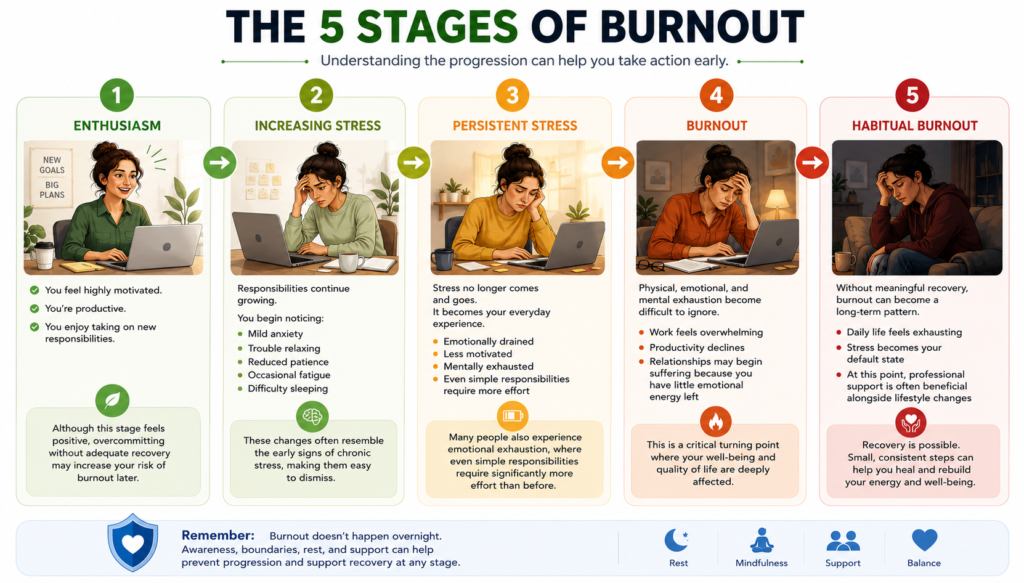
Burnout usually progresses through several stages rather than appearing suddenly.
Understanding these stages can help you recognize when it’s time to slow down before your health is affected.
Stage 1: Enthusiasm
You feel highly motivated.
You’re productive.
You enjoy taking on new responsibilities.
Although this stage feels positive, overcommitting without adequate recovery may increase your risk of burnout later.
Stage 2: Increasing Stress
Responsibilities continue growing.
You begin noticing:
- Mild anxiety
- Trouble relaxing
- Reduced patience
- Occasional fatigue
- Difficulty sleeping
These changes often resemble the early signs of chronic stress, making them easy to dismiss.
Stage 3: Persistent Stress
Stress no longer comes and goes.
It becomes your everyday experience.
You may begin feeling emotionally drained, less motivated, and mentally exhausted.
Many people also experience emotional exhaustion, where even simple responsibilities require significantly more effort than before.
Stage 4: Burnout
Physical, emotional, and mental exhaustion become difficult to ignore.
Work feels overwhelming.
Productivity declines.
Relationships may begin suffering because you simply have little emotional energy left.
Stage 5: Habitual Burnout
Without meaningful recovery, burnout can become a long-term pattern.
Daily life feels exhausting.
Stress becomes your default state.
At this point, professional support is often beneficial alongside lifestyle changes.
Burnout vs. Everyday Stress
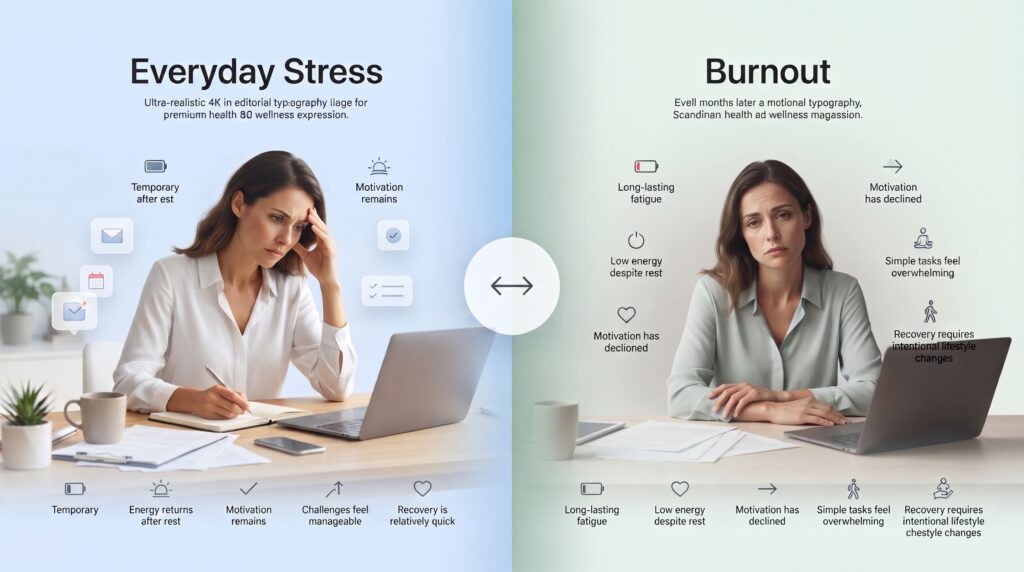
Although the two are closely related, stress and burnout are not the same thing.
Stress is usually temporary.
You may feel pressured before an important deadline or a challenging event, but once the situation passes, your energy gradually returns.
Burnout is different.
It’s the result of prolonged, unmanaged stress that leaves you emotionally, mentally, and physically depleted.
How to Recover from Burnout
If you’re experiencing burnout, the first thing to know is this:
Recovery is possible.
Burnout isn’t a permanent state. Your brain and body are remarkably adaptable, but they need time, consistency, and the right support to recover from prolonged stress.
Many people hope that taking a weekend off or a short vacation will solve the problem.
While rest is important, burnout recovery usually requires deeper lifestyle changes that address both the source of stress and the habits that keep you stuck in the cycle.
Think of recovery as rebuilding your energy rather than simply catching up on sleep.
Let’s explore the strategies that make the biggest difference.
1. Accept That Burnout Is a Signal, Not a Failure
One of the biggest obstacles to recovery is believing you should simply “push through.”
Many high-achieving people view burnout as a personal weakness.
In reality, burnout is often a sign that you’ve been functioning under excessive pressure for too long without enough opportunities to recover.
Instead of asking,
“Why can’t I handle this anymore?”
Try asking,
“What has been draining my energy, and what can I realistically change?”
This shift encourages self-awareness instead of self-criticism.
Recognizing burnout early gives you the opportunity to make meaningful changes before it affects your health more seriously.

2. Prioritize High-Quality Rest
Burnout recovery isn’t just about sleeping longer.
It’s about giving your brain genuine opportunities to recover.
That includes:
- Maintaining a consistent sleep schedule
- Taking short breaks throughout the day
- Reducing screen time before bed
- Scheduling downtime without feeling guilty
- Allowing yourself moments of stillness
Many people continue checking emails, answering messages, or thinking about work long after the workday ends.
Unfortunately, this keeps the brain activated and makes recovery much more difficult.
If racing thoughts are preventing you from relaxing, our guide on Overthinking at Night: Why Your Mind Won’t Switch Off offers practical techniques to calm your mind before bedtime.

3. Rebuild Healthy Daily Habits
Burnout often disrupts the routines that support good mental health.
Meals become rushed.
Exercise gets skipped.
Sleep becomes inconsistent.
Instead of trying to change everything overnight, focus on one small habit at a time.
You might begin by:
- Walking for 20–30 minutes each day
- Drinking enough water
- Eating balanced meals
- Spending time outdoors
- Practicing mindful breathing
- Creating a consistent bedtime routine
These habits may seem simple, but they create the foundation your brain and body need to recover.
If you’re looking for practical ideas, our guide to Simple Mental Wellness Routines That Actually Work shares sustainable habits that fit into even the busiest schedules.

4. Calm Your Nervous System
Burnout isn’t just emotional.
It’s also physiological.
When stress continues for weeks or months, your sympathetic nervous system—the body’s “fight-or-flight” response—can remain activated for longer than it’s designed to.
This ongoing activation affects:
- Heart rate
- Breathing
- Sleep quality
- Concentration
- Emotional regulation
- Muscle tension
Recovery involves activating the parasympathetic nervous system, sometimes called the “rest-and-digest” system.
Science-backed practices that support this include:
- Deep diaphragmatic breathing
- Meditation
- Gentle yoga
- Progressive muscle relaxation
- Spending time in nature
- Mindfulness exercises
Our article How Stress Affects Your Nervous System (And How to Calm It Naturally) explains why these techniques are effective and how they help your body transition from survival mode to recovery.
Likewise, improving mental clarity becomes easier as your nervous system becomes more balanced.

5. Set Healthier Boundaries
Burnout often develops because responsibilities continue expanding while personal boundaries disappear.
Learning to say “no” isn’t selfish.
It’s a way of protecting the energy you need to stay healthy.
Healthy boundaries may include:
- Finishing work on time
- Limiting after-hours emails
- Delegating responsibilities
- Taking regular breaks
- Protecting personal time
- Saying no to unnecessary commitments
Boundaries aren’t about avoiding responsibility.
They’re about creating balance.

6. Reconnect With Meaningful Activities
Burnout has a way of making life feel like an endless checklist.
One of the most effective ways to restore emotional energy is to intentionally reconnect with activities that bring joy and purpose.
That might include:
- Reading
- Gardening
- Painting
- Playing music
- Hiking
- Cooking
- Spending time with family
- Volunteering
These activities aren’t distractions from recovery.
They’re part of recovery.
They remind your brain that life includes more than deadlines and responsibilities.

When Should You Seek Professional Support?
Although many people recover from burnout by making healthy lifestyle changes, professional support can be extremely valuable when symptoms become more severe.
Consider speaking with a healthcare or mental health professional if:
- Exhaustion continues for several weeks despite improving your routine.
- You struggle to perform everyday responsibilities.
- Sleep problems persist.
- Anxiety or sadness becomes overwhelming.
- Your relationships are suffering.
- You feel emotionally detached most days.
- You begin losing hope that things will improve.
A qualified professional can help determine whether you’re experiencing burnout, an anxiety disorder, depression, or another condition that may require additional support.
Seeking help isn’t a sign that you’ve failed.
It’s a proactive investment in your long-term wellbeing.
Final Thoughts
Burnout rarely develops because someone isn’t strong enough.
More often, it develops because someone has been strong for too long without enough time to recover.
Your mind and body are incredibly resilient, but they also have limits.
Ignoring those limits doesn’t make them disappear—it simply delays the recovery your body has been asking for.
The encouraging news is that burnout is reversible.
By recognizing the warning signs early, improving your daily habits, protecting your boundaries, and prioritizing recovery, you can gradually rebuild your energy and emotional wellbeing.
If you’ve noticed early signs of chronic stress, persistent emotional exhaustion, or increasing mental overload, don’t wait for burnout to become more severe.
Every small action matters.
A short walk.
A mindful breath.
An earlier bedtime.
A healthy boundary.
Over time, these consistent choices can transform not only how you feel today but also how resilient you become in the future.
Recovery isn’t about becoming perfect.
It’s about becoming balanced.







No Comment! Be the first one.