




Have you ever reached the end of the day and thought,
Table Of Content
- What Is Mental Fatigue?
- Mental Fatigue vs. Normal Tiredness
- Common Symptoms of Mental Fatigue
- 1. You Can’t Focus Like You Used To
- 2. Brain Fog Becomes Your New Normal
- 3. You Forget Small Things More Often
- 4. Even Simple Decisions Feel Exhausting
- 5. You’re More Emotional Than Usual
- 6. Your Motivation Disappears
- 7. Rest Doesn’t Leave You Feeling Refreshed
- What Causes Mental Fatigue?
- Poor Sleep
- Information Overload
- Constant Multitasking
- Burnout
- 10 Science-Backed Recovery Tips for Mental Fatigue
- 1. Prioritize Quality Sleep, Not Just More Sleep
- 2. Stop Trying to Multitask
- 3. Give Your Brain Permission to Take Breaks
- 4. Practice Slow, Intentional Breathing
- 5. Move Your Body Every Day
- 6. Reduce Your Daily Mental Load
- 7. Spend Less Time Consuming Information
- 8. Practice Mindfulness Without Trying to Be Perfect
- 9. Fuel Your Brain Properly
- 10. Know When It’s Time to Ask for Help
- Final Thoughts
- Frequently Asked Questions
“I didn’t even do that much today… so why do I feel completely drained?”
Maybe you’ve slept for seven or eight hours, poured yourself a cup of coffee, and sat down to start work,only to find yourself staring at the screen, unable to focus.
Simple decisions suddenly feel complicated.
You forget why you walked into a room.
You read the same email three times before it finally makes sense.
If this sounds familiar, you’re not alone.
More importantly, you’re probably not lazy, unmotivated, or losing your ability to think clearly.
Your brain may simply be telling you that it’s exhausted.
This experience is known as mental fatigue, and it’s becoming increasingly common in today’s always-connected world. Between endless notifications, demanding workloads, family responsibilities, financial worries, and constant information overload, our minds rarely get the chance to truly rest.
The problem is that many people ignore these early warning signs.
They push through with more coffee.
Work longer hours.
Stay up later trying to catch up.
Unfortunately, that often makes the problem worse.
The good news?
Mental fatigue is something you can recover from. Once you understand why it’s happening, you can start making small, practical changes that help your brain recharge and regain its natural ability to focus.
In this guide, we’ll explore:
- What mental fatigue actually is
- The most common symptoms to look out for
- Why it happens
- How it’s different from ordinary tiredness
- And 10 science-backed strategies that can help you feel mentally refreshed again.
What Is Mental Fatigue?
Think about your smartphone for a moment.
When you first buy it, everything runs smoothly. Apps open instantly, the battery lasts all day, and switching between tasks is effortless.
Now imagine opening dozens of apps without ever closing them.
Streaming music.
Watching videos.
Downloading files.
Keeping dozens of browser tabs open.
Eventually, your phone starts slowing down. The battery drains faster, apps freeze, and even simple tasks take longer than they should.
Your brain works in a surprisingly similar way.
Every conversation you have, every decision you make, every notification you respond to, and every stressful situation your mind processes requires mental energy.
Normally, your brain gets a chance to recover through quality sleep, relaxation, physical movement, and quiet moments throughout the day.
But when life becomes a constant cycle of pressure, deadlines, multitasking, and emotional stress, that recovery time often disappears.
Instead of recharging, your brain keeps working.
Day after day.
Week after week.
Eventually, it starts sending signals that it’s running low on energy.
That’s what we call mental fatigue.
Mental fatigue isn’t simply feeling sleepy. It’s a state of cognitive and emotional exhaustion, where your brain struggles to process information as efficiently as it normally would.
You might notice that your attention wanders more easily. You forget little things. Solving problems feels harder than usual. Even activities you normally enjoy can start to feel like a chore.
If you’ve recently been under constant pressure, you may also recognize some of the warning signs discussed in our article on Early Signs of Chronic Stress You Shouldn’t Ignore, where we explain how prolonged stress gradually affects both the brain and body.
The important thing to remember is this:
Mental fatigue isn’t a sign of weakness. It’s a sign that your brain has been working harder than it’s had time to recover from.

Mental Fatigue vs. Normal Tiredness
We’ve all had those days when we’re simply tired.
Maybe you spent the day travelling, exercised more than usual, or stayed up too late watching your favourite series.
In most cases, a good night’s sleep is enough to help you bounce back.
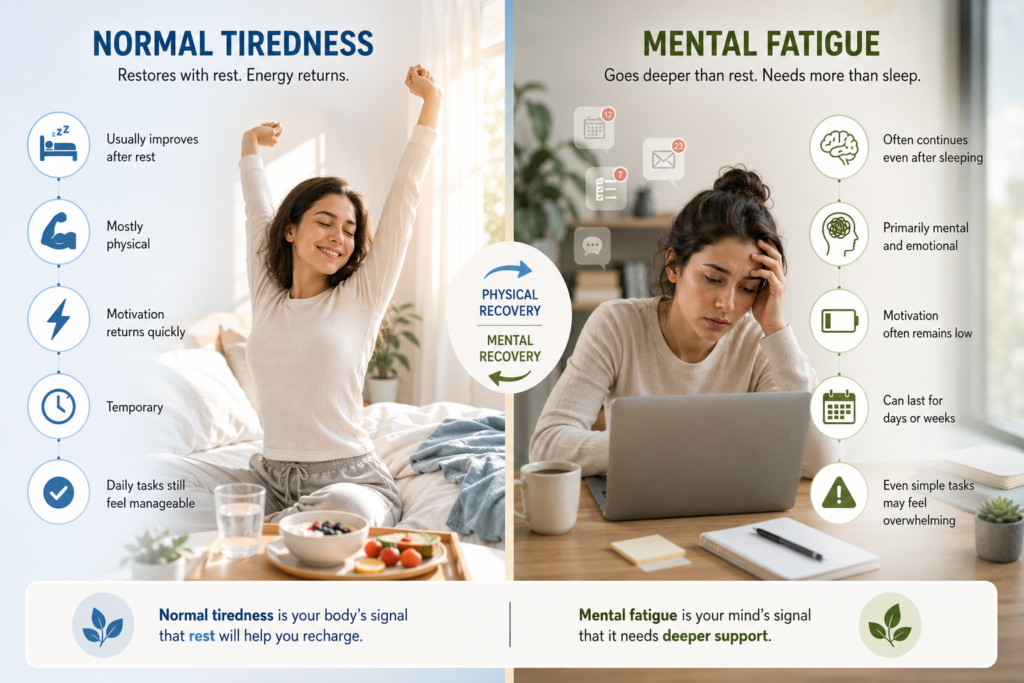
Mental fatigue feels different.
Imagine waking up after eight hours of sleep but still feeling like your brain never switched off.
Your body might have rested, but your mind still feels foggy.
You struggle to focus during meetings.
Simple decisions,like replying to an email or deciding what to cook for dinner,feel strangely overwhelming.
Even things you usually enjoy don’t seem as interesting.
That’s because mental fatigue isn’t just about being physically tired.
It’s about your brain’s ability to process information, stay focused, regulate emotions, and make decisions efficiently.
Researchers believe that prolonged stress can keep the body’s stress-response system activated for too long. When stress hormones such as cortisol remain elevated over extended periods, they may interfere with attention, memory, emotional regulation, and overall cognitive performance.
If you’d like to understand why this happens, our guide on How Stress Affects Your Nervous System (And How to Calm It Naturally) explains how chronic stress influences the brain and nervous system,and why recovery is just as important as productivity.
If you’ve been feeling this way for several weeks, your brain may be asking for recovery,not more pressure.
Common Symptoms of Mental Fatigue
Mental fatigue doesn’t usually arrive overnight.
It sneaks into your life little by little.
At first, you might think, “I’m just having an off day.”
Then those “off days” start happening more often.
Before you know it, getting through your normal routine feels harder than it used to.
The tricky part is that many of these symptoms are easy to dismiss. You might blame a busy schedule, poor sleep, or simply getting older. While those factors can certainly play a role, persistent mental fatigue is often your brain’s way of saying, “I need a chance to recover.”
Let’s look at some of the most common signs.
1. You Can’t Focus Like You Used To
Have you ever opened your laptop to start an important task, only to find yourself checking emails, scrolling through your phone, and staring out the window five minutes later?
Mental fatigue makes it much harder for your brain to filter distractions and stay focused.
Tasks that once took 20 minutes suddenly take an hour because your attention keeps drifting.
If you’ve noticed your concentration slipping recently, you may also find our guide on Mental Clarity: How to Clear a Busy Mind helpful. It shares practical strategies to improve focus when your mind feels overloaded.


2. Brain Fog Becomes Your New Normal
Many people describe mental fatigue as feeling like they’re thinking through a thick fog.
Words don’t come as easily.
Problem-solving feels slower.
You know the answer is somewhere in your mind, you just can’t seem to access it.
This isn’t a sign that you’re becoming less intelligent.
More often, it’s a sign that your brain has been working without enough recovery time.
3. You Forget Small Things More Often
Everyone forgets things occasionally.
But when mental fatigue builds up, these little memory lapses become more noticeable.
You might:
- Walk into a room and forget why.
- Miss appointments you normally wouldn’t.
- Forget someone’s name moments after hearing it.
- Read the same paragraph several times before understanding it.
These temporary memory problems are common when your brain is under prolonged stress.


4. Even Simple Decisions Feel Exhausting
What should I cook tonight?
Should I reply to this email now or later?
Which task should I start first?
Normally, these decisions take only a few seconds.
But when you’re mentally fatigued, even the smallest choices can feel surprisingly overwhelming.
This happens because your brain has a limited amount of mental energy each day. When that energy has already been used up by constant stress and decision-making, even routine choices begin to feel difficult.
5. You’re More Emotional Than Usual
Have you noticed yourself becoming irritated over things that normally wouldn’t bother you?
Perhaps someone makes a small comment, and it feels much more upsetting than it should.
Or maybe you find yourself tearing up during a commercial or feeling frustrated over a minor inconvenience.
Mental fatigue doesn’t just affect your thinking, it also affects how you regulate your emotions.
If emotional exhaustion has been part of your experience, our article on Emotional Exhaustion: Signs, Causes, and How to Recover explains why prolonged stress can leave you feeling emotionally drained.


6. Your Motivation Disappears
One of the most frustrating parts of mental fatigue is losing the motivation to do things you genuinely care about.
Projects you were excited about suddenly feel like obligations.
Even hobbies that usually help you relax don’t seem appealing.
This doesn’t mean you’ve become lazy.
It often means your brain is trying to conserve the little mental energy it has left.
7. Rest Doesn’t Leave You Feeling Refreshed
Perhaps the biggest clue that you’re dealing with mental fatigue is this:
You rest…
…but you still don’t feel rested.
You sleep for eight hours.
You take the weekend off.
You even go on holiday.
Yet within a day or two, you’re back to feeling mentally drained.
That’s because recovery isn’t only about getting more sleep.
It’s about reducing the mental load your brain has been carrying for weeks, or even months.

What Causes Mental Fatigue?
If you’re experiencing mental fatigue, you might be wondering,
“Why is this happening to me?”
The answer is rarely just one thing.
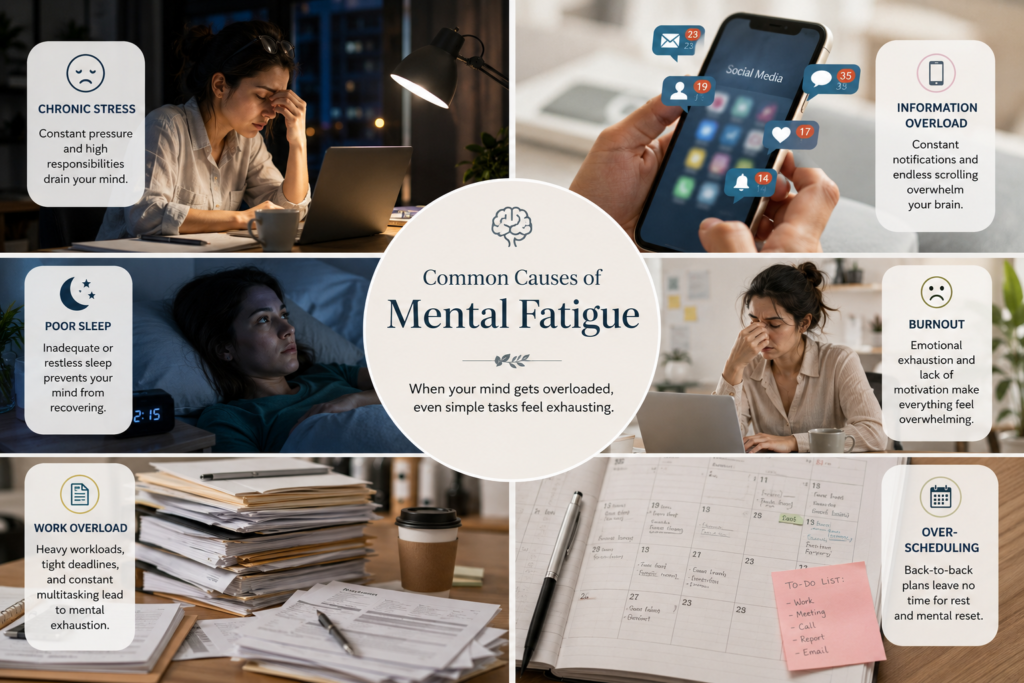
Mental fatigue usually develops when your brain has been under continuous pressure without enough time to recover.
Think of it like constantly withdrawing money from your bank account without making any deposits.
Eventually, your balance runs low.
Your mental energy works in much the same way.
Here are some of the most common reasons people experience mental fatigue.
Poor Sleep
Sleep is when your brain performs many of its essential maintenance tasks.
It processes memories, clears waste products, restores energy, and prepares you for the next day.
When sleep becomes inconsistent or poor in quality, your brain simply doesn’t get the recovery time it needs.


Information Overload
Most of us consume more information in a single day than previous generations did in an entire week.
Emails, Social media, News, Podcasts, Videos, Messages, Notifications.
Your brain has to process all of it.
Without regular breaks, this constant stream of information can become mentally exhausting.
Constant Multitasking
Many people believe multitasking makes them more productive.
In reality, research suggests our brains switch rapidly between tasks rather than doing multiple things simultaneously.
Each switch requires additional mental effort.
Over time, this can leave you feeling mentally depleted even if you haven’t completed much meaningful work.


Burnout
Mental fatigue is also one of the earliest signs of burnout.
If you’ve been pushing yourself for months without proper recovery, mental fatigue can gradually develop into emotional exhaustion and eventually burnout.
That’s why it’s important to recognize the early warning signs.
Our article Burnout Symptoms: How to Recognize Burnout Before It Gets Worse explains what to watch for before stress becomes more difficult to manage.
10 Science-Backed Recovery Tips for Mental Fatigue
If you’ve made it this far, you might be thinking,
“Okay… I know what’s happening. But how do I actually feel like myself again?”
That’s the question that matters most.
The encouraging news is that mental fatigue is usually reversible. Your brain is remarkably adaptable, and when you give it the right environment, it can recover.
The goal isn’t to “push through” or simply wait for things to improve.
It’s to create small, consistent habits that help your brain recharge.
Let’s look at what really works.
1. Prioritize Quality Sleep, Not Just More Sleep
When you’re mentally exhausted, your first instinct might be to sleep longer.
Sometimes that’s helpful, but quality matters just as much as quantity.
Your brain uses sleep to consolidate memories, regulate emotions, and restore the mental energy you’ve used throughout the day.
Try to:
- Go to bed and wake up at the same time each day.
- Avoid screens 30–60 minutes before bedtime.
- Keep your bedroom cool, quiet, and dark.
- Limit caffeine later in the day.
If falling asleep has become a challenge, you’ll also benefit from our upcoming guide on How Sleep Affects Stress, Anxiety, and Mental Clarity, where we’ll explore simple habits that support deeper, more restorative sleep.
2. Stop Trying to Multitask
Many of us wear multitasking like a badge of honour.
But here’s the truth:
Your brain isn’t designed to focus on several demanding tasks at once.
Instead, it rapidly switches between them, and every switch costs mental energy.
For the next few days, try doing one thing at a time.
Close unnecessary browser tabs.
Silence notifications.
Finish one task before moving to the next.
You may be surprised by how much lighter your mind feels.
3. Give Your Brain Permission to Take Breaks
Have you ever noticed that your best ideas often come when you’re walking, showering, or simply taking a break?
That’s because your brain needs moments of recovery to process information.
Instead of working for hours without stopping, try the 50–10 rule:
- Focus for 50 minutes.
- Step away for 10 minutes.
Stretch.
Walk.
Look outside.
Take a few slow breaths.
Small pauses throughout the day can prevent mental fatigue from building up.
4. Practice Slow, Intentional Breathing
When we’re stressed, our breathing often becomes fast and shallow without us even noticing.
Slowing your breathing sends a signal to your nervous system that you’re safe.
One of the easiest techniques is this:
- Inhale through your nose for 4 seconds
- Exhale slowly for 6 seconds
- Repeat for 5 minutes
Longer exhalations encourage your body to shift toward its natural relaxation response.
If you’d like to learn more, our guide on How Stress Affects Your Nervous System (And How to Calm It Naturally) explains why breathing is such a powerful tool for recovery.
5. Move Your Body Every Day
You don’t need an intense workout.
In fact, when you’re mentally fatigued, gentle movement is often more beneficial.
A 20-minute walk.
Some light stretching.
Yoga.
Cycling.
Even dancing in your living room.
Physical activity improves blood flow to the brain, reduces stress hormones, and releases endorphins that naturally improve mood and mental clarity.

6. Reduce Your Daily Mental Load
Sometimes, the problem isn’t that life is too busy.
It’s that your brain is trying to remember everything.
Appointments.
Shopping lists.
Work deadlines.
Family commitments.
Passwords.
Bills.
Instead of keeping it all in your head, get it out.
Write things down.
Use a planner.
Create checklists.
Set reminders.
Every task you move from your mind to paper frees up valuable mental space.
If your thoughts constantly feel like they’re competing for attention, our article Mental Overload: When Your Mind Feels Too Full offers practical ways to simplify the mental clutter.
7. Spend Less Time Consuming Information
Take a moment and think about how many times you’ve checked your phone today.
News.
Emails.
Social media.
Videos.
Messages.
Your brain is processing hundreds, sometimes thousands, of pieces of information every day.
Try creating technology-free moments.
Leave your phone in another room during meals.
Go for a walk without headphones.
Read a book instead of scrolling before bed.
These small habits give your brain something it rarely gets…
Silence.
8. Practice Mindfulness Without Trying to Be Perfect
A lot of people hear the word mindfulness and imagine sitting cross-legged for an hour.
It doesn’t have to look like that.
Mindfulness simply means paying attention to what’s happening right now.
Notice your breathing.
Feel your feet on the ground.
Drink your coffee without checking your phone.
Take one mindful minute between meetings.
Tiny moments of awareness can interrupt the cycle of constant mental stimulation.
If you’re new to mindfulness, you’ll enjoy Simple Mental Wellness Routines That Actually Work, where we share beginner-friendly habits that fit naturally into everyday life.
9. Fuel Your Brain Properly
Your brain uses around 20% of your body’s energy, even though it makes up only a small percentage of your body weight.
That means what you eat matters.
Aim for meals that include:
- Whole grains
- Vegetables
- Fruit
- Healthy fats
- Lean protein
- Plenty of water
Skipping meals or relying on sugar and caffeine may give you a short burst of energy, but it often leads to an even bigger crash later.
10. Know When It’s Time to Ask for Help
Sometimes, mental fatigue improves with rest and healthy lifestyle changes.
Sometimes, it doesn’t.
If you’ve been feeling mentally exhausted for several weeks, or if it’s affecting your work, relationships, or daily life, it’s worth speaking with a healthcare professional.
Persistent mental fatigue can sometimes be linked to chronic stress, anxiety, depression, sleep disorders, nutritional deficiencies, or other medical conditions that deserve proper attention.
Asking for help isn’t giving up.
It’s taking care of yourself.

Final Thoughts
Mental fatigue doesn’t mean you’re weak.
It doesn’t mean you’ve failed.
And it certainly doesn’t mean you’ll always feel this way.
More often than not, it’s your brain asking for something it hasn’t had enough of, rest, balance, and recovery.
You don’t have to change your entire life overnight.
Start with one habit.
Take one proper break today.
Go for one short walk.
Practice one breathing exercise.
Protect one hour before bed from screens.
Small changes may seem insignificant in the moment, but over time, they can make a remarkable difference.
If you’ve recognised yourself in this article, don’t ignore those signals. Your mind works incredibly hard for you every single day. Giving it the care it deserves isn’t a luxury, it’s an investment in your long-term health and wellbeing.
And remember, recovery isn’t about becoming a different person.
It’s about helping your mind feel like you again.
Frequently Asked Questions
What is mental fatigue?
Mental fatigue is a state of cognitive and emotional exhaustion caused by prolonged mental effort, chronic stress, or insufficient recovery. It can affect concentration, memory, motivation, and decision-making, even if you’ve had enough sleep.
What causes mental fatigue?
Common causes include chronic stress, poor sleep, constant multitasking, emotional strain, information overload, burnout, and long periods of intense mental work without adequate rest.
How long does mental fatigue last?
Recovery varies from person to person. Some people feel better within a few days after improving sleep and reducing stress, while others may need several weeks or longer if mental fatigue has built up over time.
Can mental fatigue be cured naturally?
In many cases, yes. Quality sleep, regular exercise, healthy nutrition, mindfulness, breathing exercises, and reducing daily stress can significantly improve mental fatigue. If symptoms persist, it’s important to seek professional medical advice.
What's the difference between burnout and mental fatigue?
Mental fatigue is often an early warning sign, while burnout is a more severe state of prolonged emotional, physical, and mental exhaustion. Recognising mental fatigue early can help prevent burnout.

Art of Wellness Team is a collective of mental wellness writers and researchers focused on stress, anxiety, and mental clarity. We create practical, evidence-informed content to help readers better understand their mental well-being and build healthier habits for everyday life.






No Comment! Be the first one.