




Have you ever sat down to do something important…
Table Of Content
- What Does "Focus" Actually Mean?
- Why Is It So Hard to Focus Today?
- Early Signs Your Brain Is Struggling to Concentrate
- What's Really Stealing Your Attention?
- Is It Normal to Lose Focus Sometimes?
- 6 Reasons You Can't Focus Anymore
- 1. Chronic Stress Keeps Your Brain in Survival Mode
- 2. You're Mentally Exhausted Without Realizing It
- 3. Poor Sleep Is Quietly Affecting Your Brain
- 4. Your Brain Never Gets a Break
- 5. You're Trying to Do Too Many Things at Once
- 6. Anxiety Is Filling Your Mind With "What If..."
- It's Usually Not Just One Thing
- 12 Science-Backed Ways to Improve Your Concentration
- 1. Stop Multitasking
- 2. Protect Your Sleep Like It's an Appointment
- 3. Give Your Brain Regular Breaks
- 4. Move Your Body
- 5. Create Phone-Free Moments
- 6. Practice Mindfulness
- 7. Reduce Mental Clutter
- 8. Fuel Your Brain Properly
- 9. Learn to Say "No"
- 10. Spend Time in Nature
- 11. Manage Stress Instead of Ignoring It
- 12. Ask for Help When You Need It
- Final Thoughts
- Frequently Asked Questions
Opened your laptop…
Read the first paragraph…
Then suddenly realized you’d been staring at the same sentence for five minutes?
Or maybe you’ve walked into a room and completely forgotten why you were there.
Perhaps you’re in the middle of a conversation, and your mind drifts somewhere else without warning.
If you’re nodding your head right now, you’re definitely not alone.
One of the most common questions people ask today is:
“Why can’t I focus anymore?”
It’s frustrating because you know you’re capable of concentrating.
You remember a time when you could work for hours, study without constantly checking your phone, or finish a book without rereading the same page over and over again.
So what changed?
The answer usually isn’t that you’ve become lazy or less intelligent.
More often than not, your brain is reacting to the way modern life places continuous demands on your attention.
Stress.
Constant notifications.
Poor sleep.
Mental fatigue.
Multitasking.
Information overload.
Each one quietly chips away at your ability to concentrate.
The good news is that concentration isn’t something you’ve permanently lost.
It’s a skill your brain can rebuild when you understand what’s getting in the way.
In this guide, we’ll explore:
- Why your concentration has changed
- The hidden reasons your brain struggles to focus
- What science says about attention
- And practical, everyday strategies that can help you improve your focus again.
What Does "Focus" Actually Mean?
When people talk about focus, they’re usually referring to their ability to pay attention to one thing without becoming distracted.
But your brain is doing much more than that.
Every time you concentrate, your brain has to:
- Filter out distractions
- Hold information in working memory
- Ignore interruptions
- Switch between tasks when necessary
- Make decisions
- Regulate emotions
That’s a lot of work.
Imagine trying to have an important conversation in a crowded café where dozens of people are talking at the same time.
You could probably still hear the person sitting across from you…
But it would take much more effort.
That’s exactly what happens inside your brain when it’s overloaded.
Your thoughts become the background noise.
The task you’re trying to complete becomes the conversation.
And eventually, the noise wins.

Why Is It So Hard to Focus Today?
Think about your average morning.
Before you’ve even finished breakfast, you’ve probably:
Checked your phone.
Read a few messages.
Looked at social media.
Answered an email.
Seen today’s news.
Maybe listened to a podcast.
Your brain hasn’t even had a chance to wake up properly…
…and it’s already processing hundreds of pieces of information.
Now imagine repeating that every day.
Week after week.
Month after month.
Eventually, your brain starts protecting itself.
Instead of concentrating deeply on one thing, it becomes trained to expect constant interruptions.
This isn’t because your brain is broken.
It’s because it’s adapting to the environment you’ve given it.
Researchers often refer to this as cognitive overload, a state where the amount of information competing for your attention exceeds your brain’s ability to process it efficiently.
If you’ve ever felt like your mind has “too many tabs open,” you’ll probably relate to our article Mental Overload: When Your Mind Feels Too Full, where we explore why modern life leaves so many people feeling mentally overwhelmed.
Early Signs Your Brain Is Struggling to Concentrate
Loss of focus rarely happens overnight.
It usually starts with small changes that are easy to ignore.
For example…
You begin rereading emails because the information doesn’t stick.
You lose your train of thought halfway through a sentence.
Meetings feel longer than they used to.
You keep switching between tasks without actually finishing any of them.
Simple decisions take longer.
You procrastinate, not because you don’t care, but because your brain feels overloaded before you’ve even started.
Sound familiar?
These are often early signs that your brain is working harder than it’s recovering.
If you’ve recently noticed several of these symptoms, you may also benefit from reading Mental Fatigue: Symptoms, Causes, and 10 Science-Backed Recovery Tips, where we explain how prolonged mental effort gradually reduces your brain’s ability to think clearly.
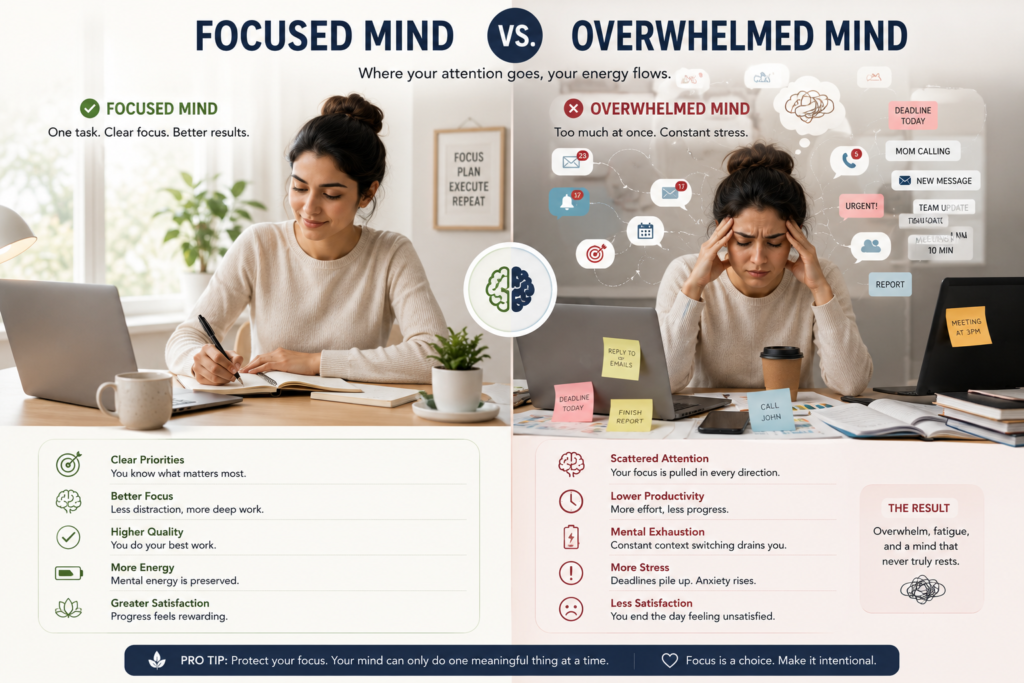
What's Really Stealing Your Attention?
Many people blame themselves when they can’t focus.
They think,
“Maybe I just need to try harder.”
But concentration isn’t simply about willpower.
Your ability to focus is influenced by many different parts of your physical and mental health.
Stress can keep your brain in survival mode.
Poor sleep reduces attention and memory.
Mental fatigue drains your cognitive energy.
Anxiety fills your mind with constant “what if” thoughts.
Even emotional exhaustion can make simple tasks feel mentally overwhelming.
That’s why improving concentration isn’t about finding one magical productivity hack.
It’s about understanding why your brain is struggling in the first place.
Our article How Stress Affects Your Nervous System (And How to Calm It Naturally) explains how prolonged stress affects the brain’s ability to shift from survival mode into a calmer, more focused state.
Is It Normal to Lose Focus Sometimes?
Absolutely.
Everyone loses concentration from time to time.
Poor sleep.
Stress.
A busy week at work.
Looking after children.
Preparing for exams.
All of these can temporarily affect your attention.
The difference is this:
Temporary loss of focus improves once life settles down.
Persistent difficulty concentrating continues even after you’ve had time to rest.
If you’ve been struggling for several weeks, or longer, it’s worth paying attention.
Your brain may be asking for recovery rather than more productivity.
6 Reasons You Can't Focus Anymore
By now, you might be wondering,
“So… what’s actually causing this?”
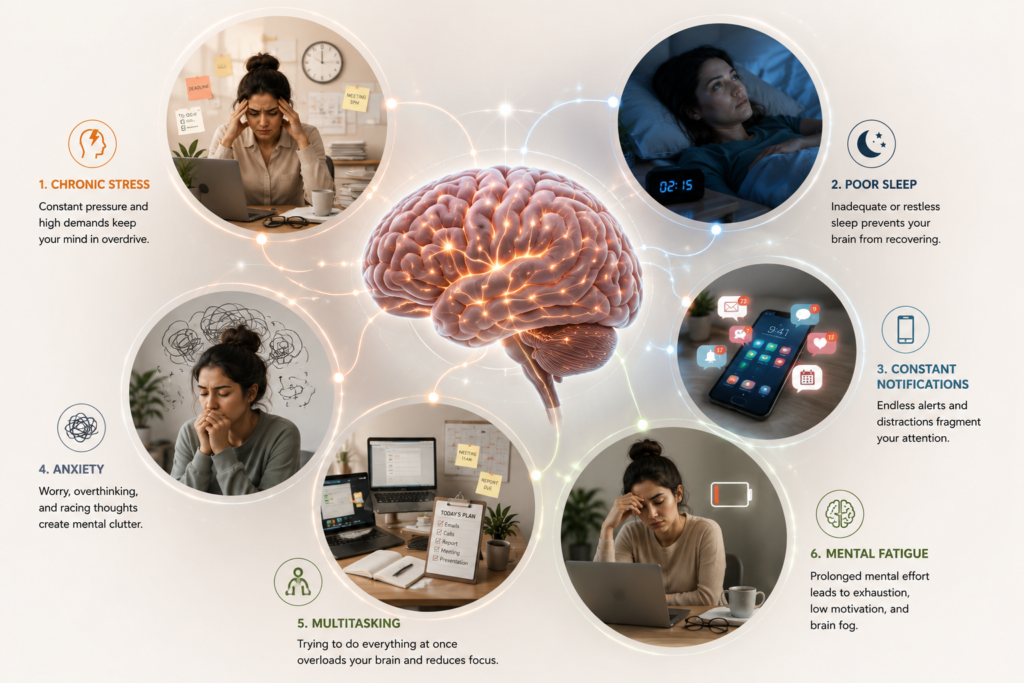
The truth is, there’s rarely just one reason.
Think of your ability to focus like a smartphone battery.
One app running in the background doesn’t make much difference.
But when dozens of apps are running at the same time, your battery drains quickly, even if you’re not actively using them.
Your brain works in a similar way.
Stress, poor sleep, emotional strain, constant notifications, and endless decision-making all run quietly in the background, using up mental energy without you even realizing it.
Let’s look at the most common reasons.
1. Chronic Stress Keeps Your Brain in Survival Mode
Imagine trying to read a book while someone is constantly shouting your name.
That’s what chronic stress can feel like for your brain.
When you’re under ongoing pressure, your body releases stress hormones like cortisol and adrenaline. These hormones are incredibly helpful during short-term emergencies because they make you more alert and ready to react.
The problem is…
Modern stress rarely lasts just a few minutes.
Work deadlines.
Financial worries.
Family responsibilities.
Health concerns.
Relationship challenges.
When stress continues for weeks or months, your brain stays on high alert instead of switching into recovery mode.
It’s much harder to focus when part of your brain is constantly scanning for the next problem.
If this sounds familiar, you’ll find practical recovery strategies in How to Recover from Chronic Stress: 12 Science-Backed Ways to Reset Your Mind and Body.
2. You're Mentally Exhausted Without Realizing It
Have you ever reached the end of the day feeling completely drained…
…even though you hardly left your desk?
That’s because thinking is work.
Making decisions is work.
Managing emotions is work.
Concentrating for hours is work.
Your brain uses an enormous amount of energy every day.
Without enough recovery, it simply slows down to protect itself.
That’s why focus often disappears before physical energy does.
If you’ve been feeling mentally “empty” lately, our article Mental Fatigue: Symptoms, Causes, and 10 Science-Backed Recovery Tips explains why this happens and how to recover.
3. Poor Sleep Is Quietly Affecting Your Brain
Most people know poor sleep makes them feel tired.
What many people don’t realize is how much it affects attention.
Even one or two nights of poor-quality sleep can make it harder to:
- Stay focused
- Learn new information
- Remember details
- Solve problems
- Control emotions
Think about the last time you slept badly.
Did everything seem just a little harder the next day?
That’s not your imagination.
While you sleep, your brain is busy repairing, organizing memories, and clearing away metabolic waste that builds up throughout the day.
When that recovery process is interrupted, concentration is often one of the first things to suffer.
4. Your Brain Never Gets a Break
Let’s be honest.
When was the last time you stood in a queue…
…without reaching for your phone?
Or sat quietly for five minutes…
…without checking a notification?
Most of us fill every spare moment with information.
Social media.
Emails.
Videos.
News.
Podcasts.
Messages.
Your brain is constantly consuming something.
Eventually, it reaches a point where it simply can’t process any more.
That’s when focus begins to fade.
Our guide Mental Overload: When Your Mind Feels Too Full explores why information overload has become one of the biggest challenges to modern mental wellbeing.
5. You're Trying to Do Too Many Things at Once
Many people proudly say,
“I’m great at multitasking.”
But neuroscience tells a different story.
Your brain doesn’t truly multitask.
Instead, it switches rapidly between tasks.
Every switch takes time.
Every switch uses mental energy.
Imagine driving a car while someone keeps grabbing the steering wheel every few seconds.
Eventually, the journey becomes exhausting.
That’s exactly what constant task-switching does to your attention.
Instead of finishing one thing well, your brain keeps restarting.
6. Anxiety Is Filling Your Mind With "What If..."
Even when you’re sitting quietly, anxiety can keep your brain incredibly busy.
“What if I make a mistake?”
“What if something goes wrong?”
“What if I forget something important?”
Those thoughts compete for the same mental resources you need for concentration.
It’s difficult to focus on today’s work when your mind is already imagining tomorrow’s problems.
If you’ve ever wondered whether you’re dealing with anxiety or stress, our article Anxiety vs. Stress: Key Differences You Should Know can help you understand the difference.

It's Usually Not Just One Thing
One of the biggest myths about concentration is that there’s always one simple cause.
In reality…
It’s often a combination.
Imagine this.
You’re sleeping six hours a night.
Work has been stressful for months.
You’re checking your phone every few minutes.
You’ve stopped exercising.
You’re constantly thinking about everything you still need to do.
None of those things alone might completely destroy your focus.
Together?
They create the perfect environment for poor concentration.
That’s why improving your focus isn’t about finding a miracle supplement or productivity hack.
It’s about reducing the number of things that are quietly draining your mental energy every day.
The encouraging news is that your brain is incredibly adaptable.
When you remove some of those daily pressures and support it with healthier habits, your ability to concentrate can improve, often much more than you expect.

12 Science-Backed Ways to Improve Your Concentration
Here’s something that might surprise you.
Your brain wants to focus.
It isn’t trying to work against you.
In fact, your brain performs best when it feels safe, well-rested, and free from constant interruptions.
The problem is that most of us spend our days doing the exact opposite.
We rush from one task to another.
We check our phones dozens of times an hour.
We skip breaks.
We stay up late.
Then we wonder why concentrating feels impossible.
The good news?
You don’t need to completely change your life to improve your focus.
Small, consistent changes often have the biggest impact.
Let’s look at some of the habits that research and everyday experience suggest can make a real difference.
1. Stop Multitasking
Let’s start with one of the biggest myths about productivity.
Doing several things at once doesn’t make you more efficient.
It usually makes you slower.
Every time you switch between emails, messages, meetings, and work, your brain needs a few moments to refocus.
That constant switching drains mental energy.
Instead, try this simple challenge:
Choose one task.
Set a timer for 30–45 minutes.
Turn off notifications.
Give that task your full attention before moving to the next.
You may be surprised how much more you accomplish.
2. Protect Your Sleep Like It's an Appointment
Many people sacrifice sleep to get more done.
Ironically, that often makes them less productive the next day.
Your brain needs quality sleep to organise memories, repair neural connections, regulate emotions, and prepare for another day of thinking.
Treat your bedtime the same way you’d treat an important meeting.
Because in many ways…
It is.
3. Give Your Brain Regular Breaks
Have you ever noticed your best ideas arrive when you’re walking the dog, taking a shower, or making a cup of tea?
That’s not a coincidence.
Your brain continues processing information even when you’re not actively working.
Instead of waiting until you’re exhausted, schedule short breaks throughout the day.
Stand up.
Stretch.
Walk outside.
Look at something other than a screen.
Those few minutes help your brain reset.
4. Move Your Body
You don’t have to run a marathon.
Even a 20-minute walk can improve blood flow to the brain and support attention.
Movement also helps reduce stress hormones while increasing chemicals that support learning, memory, and mood.
If you’ve been feeling mentally drained recently, combining regular movement with the recovery strategies in Mental Fatigue: Symptoms, Causes, and 10 Science-Backed Recovery Tips can make a noticeable difference over time.
5. Create Phone-Free Moments
Take a moment and ask yourself:
How many times have you picked up your phone today…
…without even thinking about it?
Most of us don’t realise how often our attention is interrupted.
Try creating small phone-free habits.
Leave your phone in another room while working.
Avoid checking notifications during meals.
Spend the first 30 minutes after waking up without social media.
Your attention span will thank you.
6. Practice Mindfulness
Mindfulness isn’t about emptying your mind.
It’s about gently bringing your attention back whenever it wanders.
That could be while drinking your morning coffee.
Walking outside.
Listening to music.
Or simply noticing your breathing for one minute.
If you’re new to mindfulness, our guide Simple Mental Wellness Routines That Actually Work includes practical habits you can start today.

7. Reduce Mental Clutter
Have you ever gone to the supermarket…
…only to remember three more things you needed while standing in the checkout line?
Your brain spends an incredible amount of energy trying to remember unfinished tasks.
Instead of relying on memory for everything, write things down.
Keep a notebook nearby.
Use reminders.
Create checklists.
Freeing your mind from trying to remember everything leaves more room for focused thinking.
If your thoughts often feel scattered, you’ll probably enjoy Mental Overload: When Your Mind Feels Too Full, where we explore simple ways to quiet a busy mind.
8. Fuel Your Brain Properly
Your brain needs a steady supply of nutrients to perform well.
Skipping meals, relying on sugary snacks, or drinking coffee instead of eating can lead to energy crashes that make concentrating even harder.
Aim for balanced meals that include:
- Whole grains
- Healthy fats
- Fruit and vegetables
- Lean protein
- Plenty of water
You don’t need a perfect diet.
Just aim for consistency.
9. Learn to Say "No"
Sometimes poor concentration isn’t caused by a lack of ability.
It’s caused by having too much on your plate.
Every commitment requires mental energy.
Every unfinished task takes up space in your mind.
Protecting your focus sometimes means politely declining things that don’t align with your priorities.
Remember…
Every “yes” is also a “no” to something else.
10. Spend Time in Nature
Nature gives your brain something modern life rarely does…
Gentle stimulation.
A walk in the park.
Sitting by a lake.
Listening to birds.
Research suggests that spending time in natural environments may help reduce stress and restore attention.
You don’t have to disappear into the mountains.
Even twenty minutes outside can help.
11. Manage Stress Instead of Ignoring It
If stress is constantly running in the background, concentrating becomes much harder.
That’s why improving focus often begins with managing stress.
Deep breathing.
Journaling.
Exercise.
Meditation.
Talking with someone you trust.
These aren’t just relaxation techniques.
They’re ways of helping your brain move out of survival mode.
If stress has become a daily companion, we recommend reading How Stress Affects Your Nervous System (And How to Calm It Naturally) to better understand what’s happening inside your body.
12. Ask for Help When You Need It
Sometimes difficulty concentrating is connected to something that needs professional support.
Persistent problems with focus can occasionally be related to anxiety, depression, sleep disorders, ADHD, nutritional deficiencies, or other medical conditions.
If your concentration has changed significantly and doesn’t improve despite healthy habits, don’t hesitate to speak with a healthcare professional.
Seeking help isn’t a sign of weakness.
It’s one of the healthiest decisions you can make.

Final Thoughts
If you’ve been struggling to focus lately, take a deep breath.
You’re not alone.
And you’re certainly not “broken.”
In today’s world, our attention is constantly being pulled in dozens of different directions. It’s no surprise that so many people feel distracted, mentally drained, or unable to concentrate the way they used to.
The important thing is to listen to what your mind is telling you.
Sometimes, difficulty concentrating isn’t a sign that you need to work harder.
It’s a sign that you need to recover.
Start with one small change this week.
Maybe it’s putting your phone away during dinner.
Taking a short walk during your lunch break.
Going to bed 30 minutes earlier.
Or simply allowing yourself a proper break without feeling guilty.
These small choices may not seem dramatic, but over time they can help your brain regain the clarity and focus you’ve been missing.
Be patient with yourself.
Your brain has an incredible ability to adapt, and with the right support, your concentration can improve again.
Frequently Asked Questions
Why can't I focus anymore even after getting enough sleep?
Sleep is important, but it’s only one piece of the puzzle. Chronic stress, mental fatigue, anxiety, information overload, poor nutrition, and constant multitasking can all affect concentration, even if you’re getting seven or eight hours of sleep.
Can stress really affect concentration?
Yes. Ongoing stress can keep your brain in a heightened state of alertness, making it harder to concentrate, remember information, and make decisions.
How can I improve my focus naturally?
Simple habits such as getting quality sleep, taking regular breaks, reducing distractions, exercising, practicing mindfulness, staying hydrated, and managing stress can all help improve concentration over time.
Is brain fog the same as poor concentration?
Not exactly. Brain fog is a broader term that often includes mental sluggishness, forgetfulness, and difficulty thinking clearly. Poor concentration is one of the symptoms that can occur alongside brain fog.
When should I see a doctor about concentration problems?
If your difficulty concentrating lasts for several weeks, interferes with work or daily life, or is accompanied by symptoms such as persistent low mood, severe anxiety, memory problems, or significant changes in behaviour, it’s a good idea to consult a healthcare professional for an evaluation.

Art of Wellness Team is a collective of mental wellness writers and researchers focused on stress, anxiety, and mental clarity. We create practical, evidence-informed content to help readers better understand their mental well-being and build healthier habits for everyday life.






No Comment! Be the first one.