




Have you ever walked into a room…
Table Of Content
- What Exactly Is Brain Fog?
- Brain Fog vs. Forgetfulness: Are They the Same?
- Common Symptoms of Brain Fog
- You Read the Same Thing Over and Over
- You Forget Everyday Things
- You Feel Mentally Slow
- Making Decisions Feels Harder
- You Struggle to Stay Present
- When Brain Fog Becomes More Than "Just a Busy Week"
- What Causes Brain Fog?
- 1. Chronic Stress Keeps Your Brain on High Alert
- 2. Poor Sleep Doesn't Give Your Brain Time to Reset
- 3. Mental Fatigue Has Drained Your Cognitive Energy
- 4. Information Overload
- 5. Poor Nutrition and Dehydration
- 6. Hormonal Changes
- Often, It's a Combination of Factors
- 10 Science-Backed Ways to Clear Brain Fog and Think More Clearly
- 1. Prioritize Quality Sleep
- 2. Reduce Stress Before It Reduces Your Focus
- 3. Move Your Body Every Day
- 4. Stay Hydrated
- 5. Feed Your Brain, Not Just Your Appetite
- 6. Give Your Brain Time Away From Screens
- 7. Practice Mindfulness
- 8. Stop Trying to Remember Everything
- 9. Take Regular Mental Breaks
- 10. Know When to Seek Professional Advice
- Final Thoughts
- Frequently Asked Questions
…and completely forgotten why you were there?
Or maybe you’ve opened your laptop, ready to start an important project, only to spend the next ten minutes staring at the screen because your mind just wouldn’t cooperate.
Perhaps you’ve been in the middle of a conversation and suddenly lost your train of thought.
It can be frustrating.
Sometimes even a little worrying.
You might find yourself wondering,
“Why does my brain feel so slow lately?”
“Am I just tired?”
“Is something wrong with me?”
If you’ve asked yourself any of those questions, you’re far from alone.
Many people describe this experience as brain fog a feeling that your mind is wrapped in a thick cloud, making it harder to think clearly, remember information, or concentrate.
The good news is this:
Brain fog isn’t a medical condition by itself. Instead, it’s a symptom that often signals your brain needs attention, recovery, or support.
For some people, it’s linked to prolonged stress.
For others, it may be poor sleep, mental fatigue, nutritional deficiencies, hormonal changes, certain medications, or an underlying health condition.
The important thing is not to ignore it.
Your brain has an incredible way of telling you when something is out of balance.
Brain fog is often one of those signals.
In this guide, we’ll explore:
- What brain fog actually is
- The most common symptoms
- Why it happens
- What’s causing your mind to feel cloudy
- And 10 science-backed strategies that can help you think more clearly again.
What Exactly Is Brain Fog?
Let’s clear up one common misunderstanding first.
Brain fog isn’t a disease.
You won’t find “brain fog” listed as a medical diagnosis on its own.
Instead, it’s a term people use to describe a collection of symptoms that affect the way they think and process information.
Imagine trying to drive through thick fog.
The road is still there.
Your destination hasn’t changed.
But everything feels slower, less clear, and more difficult to navigate.
That’s a good way to think about brain fog.
Your intelligence hasn’t disappeared.
Your memory hasn’t suddenly failed.
Your brain is simply working less efficiently than it normally does.
When people experience brain fog, they often describe feeling:
- Mentally sluggish
- Easily distracted
- Forgetful
- Slower at solving problems
- Unable to concentrate
- Less productive than usual
For some people, these symptoms last only a day or two.
For others, they can continue for weeks if the underlying cause isn’t addressed.
One of the biggest mistakes people make is assuming they just need another cup of coffee or a weekend off.
While those things might provide temporary relief, they don’t always solve the real problem.
Understanding why your brain feels foggy is the first step toward clearing it.

Brain Fog vs. Forgetfulness: Are They the Same?
Not quite.
Everyone forgets things from time to time.
You misplace your keys.
Forget someone’s birthday.
Leave your coffee on the kitchen counter.
That’s completely normal.
Brain fog is different.
Instead of one forgotten detail, it feels as though your entire thinking process has slowed down.
You may notice that:
You struggle to find the right words.
Reading takes longer than it used to.
You lose your train of thought more often.
Simple decisions suddenly feel surprisingly difficult.
You feel mentally “checked out,” even when you’re trying your best to pay attention.
Many people also describe feeling as though they’re operating on autopilot.
They’re getting through the day…
But they’re not fully present.
If you’ve recently noticed both brain fog and difficulty concentrating, our article Why Can’t I Focus Anymore? 12 Reasons and Science-Backed Ways to Improve Concentration explains why these two experiences often go hand in hand.
Common Symptoms of Brain Fog
Brain fog can look a little different from one person to another.
Some people mainly notice memory problems.
Others struggle with concentration.
For many, it’s a combination of several symptoms.
Here are some of the most common signs.
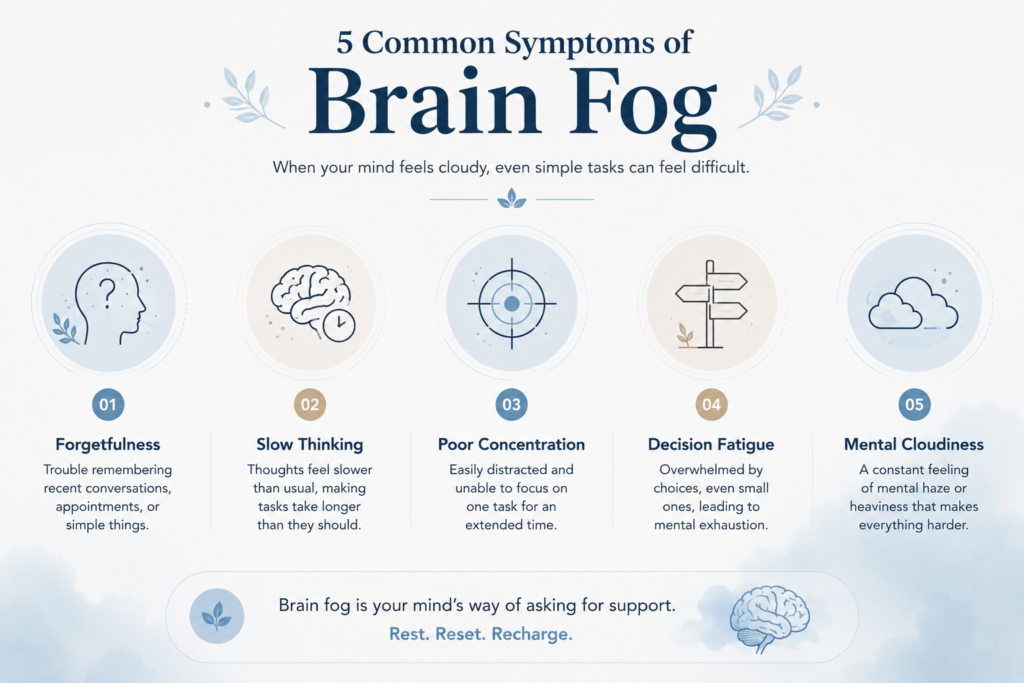
You Read the Same Thing Over and Over
Have you ever reached the bottom of a page…
…only to realise you haven’t actually absorbed a single word?
Your eyes were reading.
Your brain just wasn’t processing.
You Forget Everyday Things
Not big life events.
Just the little things.
Why you opened the fridge.
Where you left your phone.
What someone said five minutes ago.
These small memory lapses can become more frequent when your brain is under prolonged pressure.
You Feel Mentally Slow
Some people describe it as though their thoughts are moving through syrup.
You know what you want to say…
It just takes longer to get there.
Making Decisions Feels Harder
Choosing what to cook for dinner.
Replying to an email.
Planning your day.
Tasks that normally take seconds suddenly require much more mental effort.
You Struggle to Stay Present
Your body is in the meeting.
Your mind is somewhere else.
You keep rereading the same sentence.
You lose your place during conversations.
It’s not because you don’t care.
Your brain is simply overloaded.
When Brain Fog Becomes More Than "Just a Busy Week"
We’ve all had days when our minds feel a little slower.
Maybe you stayed up too late.
Maybe work has been hectic.
Maybe you’ve simply had a stressful week.
Usually, once life settles down and you get some quality rest, your thinking becomes clearer again.
But if that cloudy feeling has been hanging around for several weeks…
If it’s affecting your work…
Your studies…
Your relationships…
Or your confidence…
It’s worth paying attention.
Brain fog is often your brain’s way of saying,
“Something needs to change.”
That “something” might be chronic stress.
Poor sleep.
Mental fatigue.
Burnout.
Nutritional deficiencies.
Or another underlying health issue.
If you’ve also been feeling emotionally and mentally drained, you’ll find our guide Mental Fatigue: Symptoms, Causes, and 10 Science-Backed Recovery Tips especially helpful, as mental fatigue and brain fog frequently overlap.
The encouraging news is that identifying the cause is the first step toward feeling like yourself again.
What Causes Brain Fog?
By now, you probably have a better idea of what brain fog feels like.
But the bigger question is…
Why does it happen in the first place?
The answer isn’t always straightforward.
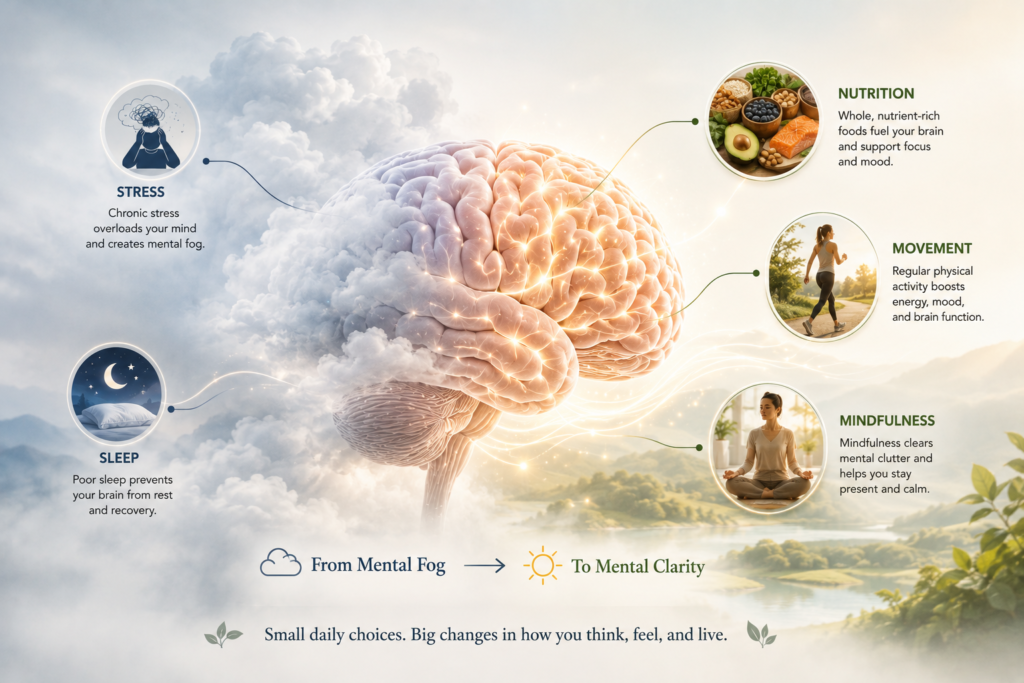
Brain fog isn’t usually caused by just one thing. More often, it’s the result of several factors working together.
Think of your brain like a high-performance computer.
When it’s well-rested, properly fueled, and not overloaded, everything runs smoothly.
But if dozens of programs are running in the background, the battery is low, and the storage is almost full, the whole system starts slowing down.
Your brain works in much the same way.
Let’s look at some of the most common reasons your mind may feel cloudy.
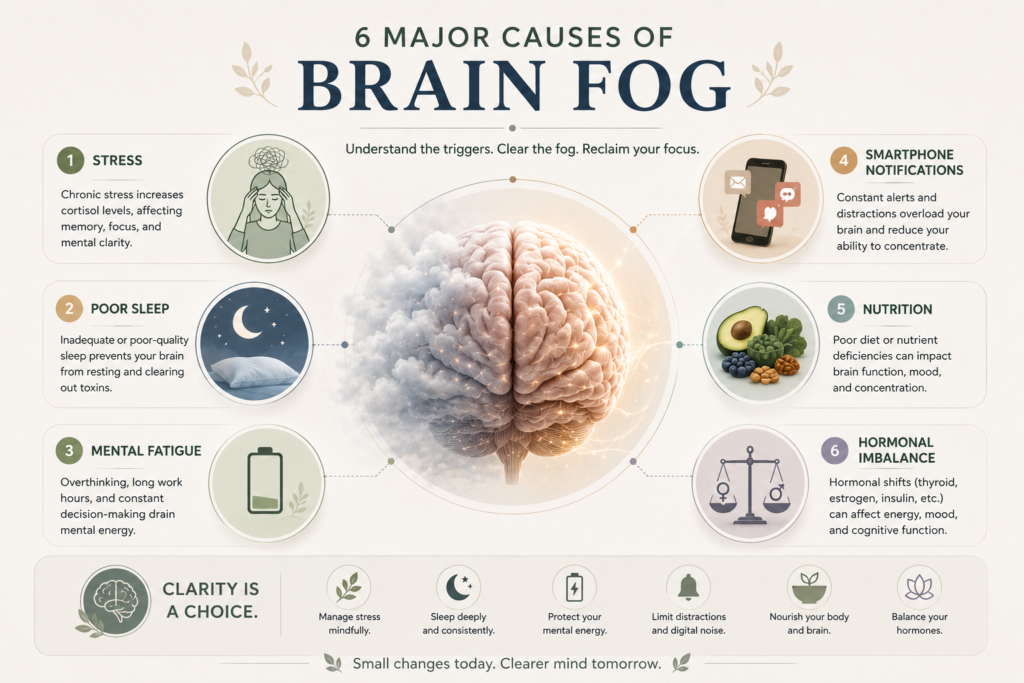
1. Chronic Stress Keeps Your Brain on High Alert
Have you ever noticed that it’s almost impossible to think clearly when you’re overwhelmed?
That’s because your brain is prioritising survival not productivity.
When you’re under chronic stress, your body releases hormones like cortisol and adrenaline. In short bursts, these hormones help you react quickly.
But when stress sticks around for weeks or months, your brain doesn’t get the chance to fully relax.
Instead of focusing on learning, creativity, or problem-solving, it’s constantly scanning for the next challenge.
Imagine trying to write an important report while a fire alarm is ringing in the background.
Eventually, concentrating becomes almost impossible.
If you’ve been feeling under constant pressure lately, our article How Stress Affects Your Nervous System (And How to Calm It Naturally) explains why long-term stress can leave your mind feeling foggy.
2. Poor Sleep Doesn't Give Your Brain Time to Reset
We’ve all experienced a bad night’s sleep.
The next morning, everything feels a little harder.
You lose your train of thought.
You forget simple things.
You struggle to concentrate.
Now imagine that happening night after night.
Sleep isn’t just about resting your body.
It’s when your brain processes memories, removes waste products, regulates emotions, and prepares for the next day.
Without enough quality sleep, your brain never gets the chance to fully recharge.
That’s why brain fog is often one of the first signs that your sleep needs attention.
3. Mental Fatigue Has Drained Your Cognitive Energy
Think back to the last time you made hundreds of decisions in a single day.
Work deadlines.
Family responsibilities.
Financial planning.
Replying to emails.
Making appointments.
Solving problems.
Even though none of those tasks required heavy physical effort, they demanded something just as valuable…
Mental energy.
Over time, constant thinking without enough recovery can leave your brain feeling depleted.
If that sounds familiar, you’ll probably relate to our guide Mental Fatigue: Symptoms, Causes, and 10 Science-Backed Recovery Tips, where we explain why your brain sometimes feels like it’s running on an empty battery.
4. Information Overload
Here’s a simple question.
How many notifications have you seen today?
Twenty?
Fifty?
More?
Between social media, emails, news alerts, text messages, podcasts, and endless scrolling, your brain processes an extraordinary amount of information every single day.
The problem isn’t just the quantity.
It’s the lack of quiet.
Your brain rarely gets a chance to slow down.
Eventually, all that mental input starts competing for your attention, making it much harder to think clearly.
5. Poor Nutrition and Dehydration
Your brain may only account for a small percentage of your body weight, but it uses a significant amount of your daily energy.
That means it needs a steady supply of nutrients to function well.
Skipping meals.
Living on processed snacks.
Not drinking enough water.
Relying on caffeine to get through the day.
All of these habits can leave your brain struggling to perform at its best.
Sometimes, what feels like brain fog is simply your brain asking for better fuel.
6. Hormonal Changes
Hormones influence much more than mood.
They also affect memory, attention, and mental clarity.
Some people notice brain fog during pregnancy, menopause, or periods of significant hormonal change.
Others experience it because of thyroid conditions or other health-related factors.
If your brain fog appears suddenly or continues despite healthy lifestyle changes, it’s worth discussing your symptoms with a healthcare professional to rule out any underlying medical causes.
Often, It's a Combination of Factors
One of the biggest misconceptions about brain fog is that there’s always one clear explanation.
In reality, most people experience it because several small challenges build up over time.
Imagine this.
You’ve been sleeping six hours a night.
Work has been unusually stressful.
You’re constantly checking your phone.
You’ve stopped exercising because you’re busy.
Lunch is usually whatever you can grab quickly.
Individually, none of those habits might cause noticeable problems.
Together?
They create the perfect conditions for your brain to feel slow, overwhelmed, and unfocused.
That’s why finding the “one magic solution” rarely works.
Real improvement comes from addressing the habits that are quietly draining your mental energy each day.
The encouraging news is that your brain is remarkably adaptable.
When you begin supporting it with better sleep, less stress, regular movement, nourishing food, and intentional breaks, many people notice gradual improvements in their mental clarity.

10 Science-Backed Ways to Clear Brain Fog and Think More Clearly
Here’s the encouraging part.
If you’ve been struggling with brain fog, it doesn’t mean you’ve lost your ability to think clearly forever.
In many cases, brain fog is your brain’s way of saying,
“I need better support.”
The goal isn’t to force yourself to think harder.
It’s to create an environment where your brain can perform at its best again.
The good news?
Small, consistent habits often make a bigger difference than dramatic lifestyle changes.
Let’s explore what really helps.
1. Prioritize Quality Sleep
If your brain could ask for one thing, it would probably be quality sleep.
Sleep isn’t simply “switching off.”
While you’re asleep, your brain is incredibly busy. It organizes memories, strengthens learning, regulates emotions, and clears away waste products that build up during the day.
When you consistently miss out on good-quality sleep, it’s much harder to think clearly the next day.
Try to:
- Keep a regular bedtime.
- Avoid screens for at least 30–60 minutes before bed.
- Limit caffeine later in the day.
- Make your bedroom cool, quiet, and dark.
Think of sleep as your brain’s nightly reset button.
2. Reduce Stress Before It Reduces Your Focus
Stress and brain fog often go hand in hand.
When your nervous system spends too much time in “survival mode,” your brain naturally prioritizes dealing with perceived threats instead of helping you concentrate.
You don’t need to eliminate every source of stress.
That’s impossible.
Instead, aim to lower your stress levels a little each day.
A short walk.
Deep breathing.
Listening to calming music.
Journaling.
Talking to someone you trust.
If stress has been part of your daily life, you’ll find practical strategies in How Stress Affects Your Nervous System (And How to Calm It Naturally).
3. Move Your Body Every Day
Exercise isn’t just good for your muscles.
It’s one of the best things you can do for your brain.
Regular movement increases blood flow, supports healthy brain function, and can improve attention, mood, and mental clarity.
The best part?
You don’t need an intense workout.
A 20–30 minute walk.
Gentle yoga.
Cycling.
Swimming.
Even stretching throughout the day helps.
Consistency matters far more than intensity.
4. Stay Hydrated
Sometimes the solution is surprisingly simple.
Even mild dehydration can make it harder to concentrate and think clearly.
If you’ve been relying on coffee all day but forgetting to drink water, your brain may be feeling the effects.
Keep a water bottle nearby.
Drink regularly throughout the day.
Small habits like this often make a noticeable difference over time.
5. Feed Your Brain, Not Just Your Appetite
Your brain needs quality fuel to perform well.
Instead of relying on sugary snacks for quick energy, try meals that include:
- Whole grains
- Colourful vegetables
- Fruit
- Healthy fats
- Lean protein
- Omega-3-rich foods such as salmon, walnuts, or flaxseeds
A balanced diet helps provide the steady energy your brain needs to stay focused throughout the day.

6. Give Your Brain Time Away From Screens
Our brains were never designed to process endless notifications.
Try creating intentional screen-free moments.
Leave your phone in another room while working.
Take your lunch break without scrolling.
Go for a short walk without headphones.
Those quiet moments give your brain something it rarely experiences today:
Space to recover.
7. Practice Mindfulness
Mindfulness doesn’t require sitting in silence for an hour.
It can be as simple as paying full attention to what you’re doing right now.
Notice your breathing.
Listen to the sounds around you.
Drink your tea without checking your phone.
These small moments help train your attention and gently interrupt the cycle of constant mental stimulation.
If you’re just getting started, our article Simple Mental Wellness Routines That Actually Work includes beginner-friendly practices you can easily fit into your day.
8. Stop Trying to Remember Everything
Your brain isn’t meant to be a storage device.
It’s meant to think.
When you’re trying to remember appointments, shopping lists, passwords, deadlines, and ideas all at once, it’s no wonder your mind feels overloaded.
Instead, use external tools.
Keep a notebook.
Use a digital calendar.
Create simple checklists.
Writing things down frees up mental space for deeper thinking.
If your mind constantly feels overloaded, you’ll also benefit from reading Mental Overload: When Your Mind Feels Too Full.
9. Take Regular Mental Breaks
Have you noticed how your best ideas often arrive when you’re not trying so hard?
Perhaps while you’re in the shower.
Walking the dog.
Driving home.
That’s because your brain continues processing information during periods of rest.
Instead of working for hours without stopping, try taking a five- to ten-minute break every hour.
Step outside.
Stretch.
Look away from your screen.
Your brain will often come back sharper.
10. Know When to Seek Professional Advice
Brain fog is often linked to lifestyle factors like stress, poor sleep, or mental fatigue.
However, if it continues for several weeks, becomes worse, or significantly affects your daily life, it’s important to speak with a healthcare professional.
Persistent brain fog can sometimes be associated with underlying medical conditions, nutritional deficiencies, medication side effects, or other health concerns that deserve proper evaluation.
Seeking help isn’t overreacting.
It’s taking your health seriously.

Final Thoughts
If your mind has felt cloudy lately, be kind to yourself.
Brain fog doesn’t mean you’re losing your intelligence.
It doesn’t mean you’ve become lazy.
And it certainly doesn’t mean things will always feel this way.
More often than not, brain fog is a signal, not a permanent state.
It’s your brain asking for better sleep.
Less stress.
More movement.
Better nutrition.
Time to recover.
The most important thing is not to ignore those signals.
You don’t need to overhaul your life overnight.
Choose one habit from this article and start there.
Drink more water.
Go to bed a little earlier.
Take a short walk after lunch.
Put your phone away for an hour.
Small steps, repeated consistently, often lead to the biggest improvements.
Your brain has an incredible ability to adapt and heal when it’s given the right support.
And with patience, you can begin to feel clear, focused, and like yourself again.
Frequently Asked Questions
What is brain fog?
Brain fog is a term used to describe symptoms such as difficulty concentrating, forgetfulness, slow thinking, and reduced mental clarity. It isn’t a medical condition itself but is often a symptom of factors like stress, poor sleep, mental fatigue, or certain health conditions.
Can stress cause brain fog?
Yes. Prolonged stress can affect attention, memory, and clear thinking by keeping your body in a heightened state of alertness. Managing stress often helps improve mental clarity over time.
How long does brain fog last?
It depends on the cause. Brain fog related to a stressful week or poor sleep may improve within days, while brain fog linked to chronic stress, burnout, or an underlying medical condition may take longer and should be evaluated if it persists.
What's the difference between brain fog and mental fatigue?
Brain fog mainly describes difficulty thinking clearly, concentrating, and remembering information. Mental fatigue refers to a broader state of cognitive and emotional exhaustion. The two often occur together but aren’t exactly the same.
👉 Learn more in Mental Fatigue: Symptoms, Causes, and 10 Science-Backed Recovery Tips.
When should I see a doctor about brain fog?
If brain fog lasts for several weeks, becomes worse, or is accompanied by symptoms such as severe memory problems, persistent low mood, confusion, or other concerning changes, it’s important to seek medical advice for a proper assessment.

Art of Wellness Team is a collective of mental wellness writers and researchers focused on stress, anxiety, and mental clarity. We create practical, evidence-informed content to help readers better understand their mental well-being and build healthier habits for everyday life.






No Comment! Be the first one.